- Artificial Intelligence
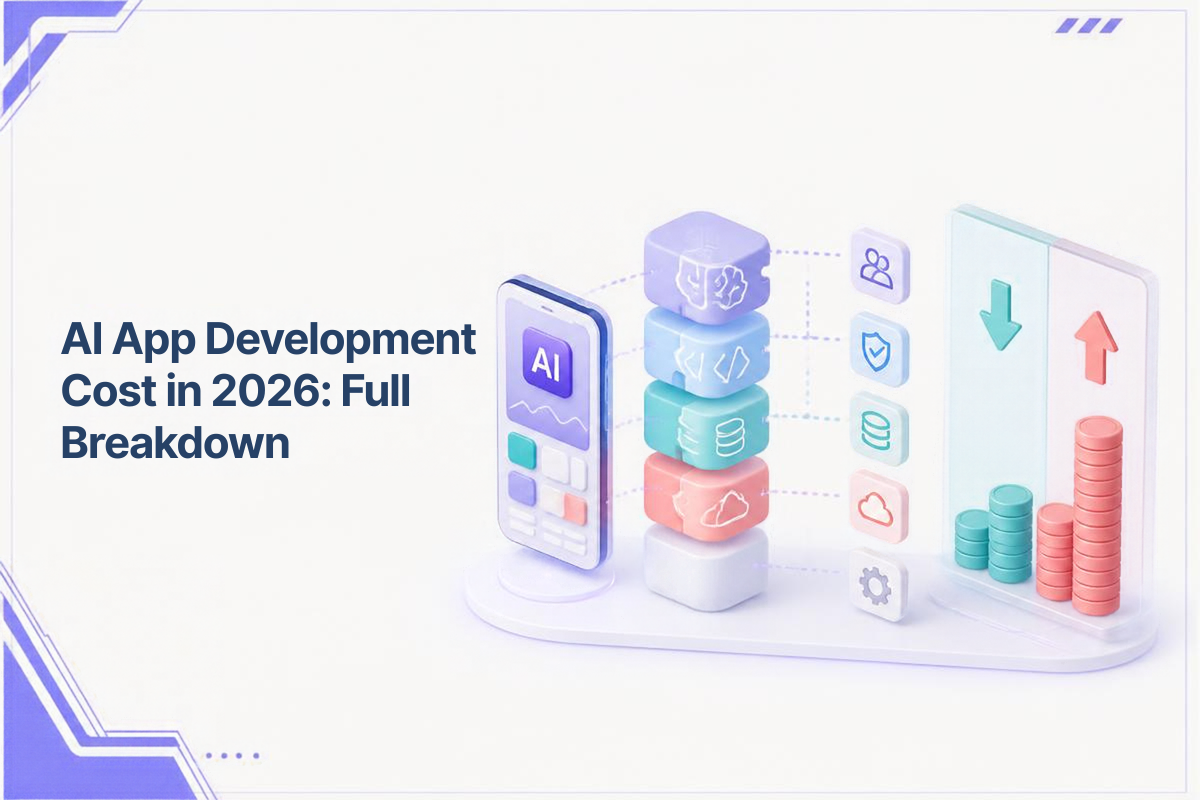
AI App Development Cost in 2026: Full Breakdown by Feature Set, Stack, and Team Model
- Written by
- Naval Madaan
- Published
- 24 September 2026
- Reading time
- 11 minutes
What This Actually Costs (And Why Most Estimates Are Wrong)
Last quarter we scoped an AI app for a Series A fintech. Their internal estimate was $90K. After mapping actual requirements, the real number landed closer to $310K for a production-ready system. The gap wasn’t padding or scope inflation. Nobody had accounted for GPU inference costs, the evaluation harness needed to actually trust the outputs, or the model fine-tuning cycle that always runs longer than anyone projects.
This happens constantly, and not because clients are naive.
Most “AI app cost guides” online are written by people who’ve never invoiced for a LangGraph multi-agent build. That’s just the truth. So here’s an honest breakdown, tier by tier. Infrastructure gets its own section because it genuinely deserves one. We’ll also walk through how team model affects your final number, often more than the tech stack itself. Figures here come from our own project history, AWS public pricing, and the a16z AI infrastructure cost study.
Tier 1: Simple AI Features (Chatbots, Search, Classification)
Most early-stage products start here. You’re wrapping an existing model, usually GPT-4o or Claude 3.5 Sonnet, with retrieval logic and a UI. Technically it’s not trivial, but compared to what’s further down the stack, it’s manageable territory. Think customer support bots sitting on a knowledge base, AI-powered search over internal documents, basic content classification pipelines that route support tickets. That category of product.
If you’re working with an AI software development services partner who’s actually done this before, build time compresses significantly. Reusable RAG scaffolding, pre-built chunking and embedding pipelines, prompt templates that have been tested in real production environments. First-timers doing this in-house spend weeks on problems experienced teams knock out in a day. Not an exaggeration.
| Component | Build Approach | Cost Range (USD) |
|---|---|---|
| RAG pipeline + vector store (Pinecone or pgvector) | Off-the-shelf + config | $8,000 – $18,000 |
| Chat UI + API integration | Custom frontend | $10,000 – $20,000 |
| Auth, logging, rate limiting | Standard backend | $6,000 – $12,000 |
| Evaluation layer (LLM-as-judge, Ragas) | Custom scripts | $4,000 – $9,000 |
| Deployment + monitoring | AWS or GCP | $3,000 – $7,000 |
Total for a solid Tier 1 MVP: roughly $31K to $66K. If someone quotes you $12K for “an AI chatbot,” ask exactly what’s included. Nine times out of ten there’s no eval layer, no logging, and no real plan for when the model hallucinates on a customer inquiry. We’ve watched that fail badly in regulated industries where audit trails aren’t optional. They’re a compliance requirement, and their absence is a real liability, not just a gap you can quietly patch after launch.
Tier 2: Multi-Agent Workflows and Orchestrated Pipelines
Budgets get serious fast at this tier. You’re not just querying an LLM anymore. You’re orchestrating multiple agents with distinct roles, memory state, tool use like web search or code execution, API calls, and sometimes human-in-the-loop approval steps sitting between agent actions. Real examples from our own work include automated due diligence systems, AI research assistants synthesizing across multiple databases, and sales intelligence pipelines pulling simultaneously from CRM, email history, and live news feeds.
Frameworks like LangGraph, CrewAI, or AutoGen are useful starting points. They don’t reduce complexity nearly as much as their documentation implies, though. The orchestration logic itself is usually fine. What’s genuinely hard is failure handling. Agents fail silently. They loop. They produce confident-sounding garbage with zero indication anything went wrong. Building retry logic, fallback paths, and observable traces, we typically use LangSmith or Langfuse, adds 20 to 30 percent to development time without fail. Every single time.
| Component | Notes | Cost Range (USD) |
|---|---|---|
| Agent orchestration layer | LangGraph or custom Python | $25,000 – $55,000 |
| Tool integrations (3-6 external APIs) | Custom connectors per integration | $12,000 – $28,000 |
| Memory and context management | Redis + vector store hybrid | $8,000 – $16,000 |
| Observability and trace logging | LangSmith or Langfuse setup | $5,000 – $11,000 |
| Human-in-the-loop UI | Approval queues, review dashboards | $14,000 – $30,000 |
| QA, adversarial testing, red-teaming | Not optional if you’re shipping to production | $10,000 – $22,000 |
Realistic Tier 2 range: $74K to $162K. Some of the highest-ROI AI products we’ve built sit right in this band. But scope creep is vicious here, because every new tool an agent can call is a new integration to build, test, and maintain indefinitely. Define scope ruthlessly before writing a single line of orchestration code. Seriously.
Tier 3: Custom-Trained Models and Domain-Specific AI
Fine-tuning or training from scratch is different in nature, not just price. You’re not consuming someone else’s model anymore. You’re building something proprietary, which means data pipelines, labeling workflows, training infrastructure, and an evaluation methodology that goes well beyond eyeballing outputs in a notebook at 11pm.
Most startups don’t need this, and we mean that genuinely. If your use case can be handled by a well-prompted GPT-4o or Claude with solid retrieval, fine-tuning is overkill, and the ongoing maintenance cost is real and almost always underestimated. We push back on custom model requests roughly 40% of the time because the ROI calculus simply doesn’t work at early revenue stages. But when you actually need it, for medical record extraction under HIPAA, proprietary trading signal generation, or specialized domain tasks where general models consistently underperform in ways that actually hurt the product, the economics shift and the investment makes sense.
| Component | Typical Approach | Cost Range (USD) |
|---|---|---|
| Data collection and labeling | Scale AI, Labelbox, or internal team | $20,000 – $80,000 |
| Fine-tuning pipeline (QLoRA on Llama 3) | AWS SageMaker or Modal.com | $15,000 – $45,000 |
| Inference infrastructure (self-hosted vLLM) | GPU instances or Runpod | $12,000 – $35,000 build cost, plus ongoing |
| Model evaluation and benchmarking | Custom eval sets, HELM framework | $10,000 – $25,000 |
| MLOps: versioning, retraining triggers | MLflow, DVC, or Weights and Biases | $18,000 – $40,000 |
All-in for Tier 3: $75K to $225K before ongoing GPU costs enter the picture at all. The a16z infrastructure research shows that model serving costs alone can consume 60 to 80% of gross margins for AI-native companies that self-host. That’s not a footnote to skim. Plan your unit economics before committing to this architecture, not after the training cluster is already spinning and the bills start landing in your inbox.
Infrastructure Costs: The Budget Line That Surprises Everyone
API token costs scale faster than most people expect. An application serving 500 daily active users with moderate context windows can run $3,000 to $8,000 per month on GPT-4o alone. More if your prompts are verbose, which they almost always are in agentic systems where you’re stuffing context into every single call. Based on AWS Bedrock public pricing, Claude 3.5 Sonnet through Bedrock runs $3 per million input tokens and $15 per million output tokens as of early 2025. Those numbers compound fast at scale.
| Infrastructure Component | Typical Config | Monthly Cost (USD) |
|---|---|---|
| LLM API tokens (GPT-4o, 500 DAU) | Moderate context, 10 calls/session avg | $2,500 – $8,000 |
| Vector database (Pinecone Serverless) | 5M vectors, 50K queries/day | $150 – $600 |
| App hosting (AWS ECS or Fargate) | 2 services, medium load | $300 – $900 |
| GPU inference (self-hosted, A10G on AWS) | 1x g5.xlarge instance on-demand | $900 – $2,500 |
| Observability and logging (Datadog or Langfuse) | Standard tier | $200 – $700 |
Here’s the honest caveat: if you’re building an AI MVP and you’re not thinking about inference cost per user request from day one, you will reprice or rearchitect later. We’ve done that rearchitecting work for clients. It’s painful, it’s expensive, and it’s completely avoidable. Set cost alerts in AWS from week one of development. Not after launch, not when you’re already staring at a surprise invoice trying to explain the number to your board.
Team Model Comparison: In-House vs. Nearshore vs. Offshore
This is where numbers swing dramatically. Not just rate differences either. Actual project outcome differences, driven by communication overhead, timezone overlap, and how scarce genuine AI domain expertise turns out to be at each price point.
In-house teams in San Francisco or New York bring zero timezone friction. They also average $180K to $260K per engineer per year fully loaded. A four-person AI team in-house runs $720K to over $1M annually before you touch infrastructure, tooling, or recruiting costs. For most startups building a first AI product, that math simply doesn’t work.
Nearshore software development services, specifically teams in Mexico, Colombia, or Eastern Europe, run $65 to $130 per hour depending on seniority and specialization. You typically get four to six hours of timezone overlap with US teams, which matters a lot for review cycles and the kind of back-and-forth that AI work constantly generates. We’ve found this model works particularly well for Tier 2 and Tier 3 builds where fully async communication would grind iteration speed to a halt.
Offshore teams in India, Vietnam, and the Philippines remain the lowest-cost option at $30 to $70 per hour. Works well for clearly scoped work with strong documentation. It tends to break down on ambiguous AI projects where requirements evolve as you learn what the model actually can and can’t do reliably at the accuracy level you need, which describes most AI projects in practice. We’ve seen offshore-led AI MVPs where a client paid $80K, got something that looked great in a screen share, then spent another $120K with a different team to make it production-ready. That’s not a knock on offshore talent specifically. It’s a scope and communication structure problem that’s harder to manage when requirements are shifting week to week and you can’t get a blocking question answered until the next morning.
| Team Model | Hourly Rate Range | Tier 1 Project Cost | Tier 2 Project Cost | Best For |
|---|---|---|---|---|
| In-house (US) | $120 – $180/hr loaded | $80K – $130K | $180K – $320K | Long-term product teams with real runway |
| Nearshore (LATAM/E. Europe) | $65 – $130/hr | $45K – $90K | $100K – $200K | Fast iteration where real-time overlap matters |
| Offshore (Asia/SE Asia) | $30 – $70/hr | $28K – $60K | $65K – $130K | Well-scoped, stable requirements only |
| Hybrid (offshore dev + nearshore lead) | $50 – $100/hr blended | $36K – $75K | $85K – $165K | Balancing cost with communication quality |
For a startup at seed or Series A looking at AI MVP development services, the hybrid model is usually where we’d start the conversation. A nearshore or US-based technical lead owns architecture and client communication. Offshore developers execute well-defined sprint work against specs that have already been thought through. That’s how a good startup MVP development company controls cost without sacrificing quality on the decisions that actually determine whether the thing works in production versus just works in a demo.
FAQ
What is a realistic budget for an AI MVP in 2026?
For a Tier 1 AI MVP covering chatbot, search, or classification features, budget $35K to $70K with a competent team. Multi-agent workflows start at $80K and realistically hit $150K by the time they’re production-ready with proper observability and error handling in place. Those numbers assume offshore or nearshore development. US in-house teams will roughly double them. And infrastructure costs, API usage, hosting, monitoring, add $2,500 to $10,000 per month depending on actual usage volume, so build that into your 12-month runway math from the start. Not as an afterthought once you’re already live.
Is fine-tuning a model necessary for my AI app?
Usually not at MVP stage. Somewhere around 70 to 75 percent of the business applications we work on perform well enough with a structured RAG pipeline and solid prompt engineering on a foundation model. Fine-tuning makes sense when you have domain-specific terminology that general models consistently botch in ways that hurt the product, when strict data residency requirements prevent data from going to a third-party API, or when inference volume is high enough that a smaller fine-tuned model would meaningfully cut per-query costs. Start with the simpler architecture. Validate product-market fit first. Then invest in custom training once the data actually supports making that call.
How do nearshore software development services compare to offshore for AI projects specifically?
The timezone overlap advantage matters more than most people assume, and it matters especially for AI work. AI projects carry a lot of ambiguity by nature. You’re constantly learning what’s possible as you prototype and test, and that’s genuinely hard to do asynchronously across a 10 to 12 hour gap when a single blocking question can sit unanswered for a full business day. Nearshore teams in LATAM or Eastern Europe typically give you four to six hours of real-time overlap with a US-based product owner, which compresses decision cycles in a very practical way. The cost difference versus offshore is real, roughly 2x on hourly rates. But for AI projects where requirements shift quickly and you need fast answers to questions like “can the model actually do this reliably at the accuracy level we need,” we’d take the timezone overlap over the rate savings almost every time.
Keep reading
- Artificial Intelligence
AI Engineers' Consulting Rates in 2026: What You're Really Paying For and How to Benchmark Fairly
11 minutes readRead article - Artificial Intelligence
Manufacturing AI Software in 2026: Use Cases, ROI Data, and How to Choose the Right Development Partner
11 minutes readRead article - Artificial Intelligence
No-Code AI Builder vs. Custom AI Development: Which One Wins for Your Business in 2026?
9 minutes readRead article
Build your team
Share where the roadmap is blocked and the capabilities you need. We’ll map a practical team and delivery model.