- App Development
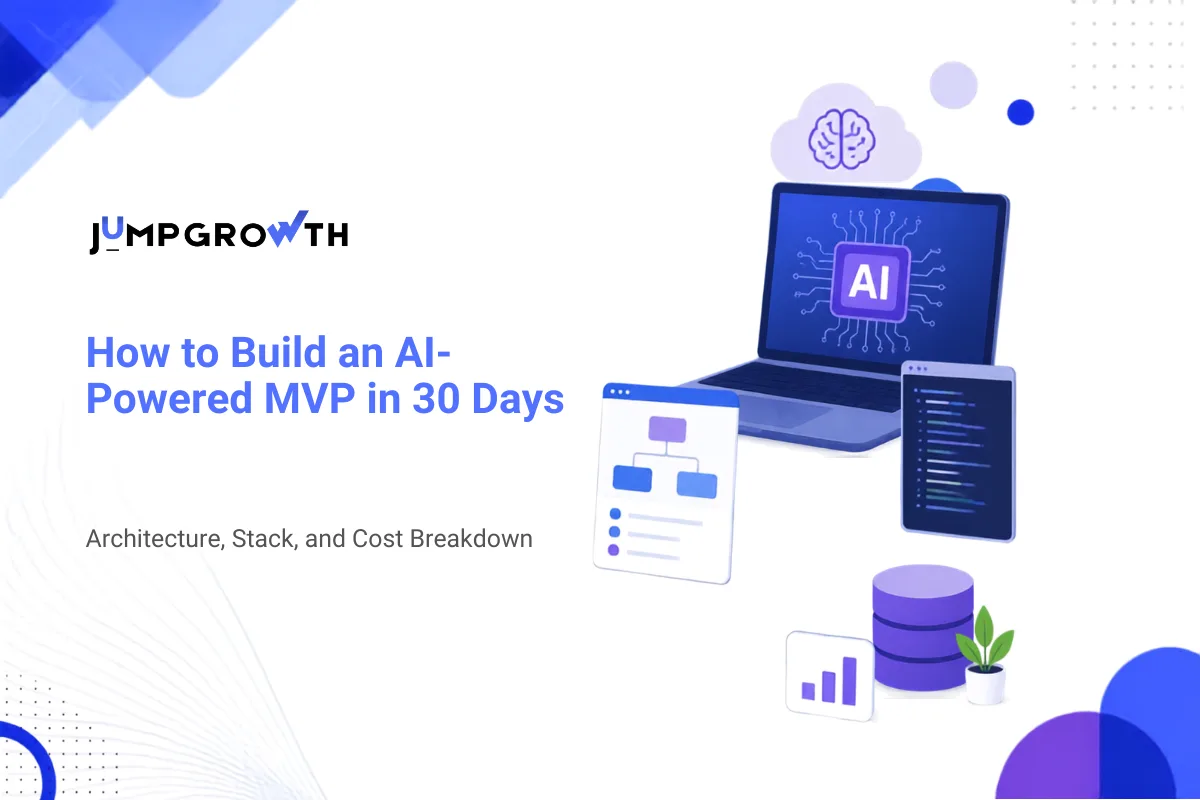
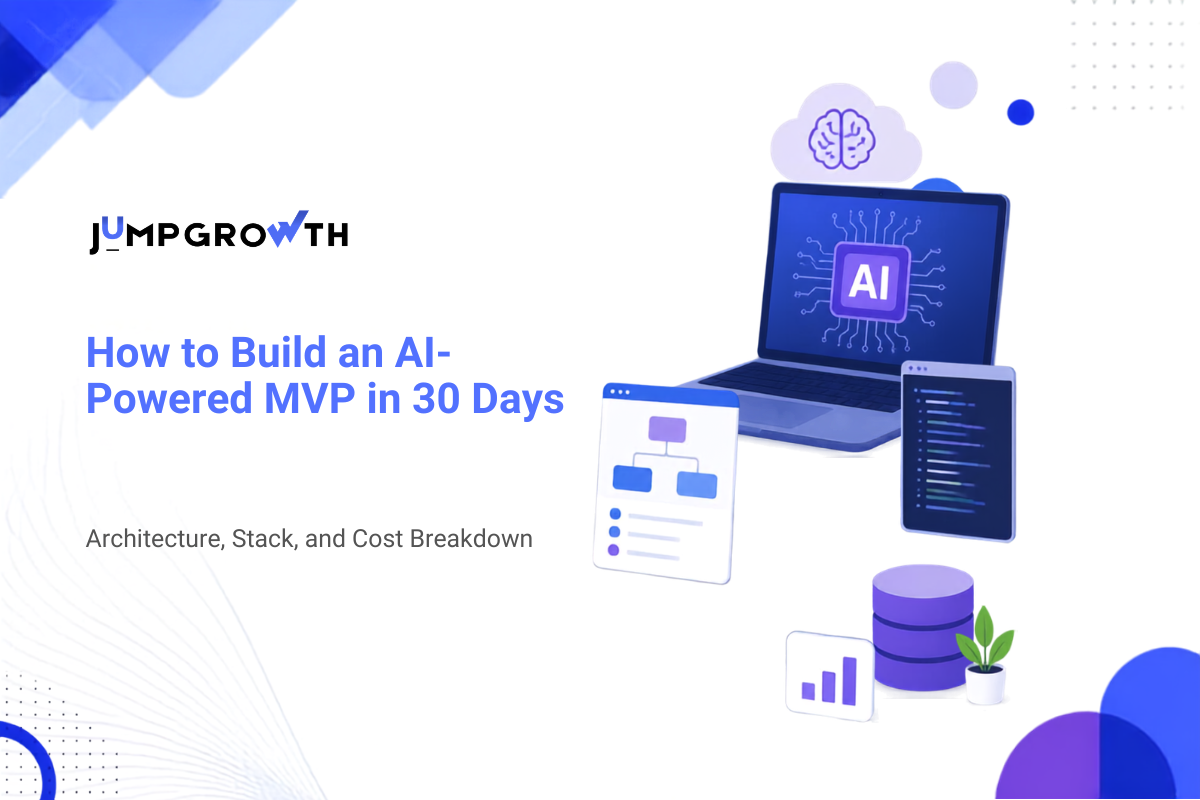
How to Build an AI-Powered MVP in 30 Days: Architecture, Stack, and Cost Breakdown
- Written by
- Naval Madaan
- Published
- 17 September 2026
- Reading time
- 10 minutes
Why 30 Days Is Actually a Real Target (Not Marketing Fluff)
A founder came to us about eight months ago with a contract review tool idea. Legal AI, basically. He’d spent four months talking to lawyers, had 40 signed letters of intent, and zero code. His concern was that a larger funded competitor would ship before him. We told him we could get a working, investor-demonstrable MVP live in 30 days. He was skeptical. We shipped on day 28.
That’s not a brag. The point is that ai mvp development at this pace is an engineering discipline, not a hustle culture slogan. It requires front-loading every architectural decision, picking a stack you won’t regret in week three, and ruthlessly cutting scope. This guide covers exactly how we do that: what to build first, which LLM layer to pick, what the backend actually needs to look like, and what it’s going to cost depending on how you staff it.
Y Combinator’s lean startup philosophy applies more literally to AI products than most founders realize. Their core principle is: get a working artifact in front of real users before you know whether your assumptions are correct. With AI, this is even more urgent because the model behavior itself is an assumption. You need users poking at it to find out where it fails.
Week-by-Week Architecture: The Phased Timeline
Before touching any code, you need a decision logged for every major technical dimension. Team composition, LLM choice, data strategy. Treat week one as a zero-ambiguity sprint. Every open question at the end of week one becomes a blocker in week three.
Here’s the phased breakdown we use for most rapid mvp development engagements:
| Phase | Timeline | Key Deliverables | Who Owns It |
|---|---|---|---|
| Discovery and Architecture | Days 1-7 | LLM selection, data pipeline design, API contract, infra decisions, prompt engineering scaffold | Tech lead + Product |
| Core AI Feature Build | Days 8-16 | LLM integration, retrieval-augmented generation (RAG) if needed, backend API live, basic auth | Backend engineer + AI engineer |
| Frontend and UX | Days 14-22 | User-facing interface, streaming responses, feedback capture, error states | Frontend engineer |
| Testing, Hardening, and Launch | Days 23-30 | Eval suite for LLM outputs, load testing, staging deploy, production release | Full team |
Notice that frontend and backend overlap from days 14-16. That’s intentional. If you sequence them strictly, you lose four to five days. The API contract has to be locked before overlap begins, which is why week one matters so much.
Choosing Your LLM Layer: What We’d Actually Pick
This is the decision most teams agonize over, and honestly, most of the time it’s simpler than people think. The a16z AI application stack research (published in their “Emerging Architectures for LLM Applications” piece, available at a16z.com) identifies three primary tiers for production AI apps: frontier API-based models, fine-tuned open-source models, and hybrid approaches. For an MVP, you almost never need the third option.
Here’s how we break down the selection for ai product development services clients:
OpenAI GPT-4o / GPT-4 Turbo
Default choice for most text-heavy applications. Fastest to integrate. If you’re building anything in the legal, medical, or financial space where output quality directly determines whether users trust the product, start here. The API reliability track record is strong. Cost per million tokens for GPT-4o is approximately $5 input / $15 output as of early 2025 (see OpenAI’s pricing page for current rates). For a typical MVP with moderate usage, budget $200-$600/month in model costs alone at launch volumes.
Anthropic Claude 3.5 Sonnet
We’ve started defaulting to Claude for document-heavy tasks. The 200k context window isn’t just a spec sheet number. It changes what’s architecturally possible. For the contract review tool mentioned above, we didn’t need a vector database in the MVP phase at all. We could stuff the entire contract into context. That eliminated a full infrastructure dependency and shaved five days off the build. Claude 3.5 Sonnet sits at $3 input / $15 output per million tokens as of this writing.
Open-Source: Llama 3, Mistral, Mixtral
Don’t pick this for speed. Self-hosted models via Ollama, vLLM, or a managed service like Together AI add real complexity. You’re trading lower per-token cost against engineering hours to run evals, manage quantization, and handle inference infrastructure. For an MVP that ships in 30 days, the math rarely works out in favor of open-source unless you’re in a regulated industry where data residency is non-negotiable, or your expected inference volume is genuinely massive (think millions of calls per day from day one, which is almost never true at MVP stage).
One honest caveat: if the founding team includes an ML engineer who’s already comfortable with Hugging Face and vLLM, open-source becomes more viable. Staff skills matter more than the vendor spec sheet.
Backend Architecture for an AI MVP
Keep it boring. Seriously. This is not the place to try a new database paradigm or an experimental message queue. You want predictability under pressure.
Our standard backend stack for a 30-day startup mvp development build looks like this:
- API layer: FastAPI (Python) or Node.js with Express, depending on team preference. FastAPI wins if the team is Python-native, because your AI library ecosystem (LangChain, LlamaIndex, OpenAI SDK) is already there.
- Vector database (if RAG is required): Pinecone for managed simplicity, or pgvector on Postgres if you want to stay in a single database. For most MVPs, pgvector is enough and eliminates a service dependency.
- Primary database: PostgreSQL. Every time. Supabase if you want a hosted option that gives you auth and storage out of the box without extra configuration.
- Orchestration: LangChain works but adds abstraction that can obscure bugs. For simple LLM call chains, raw SDK calls plus your own thin wrapper are often cleaner. LangGraph is worth considering if you’re building agent workflows.
- Hosting: Railway or Render for early staging. AWS or GCP once you’ve confirmed the product works. Moving to cloud infra mid-MVP is a week of distraction you don’t need.
- Async task handling: Celery with Redis, or BullMQ if you’re on Node. Needed if your AI calls take longer than 10-15 seconds and you don’t want the frontend sitting on an open HTTP connection.
One pattern that bites teams constantly: streaming. If your LLM responses take 8-12 seconds to complete and you’re returning them synchronously, users will assume the app is broken. Implement server-sent events (SSE) or WebSockets for streaming from the start. Retrofitting this later is painful.
Frontend and Data Pipeline Considerations
The frontend for an AI MVP is almost always React or Next.js. Not because they’re the best tools in a vacuum, but because the talent pool is wide, component libraries are mature, and Vercel deployment takes about 90 seconds. For the AI-specific UI patterns, Vercel’s AI SDK handles streaming out of the box and cuts significant frontend engineering time.
Data pipelines deserve more thought than most teams give them at MVP stage. Even if you’re just using an LLM API, you need to log every prompt and completion. Not for compliance necessarily, but because your eval strategy depends on it. Without logged outputs, you have no way to measure whether a prompt change made things better or worse. Tools like Langfuse (open-source) or Helicone integrate in under an hour and give you full tracing.
If your product relies on user-uploaded documents, structured data ingestion, or any kind of knowledge base, plan the chunking strategy in week one. Naive chunking by character count produces terrible retrieval results. Semantic chunking with overlap, or section-aware chunking for structured documents, makes a measurable difference. The LlamaIndex documentation has solid coverage of chunking strategies with benchmark comparisons.
Cost Breakdown by Team Composition
This is the question every founder asks, and the honest answer is: it depends heavily on who’s building it. Here’s a realistic breakdown across three common scenarios for ai app development cost at MVP stage:
| Team Type | Composition | 30-Day Cost Estimate | Trade-offs |
|---|---|---|---|
| In-house technical founder(s) | 1-2 founders, no external help | $3,000-$8,000 (infra + tools + model costs) | Slowest if founders lack AI/backend depth; no opportunity cost accounted for |
| Freelance team | 1 backend dev, 1 frontend dev, 1 AI specialist | $18,000-$35,000 | Coordination overhead; quality varies widely; harder to maintain post-launch |
| Product studio or MVP development services company | Dedicated team with PM, engineers, QA | $30,000-$65,000 | Fastest path; built-in accountability; higher upfront but lower risk of re-build |
Infrastructure costs for an MVP are typically $150-$500/month at launch. That covers hosting, database, model API calls, and monitoring tools. Don’t overbuild the infra. A single Railway instance with a managed Postgres database handles thousands of daily active users without issue.
One thing that inflates cost unexpectedly: prompt engineering iteration. Teams consistently underestimate how many hours go into getting LLM outputs reliable enough to show users. Budget at least 20-30% of your AI engineer’s time for prompt work and evals. That’s not wasted time. It’s the work that determines whether your product actually functions.
Risk Flags That Kill 30-Day MVPs
There are four failure modes we see repeatedly across mvp development services for startups engagements involving AI:
- Scope creep in week two. The founding team sees the AI working and immediately wants to add features. Lock scope formally. A written feature freeze agreement sounds dramatic but it works.
- No eval strategy. If you can’t measure output quality, you can’t improve it and you can’t tell investors the product works reliably. Even a simple spreadsheet of 50 test cases with expected outputs is better than nothing.
- Underestimating latency user experience. A 12-second API response feels fine in a Postman test and feels broken to an actual user. Design around latency from day one, not as an afterthought.
- Data privacy assumptions. If users are submitting sensitive data, your LLM API calls need review. OpenAI’s zero data retention option exists but requires explicit opt-in through their API settings. Missing this creates legal exposure before you’ve even launched.
These aren’t theoretical. The data privacy issue alone has delayed two post-build launches we’ve seen from other teams in the last year because legal reviews caught it during due diligence.
FAQ
01What’s the minimum viable team size for AI MVP development in 30 days?
Realistically, two engineers with complementary skills: one who owns backend and LLM integration, one who owns frontend. A product manager or technical founder handling scope and stakeholder decisions is the third essential role, though this can be the same person as one of the engineers in a pinch. Going below two engineers almost always results in either a missed deadline or a product that works in demos but not under real usage conditions.
02Should we fine-tune an LLM for our MVP or use a foundation model as-is?
Don’t fine-tune for an MVP. The data collection, annotation, training runs, and eval cycles required add weeks you don’t have. Foundation models with well-engineered system prompts and few-shot examples outperform naive fine-tuned models in most use cases anyway, at least until you have substantial domain-specific data. Save fine-tuning for version two when you’ve got real user interactions to train on.
03How do we estimate AI app development cost for investor conversations?
Be transparent about the two-part cost structure: build cost (one-time, ranges covered above) and ongoing operational cost (model API fees plus hosting). For early-stage investor conversations, we recommend presenting a range rather than a fixed number, and tying the operational cost to a per-user or per-query metric. Something like “$0.04 per query at current model pricing” is more credible than a monthly burn estimate because it shows you’ve thought through unit economics. Reference the OpenAI pricing page and Anthropic’s equivalent for current rates when building these models.
One final honest note: the 30-day target is achievable, but only if scope decisions are made before day one, not during the build. The teams that miss the deadline almost always do so because they changed what they were building mid-sprint. Commit to the smallest version of the idea that proves the core assumption, ship it, and let real user data tell you what to build next. That’s the only principle that actually matters here.
Keep reading
- App Development
How to Identify the Right AI Use Case for Your Next MVP
9 minutes readRead article - App Development
How to Develop a Cannabis App: A Step-by-Step Guide
14 minutes readRead article - App Development
How to Choose the Right App Development Company in Dallas for Your Business
11 minutes readRead article

Build your team
Share where the roadmap is blocked and the capabilities you need. We’ll map a practical team and delivery model.
Comments
Be the first to comment.