

- Global Capabilities Center
Global Capability Center vs Outsourcing vs Staff Augmentation: Which Suits a US Mid-Market Company?
- Written by
- Hemant Madaan
- Published
- 28 October 2026
- Reading time
- 16 minutes
Your roadmap is growing faster than your engineering team. Senior roles have been open for a quarter, a release is at risk, and leadership is looking at global talent. There are three options:
- Build a Global Capability Center (GCC).
- Outsource selected projects or functions.
- Add external engineers through staff augmentation.
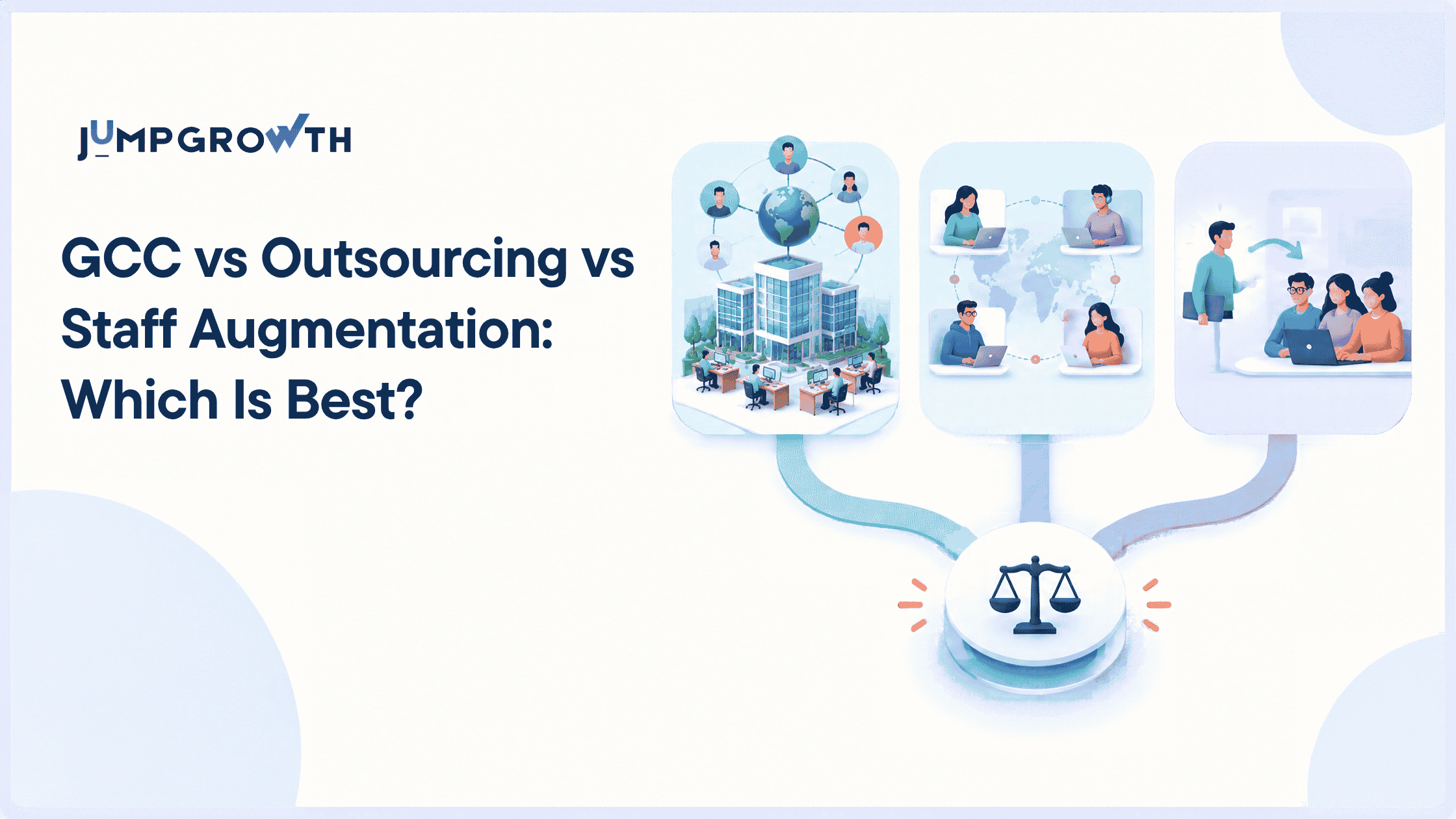
Each one fixes a different problem. Choose a GCC when you want lasting internal capability, outsourcing when you want an external partner accountable for defined deliverables, and staff augmentation when you need more people working inside your existing team's processes.
Company size alone doesn't decide the answer. How important the work is, how long you'll need it, and whether you can govern a distributed team matter as much. This guide compares global capability center vs outsourcing vs staff augmentation on control, cost, ownership, risk, and speed.
What Is a Global Capability Center (GCC)?
A Global Capability Center is a company-controlled center, usually in another country, that builds and runs capabilities for its parent organization. Unlike a vendor relationship, the GCC's people, processes, and knowledge belong to the company over the long term.
A GCC typically supports:
- Long-term engineering and product development.
- Internal technology and domain expertise that builds up over time.
- Dedicated leadership, team structures, and company-specific culture.
- Greater control over technical roadmaps and knowledge retention.
- Expansion into data, AI, QA, DevOps, and other functions.
That control comes with responsibilities: local employment, compliance, facilities, security, and day-to-day operations.
GCCs are no longer only for large enterprises. A Nasscom–Zinnov report, India's GCC Leap: Capturing Global Mid-Market Momentum (2025), counts more than 480 mid-market GCCs in India, set up by companies with global revenues of roughly $100 million to $1 billion. These make up about 27% of all GCCs in the country.
Direct setup vs build-operate-transfer (BOT)
A company can set up its own legal entity directly or work with a partner through a build-operate-transfer (BOT) arrangement:
- Build: The partner sets up the initial structure and recruits the team.
- Operate: The partner runs and stabilizes the center while the operating model matures.
- Transfer: The agreed entity, people, contracts, and operations move to the client under the contract terms.
Not every GCC uses BOT, and the timing and ownership of the transfer depend on the agreement. Law firm Morgan Lewis notes that each BOT phase may need separate workstreams and contract documents. Pricing often differs by phase, and transfer terms can cover employee transfer fees, leases, and assets held in the vendor's name.
Best suited for: companies with sustained workloads, long-term capability goals, and a willingness to invest in the governance needed to run a global center.
What Is Outsourcing?
Outsourcing assigns defined work, services, or operational responsibilities to an external provider. The provider runs its own delivery organization, and the contract sets out what it is accountable for.
Common arrangements include project-based software development, managed engineering services, application maintenance, QA and testing, infrastructure operations, and defined development workstreams. Some contracts pay for deliverables; others are ongoing managed services with service levels.
Benefits:
- Access to specialized expertise without recruiting every skill internally.
- Faster access to delivery capacity for well-scoped work.
- Defined commercial and operating terms.
- Potentially lower internal management overhead.
Limitations:
- Less direct control over how the provider runs its operations.
- Vendor dependency and knowledge-transfer challenges.
- Disputes over scope and change requests.
- A need for clear IP, security, quality, and exit terms.
Best suited for: companies with defined deliverables or functions they would rather have an external provider manage.
What Is Staff Augmentation?
Staff augmentation adds external professionals to an existing team to fill capacity gaps or missing skills. Augmented engineers work within the client's workflows, priorities, tools, and delivery processes. The provider handles the agreed employment or contracting arrangements.
Typical uses include adding developers during a product expansion, hiring specialists for a migration or integration, supporting a release deadline, or extending the team before committing to permanent hires.
Benefits:
- Flexible team capacity and access to specific skills.
- Direct control over work priorities.
- Often faster onboarding than permanent hiring.
Limitations:
- The client must provide effective technical leadership.
- Onboarding and coordination still take effort.
- Availability and continuity vary by provider.
- Augmented engineers don't make up a complete delivery function on their own.
- Contract terms decide replacement, notice, and knowledge-transfer arrangements.
Best suited for: companies with established technical leadership and workflows that need more people, not a fully outsourced delivery function.
GCC vs Outsourcing vs Staff Augmentation: Quick Comparison
| Decision factor | GCC | Outsourcing | Staff augmentation |
| Primary objective | Build lasting internal capability | Delegate defined work or services | Add capacity to an existing team |
| Operating control | High, depending on structure | Provider manages agreed responsibilities | Client directs day-to-day work |
| Team ownership | Client-owned directly or through a planned transfer | Provider supplies and manages the delivery organization | Provider supplies personnel under the agreed arrangement |
| Speed to start | Typically more setup and planning | Often faster for well-defined work | Often fast for specific roles |
| Initial commitment | Generally higher | Varies by contract and scope | Varies by role, duration, and provider |
| Internal management needs | Significant governance and leadership | Strong vendor and outcome management | Strong technical direction and integration |
| Long-term knowledge retention | Strong potential | Depends on documentation and handover terms | Depends on continuity and integration |
| Flexibility | Can scale, but structural commitments matter | Depends on scope and contract | Often flexible by role and duration |
| Best use case | Sustained strategic capability | Defined projects or managed functions | Temporary or specialized capacity gaps |
| Main consideration | Operational complexity and long-term commitment | Vendor dependency and scope governance | Client management capacity and continuity |
| These are typical patterns, not universal rules. Contract structure, location, provider model, and your own governance can change any row. |
Which Model Is Best for a US Mid-Market Company?
There is no single definition of "mid-market." The National Center for the Middle Market uses annual revenue of $10 million to $1 billion, while the Nasscom–Zinnov GCC research uses $100 million to $1 billion. Definitions also vary by industry. What matters more than the label is how you answer six questions.
1. How long will you need the capability? A six-month initiative rarely justifies a GCC. A persistent, growing workload may justify building one over time.
2. How strategically important is the work? Core product engineering, proprietary technology, and domain knowledge you can't afford to lose benefit from internal ownership. Defined, non-core activities are better candidates for outsourcing.
3. Who will manage the work? If you have a strong engineering organization that simply needs more developers, staff augmentation fits. If you need a partner to own delivery outcomes, outsourcing fits better.
4. How much operating responsibility can you take on? A GCC needs leadership, recruiting, local operations, security, and legal and financial oversight. Be realistic about your capacity before you commit.
5. How quickly must you scale? Filling specific roles can be fast. Delivering a scoped project depends on the provider's ramp-up. Building a center is a longer program. Ask any provider for a timeline you can verify for your situation.
6. How important are continuity and internal knowledge? Compare how each model handles documentation, technical decisions, staff retention, repository access, and handover.
The rule: choose the model that matches the control you want, the operating responsibility you can carry, and the commitment you're ready to make.
GCC vs Outsourcing Cost Comparison (Including Staff Augmentation)
Comparing hourly rates or monthly invoices alone leads to poor decisions. A lower rate can still cost more once you add rework, management time, and transition costs. Compare the total cost of ownership (TCO).
| Cost category | GCC | Outsourcing | Staff augmentation |
| Setup | Entity formation, legal and tax advice, office or infrastructure (if applicable) | Vendor selection, contracting, transition-in | Sourcing, onboarding |
| People | Recruitment, compensation, benefits, retention programs | Included in project or service fees | Role-based rates or contracted fees |
| Leadership | Local leadership plus headquarters oversight | Vendor and outcome management | Your technical leads' time directing work |
| Technology and security | IT, security, compliance tooling | Defined by contract; third-party costs | Access, licenses, devices |
| Change | Scaling headcount, restructuring | Scope changes and change requests | Replacements and continuity |
| Partner fees | BOT fees during build and operate phases | Core service fees | Provider margin |
| Exit or transition | Transfer costs (if BOT) | Exit, knowledge transfer, renewal | Notice periods, handover |
What is visible and what is hidden: GCC costs tend to be visible but front-loaded. With outsourcing, the invoice is clear, but change requests and exit costs often aren't. With staff augmentation, the rate is clear, but the cost of your own leads' management time is easy to miss. Write each hidden item down before you compare
A hypothetical example
All assumptions are illustrative only, not industry averages.
Say a company needs 10 engineers for three years. Option A is staff augmentation at a lower monthly rate, but it needs 25% of two senior US engineers' time for direction and review. Option B is a BOT-based GCC with a higher upfront cost for setup and partner fees, then a lower run rate once local leadership is in place. Over 12 months, Option A is likely cheaper. Over 36 months, Option B may catch up, but only if retention holds and the workload stays steady. The break-even point depends on your actual figures, so run both scenarios with your own numbers.
A GCC is not automatically the cheapest option. Deloitte's 2025 Global Business Services Survey goes further, noting that "cost is a deteriorating value proposition" and that centers increasingly have to prove their value beyond savings.
Control, IP Ownership, Security, and Compliance
The three models differ most in who controls what, both day to day and in the contract.
- Day-to-day direction: You direct augmented engineers. Outsourcing providers direct their own teams. A GCC is directed by your own leadership, or by a BOT partner under your governance until transfer.
- Repositories and environments: Insist that code lives in repositories you own and control, whatever the model.
- Custom-developed IP: Ownership depends on contract terms and applicable law. Don't assume outsourced work belongs to the provider, and don't assume staff augmentation transfers IP automatically. Spell out IP assignment and how pre-existing IP and third-party components are handled.
- Data and access: Define how customer data is accessed, use individual accounts with least-privilege access, and audit offboarding. NIST's Secure Software Development Framework (SP 800-218) is a useful reference.
- Legal and compliance: US and destination-country laws both apply, covering employment, data protection, tax, and permanent-establishment risk. Get qualified legal counsel in each jurisdiction.
- Continuity and exit: Document incident response, business continuity, audit rights, and handover terms before work begins.
A GCC may offer more structural control, but that control still depends on your governance, contracts, security practices, and execution.
When Should a US Mid-Market Company Choose Each Model?
Scenario 1: A feature must ship within a few months. Staff augmentation fits when your internal team owns the roadmap and can manage more engineers. Adding people to a working process is faster than building a new one.
Scenario 2: You want a partner to deliver a complete application. Outsourcing fits when requirements and acceptance criteria are clear and you want an external partner accountable for delivery.
Scenario 3: A SaaS company expects years of continuous engineering demand. A GCC becomes attractive when you want team continuity, knowledge that stays in-house, and more control over your engineering capability.
Scenario 4: You need a niche AI or cloud skill temporarily. Targeted staff augmentation or a specialist outsourcing engagement is usually better than building a permanent center around a short-term need.
Scenario 5: You want to move from outsourced development to internal ownership. Take it in phases: set up governance and documentation, build an internal team or GCC, move responsibilities over gradually, and reduce your dependence on the provider. Many companies are doing this. Deloitte's 2024 Global Outsourcing Survey found that 70% of executives had selectively insourced work previously held by a third party over the last five years.
Not every company should follow the same progression. Some will stay with augmentation indefinitely, and that can be the right answer.
Can You Combine GCC, Outsourcing, and Staff Augmentation?
Yes, and many companies already do. The same Deloitte survey found that 78% of respondents use global in-house centers, while 80% plan to maintain or increase their third-party outsourcing investment. A hybrid model assigns work by how strategic it is:
- GCC: core product engineering, architecture, domain expertise, and long-term technical ownership.
- Outsourcing: clearly defined projects, specialized services, or agreed operating functions.
- Staff augmentation: temporary capacity spikes and specialist skill gaps.
Fragmentation is the risk: duplicated responsibilities, conflicting technical decisions, unclear accountability, inconsistent security, poor documentation, and unclear budget ownership. Before you spread work across providers, define decision rights, architecture standards, documentation requirements, security controls, and delivery accountability.
A Practical 90-Day Evaluation Plan
This is an illustrative framework for choosing a model. It is not a promise that a GCC can be fully set up in 90 days.
Days 1–30: Assess
- Identify current delivery bottlenecks and forecast engineering demand.
- Separate strategic functions from non-strategic ones.
- Review existing technical leadership capacity.
- Set a preliminary cost baseline.
- Document security and IP requirements.
Days 31–60: Compare
- Define scope and expected outcomes.
- Compare fully loaded costs and management overhead for each model.
- Assess vendor capability and geographic fit, for example nearshore Mexico or Canada vs offshore India.
- Identify risks, dependencies, and a draft governance and transition plan.
Days 61–90: Validate
- Pilot the chosen approach on real work where practical.
- Measure delivery quality, speed, communication, and technical integration.
- Review actual costs against your assumptions.
- Decide whether to expand, adjust, or change the model.
How JumpGrowth Helps US Companies Build Global Engineering Capability
JumpGrowth is a Dallas-headquartered software development and AI consultancy with delivery hubs across five countries: the United States, Mexico, Canada, Colombia, and India. Because it offers several engagement models, it can help you work out whether you need more people, an accountable team, or a center of your own.
- Global Capability Center services: JumpGrowth builds, operates, and transfers a client's own engineering center. The center is planned and contracted from its US company, and the handover of people, contracts, and knowledge is planned from the start, on a timeline the client sets. For India-specific planning, see its Global Capability Center in India page.
- Staff augmentation services: Senior engineers join your board, tools, and stand-ups. Your team directs the daily work, and JumpGrowth handles recruiting, pay, and cover.
- Dedicated development teams: A squad led by a tech lead owns sprint delivery while your product lead sets priorities.
The key difference is between adding a team and building a lasting center. Before a conversation, prepare your engineering demand forecast, preferred locations, how much ownership you want, security and IP requirements, and your three-year growth plan.
Ready to compare models for your roadmap?Talk to JumpGrowth about your engineering requirements, preferred locations, desired ownership, and long-term growth plans.
Final Decision Checklist
- We know whether our need is temporary or long-term.
- We have identified how strategically important the work is.
- We know who will manage day-to-day delivery.
- We have compared total costs, not only hourly rates.
- We have evaluated leadership and governance requirements.
- IP ownership and repository access are clearly defined.
- Security and compliance responsibilities are documented.
- Knowledge retention and continuity are addressed.
- We understand contract, exit, and transition terms.
- The chosen model supports our long-term business strategy.
The right operating model is the one that supports your business priorities without adding complexity you don't need.
Frequently Asked Questions
01What is the difference between a GCC and outsourcing?
A GCC is your own center, and its people and knowledge belong to you. Outsourcing hands defined work to a provider that runs its own team. A BOT-built GCC can feel like outsourcing until the transfer.
02How is staff augmentation different from outsourcing?
With augmentation, you direct external engineers inside your processes. With outsourcing, the provider manages delivery and owns agreed outcomes. Augmentation gives you more control but takes more of your management time.
03Is a GCC suitable for a US mid-market company?
It can be, when the workload is sustained and strategic and leadership can support governance. It's a poor fit for short-term or uncertain needs.
04When should a company establish a GCC?
When engineering demand is long-term and growing, the work is core, and you can commit leadership attention and multi-year funding.
05Is a GCC cheaper than outsourcing?
Not automatically. GCCs can lower long-run costs at steady scale, but setup, leadership, and compliance add up. Compare total cost over the period you need the capability.
06What is the build-operate-transfer model?
A partner builds a center, runs it until it's stable, then transfers the entity, people, and contracts to you. Timing, fees, and asset ownership depend on the contract.
07Can a company start with staff augmentation and later establish a GCC?
Yes. Augmentation can test a location and working model first. Set documentation and IP terms early so the move goes smoothly.
08Which model offers the most control over engineering work?
A GCC offers the most structural control. Staff augmentation offers strong day-to-day control. Either way, real control depends on governance and contracts.
09How do GCCs, outsourcing, and staff augmentation differ in IP ownership?
In a GCC, IP is created by your entity or assigned under the BOT contract. In outsourcing and augmentation, it depends on IP-assignment clauses and applicable law. Confirm with legal counsel.
10Can a company combine all three operating models?
Yes: a GCC for core work, outsourcing for defined projects, augmentation for capacity spikes. Define decision rights and shared standards first.
11Should a company establish a GCC in India or use a nearshore team in Mexico or Canada?
India offers deep talent pools at scale but limited US time-zone overlap. Mexico and Canada offer close overlap for real-time work. Decide based on how much synchronous collaboration you need. Many companies combine locations.
12What should a company evaluate before selecting a global engineering partner?
Technical vetting, retention, security practices, IP and exit terms, cost transparency, and references from similar clients. Then run a bounded pilot before scaling.
Sources and References
- Nasscom and Zinnov, India's GCC Leap: Capturing Global Mid-Market Momentum (2025), as reported by YourStory, April 2025: 480+ mid-market GCCs in India, 27% of all GCCs, mid-market defined as $100M–$1B in global revenue.
- Deloitte, Global Outsourcing Survey 2024: 500+ executives; 70% selectively insourced previously outsourced scope in the past five years; 78% use global in-house centers; 80% plan to maintain or increase outsourcing investment.
- Deloitte, 2025 Global Business Services Survey press release (August 29, 2025): "cost is a deteriorating value proposition"; Mexico entered the top three GBS locations.
- Christopher C. Archer, Morgan Lewis, The Rise of the Global Capability Center: Key Considerations (March 27, 2025): BOT phases, phase-based pricing, employee transfer, entity and permanent-establishment considerations.
- Grata, What Is the Middle Market?: cites the National Center for the Middle Market definition of $10M–$1B in annual revenue. (Secondary source. Swap in a direct NCMM citation if one can be retrieved.)
- NIST, Secure Software Development Framework (SSDF) v1.1, SP 800-218: secure development practices reference.
- JumpGrowth service pages (accessed October 28, 2026): Global Capability Center, GCC in India, Staff Augmentation, Dedicated Development Team.
Keep reading
- Global Capabilities Center

How to Manage Remote Development Teams: Quality, Process and Governance Guide for CTOs
7 minutes readRead article - Global Capabilities Center
How Global Capability Center Accelerate Software Delivery and Time to Market
14 minutes readRead article - Global Capabilities Center
BOT Model vs Hiring Contractors: Cost & Control
13 minutes readRead article
Build your team
Share where the roadmap is blocked and the capabilities you need. We’ll map a practical team and delivery model.
Comments
Be the first to comment.