

- Nearshore
Nearshore Software Development in 2026: Cost Savings, Time Zone Alignment and How to Pick the Right Partner
- Written by
- Hemant Madaan
- Published
- 29 September 2026
- Reading time
- 10 minutes

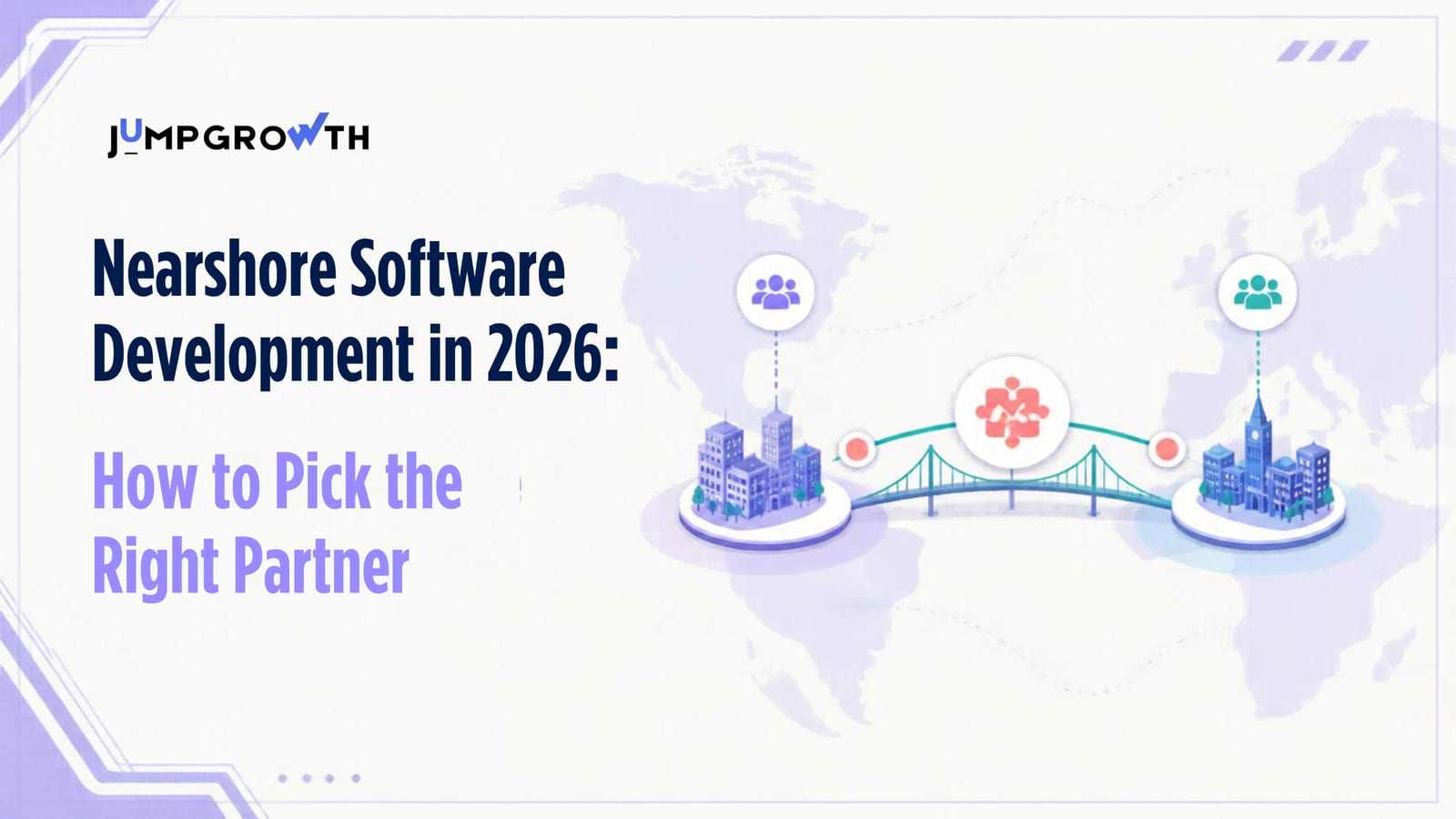
Why Nearshore Is Getting a Second Look Right Now
A fintech startup we worked with last year had burned through two offshore engagements — one in Eastern Europe, one in Southeast Asia — before they finally landed on a nearshore software development team in Medellin. The offshore work wasn’t bad, exactly. Quality was fine. But the async gap was destroying sprint velocity. By the time their San Francisco PM got around to reviewing pull requests, half a business day had already evaporated. The Medellin team? Basically the same time zone. Morning standups actually happened in the morning.
That pattern is more common than people want to admit. Offshoring gets pitched as a cost play, and it often is one, but the hidden costs eat into that margin fast. The delayed feedback loops. The cultural friction. The extra project manager you quietly hire just to babysit a timezone gap nobody accounted for in the original budget. Nearshore software development doesn’t always win on pure hourly rate. Total project cost is a completely different calculation.
What follows breaks down the actual numbers for 2026 — developer salaries by country, English proficiency scores, time zone overlap with major US hubs, and a vendor evaluation checklist built specifically for CTOs who have already seen things go sideways at least once.
The Numbers That Actually Matter: Country-by-Country Comparison
The table below pulls from CBRE’s 2024 Tech Talent Scorecard, which covers labor costs and talent supply across North and Latin America, and EF English Proficiency Index 2023 data. Salary ranges reflect mid-level software engineers with 3-6 years of experience, in USD annually. These aren’t recruiter estimates. They’re aggregated from local job boards, CBRE market reports, and Glassdoor equivalents in each country.
| Country | Avg. Mid-Level Dev Salary (USD/yr) | EF English Proficiency Score (2023) | Time Zone Overlap with NYC (hrs/day) | Time Zone Overlap with LA (hrs/day) | Cultural Fit Rating (US clients) |
|---|---|---|---|---|---|
| Mexico | $28,000 – $42,000 | 52.7 (Moderate) | 7-8 hrs | 8-9 hrs | Very High |
| Colombia | $22,000 – $38,000 | 54.9 (Moderate) | 6-7 hrs | 8-9 hrs | High |
| Argentina | $30,000 – $48,000 | 56.8 (High) | 5-6 hrs | 7-8 hrs | High |
| Poland | $38,000 – $60,000 | 62.1 (Very High) | 2-3 hrs | 0-1 hrs | Moderate-High |
Source: CBRE Tech Talent Scorecard 2024; EF English Proficiency Index 2023.
Poland is in here because a lot of US CTOs use it as a nearshore option for their European offices while treating LATAM as the US-facing nearshore layer. If your entire team is US-based, Poland starts looking a lot more like traditional offshore. Warsaw is 6 hours ahead of New York. That’s a real collaboration ceiling, not a scheduling inconvenience you can work around with good standups.
Argentina’s numbers are genuinely interesting right now. Economic volatility has kept local salaries lower in dollar terms even as technical quality has stayed strong. Buenos Aires produces serious engineering talent — NASSCOM’s 2023 global talent competitiveness analysis flagged Argentina as an underutilized pool, particularly for AI/ML and fintech specializations. The catch is currency instability. You need clear contract structures, USD-denominated preferred, or you will see churn the moment the peso swings hard in either direction.
What Outsource Software Development Cost Actually Looks Like End-to-End
The hourly rate conversation is a trap. Seriously. Every RFP we’ve reviewed leads with “what’s your blended rate?” and that’s probably the least useful question you can ask a vendor.
Here’s a more honest breakdown of what outsource software development cost looks like when you factor in the full engagement:
| Cost Component | US In-House | Nearshore (Colombia/Mexico) | Offshore (India/Vietnam) |
|---|---|---|---|
| Mid-level dev (fully loaded, annual) | $130,000 – $180,000 | $45,000 – $75,000 | $25,000 – $45,000 |
| Coordination overhead (PM time, async tooling) | Low | Low-Medium | High |
| Ramp-up / onboarding time | 4-6 weeks | 3-5 weeks | 6-10 weeks |
| Revision cycles due to miscommunication | Minimal | Low | Medium-High |
| Travel cost for in-person alignment | None | Low ($500-$1,500/trip) | High ($3,000-$6,000/trip) |
The real savings from a nearshore staff augmentation model usually land somewhere between 40-55% compared to equivalent US hiring, once you account for coordination drag. Pure offshore can hit 60-70% on paper. But we’ve seen that gap close to 15-20% on projects with heavy UX iteration or frequent stakeholder input — which is exactly the condition most SaaS and product companies operate under most of the time.
One frank caveat: these numbers assume you’re working with a vendor who already has delivery infrastructure in place. A boutique shop of 10 engineers in Bogota might give you excellent individual talent but zero process maturity. That’s a fundamentally different risk profile than a 200-person firm with ISO 27001 certification and existing US client references they’ll actually let you call.
Time Zone Alignment: Why It’s Not Just About Hours of Overlap
Eight hours of overlap sounds like plenty. And it is — except the quality of those hours matters more than the raw count. We’ve watched nearshore engagements fail not because of time zones per se, but because one team’s core hours were 10am-4pm local time and the client’s sprint reviews were scheduled at 5pm EST. Two hours of “official” overlap translated to zero usable collaboration time in practice.
When you’re evaluating a nearshore software development team, get specific about their actual working hours, not just their UTC offset. Ask directly:
- What are your core collaboration hours — in your local time and in US Eastern time?
- How do you handle urgent escalations outside business hours? Is there an on-call rotation, or does everything funnel through one person?
- Do your senior engineers actually attend live sprint ceremonies, or are they sending async Loom videos after the fact?
Mexico City and Guadalajara sit on Central Time for most of the year. That means near-perfect alignment with Chicago and Dallas, and solid overlap with both coasts. It’s an underappreciated structural advantage. For healthcare, logistics, or retail clients with heavy US Midwest operations, a Mexico-based team is probably the most practical choice from a scheduling standpoint alone.
Colombia doesn’t observe daylight saving time, which actually helps more than people realize. No biannual calendar confusion when US clocks shift. Small thing on paper. Ask anyone who’s ever managed cross-border sprint planning in March and November and they’ll tell you it’s not that small.
How to Evaluate a Software Development Partner: A CTO Checklist
This is where most vendor evaluation processes fall apart. Companies send an RFP, get back glossy decks, run one technical interview, and sign. Then three months in, they’re discovering that the senior engineers on the sales call are not the people actually writing their code.
The checklist below is what we’d actually use. It’s not exhaustive. But it covers the failure modes that come up most often.
Technical and Process Vetting
- Ask for a GitHub or GitLab sample — even scrubbed of client IP — so you can assess code style, documentation habits, and commit granularity. You learn a lot from how someone commits.
- Run a 90-minute paid technical assessment with the specific engineers who will be on your project. Not the pre-sales team.
- Ask how they handle technical debt. Do they track it, surface it proactively to clients, or let it quietly accumulate until it becomes your problem?
- Find out what CI/CD tooling they currently use and whether it’s compatible with your stack. Jenkins, GitHub Actions, CircleCI — these details matter when you’re trying to actually ship.
- Request their incident response playbook for production issues. Any mature shop has one. If they hesitate, that’s data.
Security and Compliance
- ISO 27001 or SOC 2 Type II certification — especially relevant for healthcare, fintech, or anything touching regulated data
- Data handling agreements: where does code live, who has access to it, and what does the offboarding protocol actually look like?
- IP assignment clauses reviewed by your legal team before you sign anything, not after something goes wrong
Communication and Culture Fit
- Set up a working session — even a 60-minute mock planning meeting — before you sign a contract. You’ll learn more from one live session than from five reference calls.
- Ask how they’ve handled a project that went off track. What they actually did, not what they would theoretically do in that situation.
- Check LinkedIn for actual engineer tenure at the firm. Average tenure under 12 months is a genuine red flag for nearshore staff augmentation engagements where continuity is the whole point.
Commercial Structure
- Time-and-materials vs. fixed scope: for most product work, T&M with monthly reviews is the safer structure by a significant margin
- What’s the ramp-down clause if you need to reduce headcount? Some contracts lock you in for 6-month minimums that nobody mentioned during the sales process.
- Ask for client references specifically from companies at your scale and in your industry. A reference from a Fortune 500 is essentially useless if you’re a Series B company with a 12-person engineering team.
One blunt opinion worth adding: if a vendor can’t give you direct access to engineering leadership — a VP of Engineering or CTO equivalent, not just an account manager — during the evaluation process, walk away. The firms worth working with are confident enough in their delivery to let technical people talk to technical people without a sales intermediary filtering every answer.
When Nearshore Doesn’t Win
Worth being honest about this. Nearshore isn’t automatically the right call.
If your primary constraint is absolute lowest cost and your project has a stable, well-documented spec — a data migration, a well-scoped API integration, a QA automation build — offshore might actually serve you better. NASSCOM’s 2023 industry report noted that India alone produces roughly 1.5 million engineering graduates annually, and the depth of specialized talent in areas like enterprise Java, SAP, and legacy system modernization is genuinely hard to match anywhere else. (NASSCOM Tech Sector Report 2023)
Nearshore earns its premium when collaboration density is high. Iterative product work. UX-heavy applications. Projects where requirements evolve weekly, or any context where your internal team needs to work alongside the external team as near-peers rather than simply handing off tickets into a queue and waiting.
If you’re scaling a nearshore staff augmentation model for the first time, start with one pod — 3-5 people max — before you expand. We’ve seen companies go from zero to 20 nearshore engineers in 90 days and immediately lose control of architecture decisions because nobody had built the integration patterns first. Slower ramp tends to produce clearer outcomes. That’s not a comfortable thing to tell a CTO who wants to move fast, but it’s accurate.
FAQ
What is the typical cost savings from a nearshore software development team compared to US hiring?
Realistically, 40-55% on fully-loaded annual cost for mid-level engineers, depending on country and seniority mix. Mexico and Colombia tend to land at the lower end of the salary range. Argentina can creep higher in dollar terms depending on how the contract is structured. The important thing: don’t model your savings projection based on hourly rate alone. Factor in coordination costs, onboarding time, and revision cycles — all of which affect actual delivered cost per feature in ways that don’t show up on a rate card.
How do I know if a vendor is a legitimate software development partner or just a staffing body shop?
Ask them to walk you through an architecture decision they made on a recent project. Why they chose it, what alternatives they considered, what trade-offs they accepted. A staffing firm will either give you a blank stare or hand you to an engineer who can answer technically but has no context on the client’s business situation. A real software development partner will have engineering leaders who can speak to both the technical rationale and the business constraints that shaped the decision. That conversation tells you most of what you need to know, and it usually takes about 20 minutes.
Is nearshore staff augmentation better than building a dedicated offshore development team?
Depends almost entirely on your goal. Staff augmentation gives you flexibility — you scale up and down, embed talent into your existing team, maintain direct management. A dedicated offshore development team, sometimes called a build-operate-transfer model, makes sense if you eventually want to own the team and absorb them into your org structure. Augmentation is faster to start and considerably easier to exit. A dedicated model is better for long-term cost efficiency if you’re genuinely committed to the geography for the long haul. Most companies at Series B and below should start with augmentation and revisit the dedicated model question after 12-18 months of stable, working engagement.
Keep reading
- Nearshore

Nearshore Software Development Companies in 2026: How to Evaluate, Vet, and Onboard the Right Partner
11 minutes readRead article - Nearshore
Nearshore Software Development Teams in 2026: Time Zone, Cost, and Talent Quality Compared to Offshore
10 minutes readRead article - Nearshore
Hiring Developers in 2026: Full-Time vs. Nearshore vs. Dedicated Team – A Cost and Risk Analysis
11 minutes readRead article
Build your team
Share where the roadmap is blocked and the capabilities you need. We’ll map a practical team and delivery model.