- Technology Tips
100+ Programming Languages to Know in 2026: Popular, Emerging, and Specialized Languages
- Written by
- Saurabh Wankhade
- Published
- 2 November 2026
- Reading time
- 45 minutes
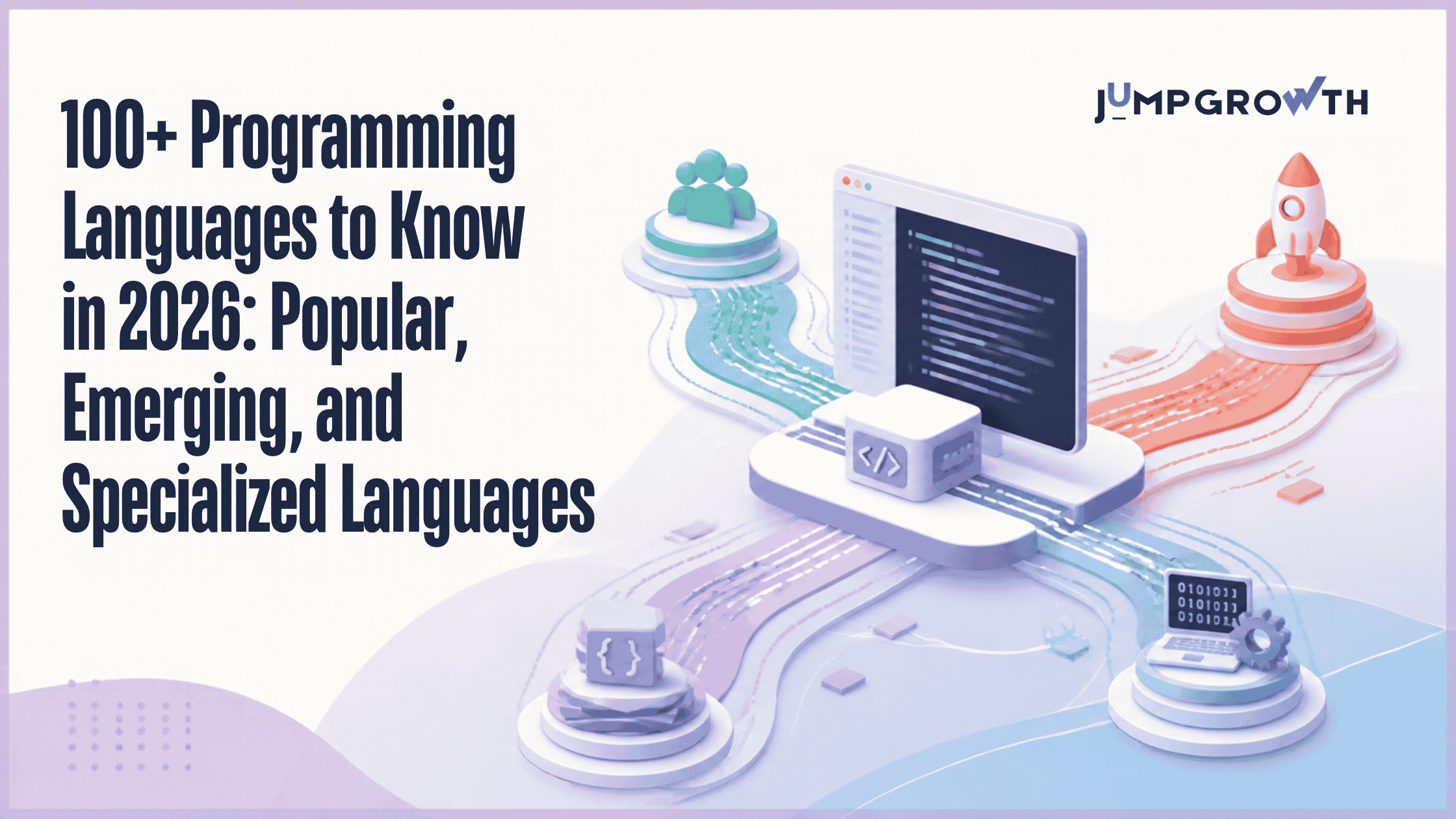
Short answer: In 2026, the programming languages that matter most for new software are Python, JavaScript, TypeScript, Java, C#, Go, and Rust, with C and C++ still underpinning operating systems, game engines, and AI runtimes, and Kotlin, Swift, and Dart leading native and cross-platform mobile work. TypeScript is now the most-used language on GitHub by monthly contributors, Python leads the TIOBE index and dominates AI development, JavaScript remains the most-used language in the Stack Overflow Developer Survey, and Rust is the fastest-growing major language across several measurements.
That short list is where most teams should start. It is not where the story ends. A large share of production software still runs on languages that rarely trend: COBOL in banking cores, Fortran in climate models, ABAP inside SAP, Ada in avionics, SQL in nearly every business system. A new generation of languages, including Zig, Mojo, Gleam, and Lean, is also changing how engineers think about performance, safety, and correctness.
This guide covers more than 100 languages in three tiers: established general-purpose languages, emerging languages worth watching, and specialized languages that remain essential in specific industries. For each major language, you will find what it is, where it is used, its trade-offs, and when it makes sense to choose it. You will also find a practical framework for choosing a language for a real project, because popularity is a signal, not a decision.
Research date: This guide reflects data available on November 2, 2026, including the Stack Overflow Developer Survey 2026 (published October 2026), GitHub Octoverse 2026 (published October 28, 2026), and the TIOBE Index for October 2026. Every statistic is attributed to its source and dated.
How We Selected the Top Programming Languages in 2026
No single ranking can tell you which language is "best." Each index measures something different, and treating them as interchangeable produces misleading lists. We combined several independent signals and then applied engineering judgment about ecosystem maturity, production readiness, and real-world use.
This list is a curated reference, not a universal ranking. The order within each section reflects broad relevance for new software projects in 2026, not a precise score.
| Selection Factor | What It Measures | Why It Matters |
|---|---|---|
| Developer usage | Share of surveyed developers who used a language in the past year (Stack Overflow) | Shows what working developers actually write today |
| GitHub contributor activity | Monthly contributors pushing code in each language (Octoverse) | Reflects open-source and project activity, including AI-assisted work |
| Search and community visibility | Engineers, courses, and vendors referenced across search engines (TIOBE); tutorial searches (PYPL) | Indicates mindshare and learning demand |
| Ecosystem maturity | Libraries, package managers, frameworks, tooling, documentation | Determines how much you build yourself versus reuse |
| Enterprise adoption | Use in regulated, large-scale, long-lived systems | Signals long-term support and hiring depth |
| AI and ML relevance | Role in model training, inference, agents, and AI-enabled apps | AI is now part of most new products |
| Performance and scalability | Runtime model, memory model, concurrency support | Decides fit for latency-sensitive or resource-constrained systems |
| Safety and correctness | Memory safety, type systems, formal verification support | Increasingly required by security guidance and regulators |
| Documentation and tooling | Compilers, IDE support, debuggers, testing tools | Affects developer productivity and onboarding |
| Long-term support | Governance, release cadence, backing organization or foundation | Reduces the risk of building on an abandoned platform |
Why the major rankings disagree
| Source | What it actually counts | Latest edition used | Key limitation |
|---|---|---|---|
| Stack Overflow Developer Survey | Self-reported language use by survey respondents (14,099 answered the language question in 2026) | 2026, published October 2026 | Respondents skew toward Stack Overflow's audience; mixes programming, query, markup, and shell languages in one list |
| GitHub Octoverse | Monthly contributors and activity on GitHub, October 1, 2025 to September 30, 2026 | 2026, published October 28, 2026 | Over-represents open-source and web development; under-represents closed enterprise code |
| TIOBE Index | Ratings based on skilled engineers, courses, and third-party vendors found through Google, Bing, Wikipedia, Amazon, and 20+ other sites | October 2026 | Measures visibility, not usage; TIOBE added Mandarin search terms in October 2026, so month-to-month comparisons are less reliable |
| PYPL Index | How often language tutorials are searched on Google (Google Trends data) | Latest figures we could verify: April 2026, via a third-party mirror | Measures learning interest, which favors beginner-friendly languages |
The practical lesson: TypeScript can rank first on GitHub and sixth in the Stack Overflow survey, while barely appearing in TIOBE's top 20, and all three can be accurate. They measure different things.
2026 data snapshot
| Language | Stack Overflow 2026 (% of respondents using) | TIOBE Oct 2026 (rank, rating) | GitHub Octoverse 2026 |
|---|---|---|---|
| Python | 58.0% | #1, 19.23% | #2 by monthly contributors |
| JavaScript | 62.0% | #6, 2.77% | #3 by monthly contributors |
| TypeScript | 43.8% | Not in top 20 | #1 by monthly contributors |
| Java | 27.6% | #4, 8.41% | Below top 3 |
| C# | 27.1% | #5, 3.79% | Below top 3 |
| C++ | 24.3% | #3, 8.87% | Below top 3 |
| C | 21.8% | #2, 11.33% | Not reported in body text |
| Rust | 18.0% | #10, 1.44% | Fastest percentage growth among top languages |
| Go | 16.5% | #11, 1.39% | In projected top 10 |
Sources: Stack Overflow 2026 language data, TIOBE Index October 2026, GitHub Octoverse 2026. Do not compare the percentages across columns; each source uses a different method.
Programming Language Trends Shaping Software Development in 2026
Observed trends (backed by 2026 data)
TypeScript has become the default for serious JavaScript work. GitHub's Octoverse 2025 reported that TypeScript overtook both Python and JavaScript in August 2025 to become the most-used language on GitHub. Octoverse 2026 confirms the order held, with TypeScript adding 3.62 million monthly contributors between September 2025 and September 2026, the largest gain among the top languages. Microsoft also shipped TypeScript 7.0 in 2026 with a native compiler written in Go, which InfoQ reports delivers roughly 8x to 12x faster full builds.
Python keeps its lead in AI, data, and automation. Python is first in the TIOBE Index for October 2026 at 19.23%, second on GitHub, and used by 58.0% of Stack Overflow respondents. Octoverse 2025 found that more than 1.1 million public repositories use an LLM SDK, and Python is the primary language of the major AI frameworks.
Rust is moving into mainstream infrastructure. Rust usage among Stack Overflow respondents rose from 14.9% in 2025 to 18.0% in 2026, moving it to 12th place. Octoverse 2026 says Rust "grew fastest by percentage among the top languages, doubling in the past year." In TIOBE, Rust climbed from 16th to 10th year over year. Linux kernel developers have also moved Rust support beyond its original experimental label (verify the exact kernel version at publication).
AI agents now write a large share of code. Octoverse 2026 reports that by September 2026, more than 40% of pull requests on GitHub started with an agent's first draft, up from 17% in March. In the Stack Overflow 2026 survey, 66% of AI users use coding agents. This affects language choice: strongly typed languages give agents and reviewers more structure to check against.
Shell and scripting usage is rising. Bash/Shell use among Stack Overflow respondents climbed from 48.7% to 51.3%, and PowerShell from 23.2% to 24.6%, consistent with more automation and agent-driven workflows that operate through the terminal.
Mojo reached 1.0 and went open source. Modular announced Mojo 1.0 in August 2026 and released it under the Apache 2.0 license, with version 1.2.0 listed as stable on mojolang.org in October 2026.
Ongoing trends (structural, multi-year)
- Enterprise stability: Java and C# remain the backbone of banking, insurance, healthcare, and government systems. Java 25 (GA September 2025) is the current long-term support release, and .NET 10 is a three-year LTS release that ships with C# 14.
- Mobile consolidation: Kotlin and Swift are the native defaults for Android and iOS; Dart (Flutter) and TypeScript (React Native) dominate cross-platform work.
- WebAssembly and WASI:WebAssembly is a portable binary instruction format, not a language. Rust, C, C++, Go, Zig, and others compile to it for browser, edge, and plugin use cases. WASI extends it to run outside browsers.
- Memory safety pressure: Government security agencies, including the US CISA and NSA, have published guidance encouraging memory-safe languages for new code. This favors Rust, Go, Java, C#, Swift, and others over unrestricted C and C++ for new components.
- GPU and accelerator programming: CUDA, Triton, and Mojo reflect demand for code that runs efficiently on GPUs and AI accelerators.
- Smart contracts: Solidity remains the main Ethereum language, while Move (Sui, Aptos) and Cairo (Starknet) represent newer, safety-focused designs.
The Most Popular Programming Languages in 2026
These 20 languages are established, production-proven, and supported by mature ecosystems. Each profile is written to stand on its own.
1. Python
What it is: A high-level, dynamically typed, general-purpose language designed for readability. Python 3.15 is the current release series as of October 2026 (python.org).
Key characteristics: Indentation-based syntax, a vast standard library, an interpreter-based runtime (CPython), and optional type hints checked by tools such as mypy and Pyright. Recent releases have added an optional free-threaded build that removes the global interpreter lock.
Common use cases: Machine learning and generative AI, data analysis, scientific computing, automation and scripting, backend APIs, and DevOps tooling.
Popular ecosystem: PyTorch, TensorFlow, JAX, scikit-learn, pandas, Polars, NumPy, FastAPI, Django, Flask.
Advantages: Fast to learn and prototype; the deepest AI and data ecosystem of any language; huge talent pool.
Limitations: Slower raw execution than compiled languages; heavy compute relies on native extensions written in C, C++, or Rust; dynamic typing can make large codebases harder to maintain without discipline.
Best suited for: AI products, data pipelines, internal tools, and API backends where developer speed matters more than per-request CPU cost. Building an AI product? JumpGrowth can help you hire Python developers who work across this stack.
2. JavaScript
What it is: The language of the web browser, standardized as ECMAScript, and now also used on servers through runtimes such as Node.js, Deno, and Bun.
Key characteristics: Dynamic typing, first-class functions, an event-driven asynchronous model, and just-in-time compilation in modern engines.
Common use cases: Front-end web interfaces, full-stack web applications, serverless functions, browser extensions, and desktop apps via Electron.
Popular ecosystem: React, Vue, Angular, Svelte, Next.js, Node.js, npm.
Advantages: Runs everywhere a browser runs; the largest package registry; JavaScript has topped the Stack Overflow survey's usage list for 12 consecutive years (62.0% in 2026).
Limitations: Loose typing invites runtime errors; ecosystem churn is high; dependency sprawl creates supply-chain risk.
Best suited for: Web front ends and small-to-medium full-stack apps. For larger codebases, most teams now write TypeScript instead.
3. TypeScript
What it is: A statically typed superset of JavaScript developed by Microsoft that compiles to plain JavaScript.
Key characteristics: Structural typing, type inference, generics, and gradual adoption (any JavaScript file is a valid starting point). TypeScript 7.0, released in 2026, moved the compiler to a native Go implementation for much faster builds.
Common use cases: Large front-end applications, Node.js backends, full-stack frameworks, SDKs, and AI-powered product interfaces.
Popular ecosystem: React, Angular (TypeScript by default), Next.js, NestJS, tRPC, Prisma, Vercel AI SDK.
Advantages: Catches many bugs at compile time; dramatically better editor tooling and refactoring; types give AI coding agents more context to work with. It ranks first on GitHub by monthly contributors in both Octoverse 2025 and 2026.
Limitations: Adds a build step; complex types can become hard to read; types are erased at runtime, so external data still needs runtime validation.
Best suited for: Any JavaScript project expected to grow beyond a few thousand lines or be maintained by more than one developer. JumpGrowth teams build TypeScript-friendly stacks with Node.js developers and React engineers.
4. Java
What it is: A statically typed, object-oriented language that compiles to bytecode for the Java Virtual Machine (JVM).
Key characteristics: Strong backward compatibility, mature garbage collectors, virtual threads for high-concurrency workloads, records, and pattern matching. Java ships a new release every six months, with long-term support (LTS) versions every two years; Java 25 is the current LTS.
Common use cases: Enterprise backends, banking and insurance platforms, large e-commerce systems, Android (legacy and shared code), and big-data tools such as Kafka and Hadoop.
Popular ecosystem: Spring Boot, Quarkus, Micronaut, Jakarta EE, Maven, Gradle.
Advantages: Proven at very large scale; excellent observability and profiling tools; deep hiring pool; stable over decades.
Limitations: More verbose than newer languages; JVM startup and memory overhead (mitigated by GraalVM native images and modern frameworks).
Best suited for: Long-lived, high-throughput business systems where stability and maintainability matter most. See JumpGrowth's page to hire Java developers.
5. C
What it is: A compiled, procedural systems language from the early 1970s that gives direct control over memory and hardware.
Key characteristics: Minimal runtime, manual memory management, pointers, and a portable standard (the latest is C23).
Common use cases: Operating system kernels, embedded firmware, device drivers, databases, language runtimes, and network stacks.
Popular ecosystem: GCC, Clang/LLVM, the Linux kernel, SQLite, Zephyr and FreeRTOS.
Advantages: Predictable performance; runs on almost any processor; a universal interface (the C ABI) that other languages use to interoperate.
Limitations: No memory safety; buffer overflows and use-after-free bugs remain a leading source of security vulnerabilities.
Best suited for: Embedded and low-level systems, and maintaining the enormous base of existing C code. New security-sensitive components increasingly use Rust instead.
6. C++
What it is: A compiled multi-paradigm language that extends C with classes, templates, and modern abstractions while keeping low-level control.
Key characteristics: Zero-cost abstractions, RAII resource management, templates, and a standard updated every three years (C++23 is current; C++26 is being finalized).
Common use cases: Game engines, AI inference runtimes, browsers, high-frequency trading, CAD and simulation, and robotics.
Popular ecosystem: Unreal Engine, Qt, Boost, LLVM, the PyTorch and TensorFlow cores, ONNX Runtime, llama.cpp.
Advantages: Top-tier performance; direct hardware access; huge existing codebases and libraries.
Limitations: Very large language surface; memory-safety risks; slow builds; steep learning curve.
Best suited for: Performance-critical systems where latency, throughput, or hardware control justify the complexity.
7. C#
What it is: A statically typed, object-oriented language from Microsoft that runs on the cross-platform .NET runtime.
Key characteristics: Strong typing, LINQ, async/await (which C# popularized), records, pattern matching, and native AOT compilation. C# 14 ships with .NET 10, a three-year LTS release.
Common use cases: Enterprise web APIs, Windows desktop apps, cloud services on Azure, and game development with Unity.
Popular ecosystem: ASP.NET Core, Entity Framework Core, Blazor, .NET MAUI, Unity.
Advantages: Excellent tooling (Visual Studio, Rider); strong performance; productive language design; long-term Microsoft support.
Limitations: Strongest in Microsoft-aligned environments; some enterprise libraries carry licensing costs.
Best suited for: Business applications, Azure-centric systems, and Unity games. See JumpGrowth's page to hire .NET developers.
8. Go
What it is: A compiled, statically typed language created at Google for simple, fast, concurrent network services.
Key characteristics: Small syntax, fast compilation, goroutines and channels for concurrency, garbage collection, and single static binaries.
Common use cases: Cloud-native infrastructure, microservices, CLIs, DevOps tooling, and networking. Docker, Kubernetes, Terraform, and Prometheus are written in Go.
Popular ecosystem: net/http, Gin, Echo, gRPC, Cobra.
Advantages: Easy for teams to read and maintain; efficient deployment; strong standard library.
Limitations: Deliberately limited expressiveness; garbage collection makes it less suitable for hard real-time systems; generics are newer and simpler than in other languages.
Best suited for: Backend services and platform tooling that need good performance without the complexity of Rust or C++.
9. Rust
What it is: A compiled systems language that guarantees memory safety without a garbage collector through its ownership and borrowing model.
Key characteristics: Ownership and lifetimes checked at compile time, fearless concurrency, algebraic data types, and the Cargo package manager.
Common use cases: Systems programming, browsers, cloud infrastructure, CLIs, WebAssembly, embedded devices, blockchain nodes, and performance-sensitive AI tooling (for example, Hugging Face's tokenizers and the Polars data library).
Popular ecosystem: Cargo, crates.io, Tokio, Axum, Serde, Bevy.
Advantages: C++-class performance with memory safety; excellent compiler errors and tooling; for years it has been among the most admired languages in Stack Overflow surveys, and its 2026 usage (18.0%) is its highest yet.
Limitations: Steep learning curve; longer compile times; a smaller hiring pool than Java or Python.
Best suited for: New systems components, security-sensitive services, and performance-critical infrastructure.
10. PHP
What it is: A server-side scripting language built for the web, now with a JIT compiler, typed properties, enums, and attributes.
Common use cases: Content management systems, e-commerce, and web applications. WordPress, Drupal, and Magento (Adobe Commerce) are PHP.
Popular ecosystem: Laravel, Symfony, Composer.
Advantages: Inexpensive hosting; fast development with Laravel; a very large installed base.
Limitations: Inconsistent legacy APIs; less common for new non-web workloads. Usage fell from 18.8% to 17.7% in the Stack Overflow survey between 2025 and 2026.
Best suited for: CMS-driven sites, e-commerce, and content-heavy web apps.
11. Ruby
What it is: A dynamic, object-oriented language designed for developer happiness, best known for the Ruby on Rails framework.
Common use cases: SaaS web applications and startup MVPs. Shopify and GitHub run large Rails codebases.
Advantages: Very fast for building CRUD-style web products; strong conventions reduce decision fatigue.
Limitations: Slower runtime than compiled languages; a smaller new-developer pipeline than Python or JavaScript (5.8% usage in Stack Overflow 2026).
Best suited for: Teams that already know Rails and want to ship web products quickly.
12. Kotlin
What it is: A statically typed JetBrains language that runs on the JVM, compiles to native code and JavaScript, and is Google's preferred language for Android.
Common use cases: Android apps, JVM backends (Spring and Ktor), and shared business logic across platforms with Kotlin Multiplatform.
Advantages: Null safety, concise syntax, coroutines, and full Java interoperability.
Limitations: Slower compile times than Java in some projects; multiplatform tooling is still maturing for some targets.
Best suited for: Native Android apps and modern JVM services. See JumpGrowth's page to hire Kotlin developers.
13. Swift
What it is: Apple's compiled, type-safe language for iOS, iPadOS, macOS, watchOS, tvOS, and visionOS, with growing server-side and Linux support.
Common use cases: Native Apple apps, SwiftUI interfaces, and some server-side services (Vapor).
Advantages: Safe by default, fast, and first-class Apple tooling; Swift 6 added data-race safety checks. TIOBE ranked Swift 14th in October 2026, up from 22nd a year earlier.
Limitations: Largely tied to Apple platforms; strict concurrency checking can complicate migrations.
Best suited for: High-quality native iOS and macOS apps. See JumpGrowth's page to hire iOS developers.
14. Dart
What it is: A Google language optimized for user interfaces and the foundation of the Flutter framework.
Common use cases: Cross-platform mobile, web, and desktop apps from one codebase.
Advantages: Hot reload for fast UI iteration; ahead-of-time compilation to native code; sound null safety. TIOBE notes Dart rose from 41st to 27th over the past year.
Limitations: Used almost entirely through Flutter; a smaller ecosystem outside it.
Best suited for: Startups and product teams that need iOS and Android apps with one team. See JumpGrowth's page to hire Flutter developers.
15. Scala
What it is: A JVM language that blends object-oriented and functional programming with a powerful type system. Scala 3 is the current major version.
Common use cases: Data engineering (Apache Spark is written in Scala), distributed systems, and fintech.
Advantages: Expressive and type-safe; full Java interoperability.
Limitations: Complex for newcomers; a smaller hiring pool; the Scala 2-to-3 migration fragmented some libraries.
Best suited for: Spark-heavy data platforms and teams that value functional programming on the JVM.
16. R
What it is: A language and environment built for statistics, data analysis, and visualization.
Common use cases: Biostatistics, clinical research, econometrics, academic research, and analytics reporting.
Advantages: Unmatched statistical package depth on CRAN and Bioconductor; ggplot2 and Quarto for publication-quality output. R ranked 8th in TIOBE in October 2026, up from 13th.
Limitations: Less suitable for general application development; memory-heavy on very large datasets.
Best suited for: Statistical analysis and research where methods matter more than application engineering.
17. Julia
What it is: A high-level, JIT-compiled language for numerical and scientific computing that aims to combine Python-like syntax with C-like speed.
Common use cases: Scientific simulation, differential equations, optimization, climate and pharmaceutical modeling, and scientific machine learning.
Advantages: Fast numerical code without rewriting in C; multiple dispatch enables composable libraries. TIOBE's October 2026 headline noted Julia returning to its top 20 for the first time in three years.
Limitations: Compile latency on first run ("time to first plot") has improved but persists; smaller ecosystem than Python.
Best suited for: Research and engineering teams with heavy numerical workloads.
18. Elixir
What it is: A functional, dynamically typed language that runs on the Erlang virtual machine (BEAM).
Common use cases: Real-time web apps, chat and messaging, IoT backends, and fault-tolerant services.
Advantages: Lightweight processes and supervision trees inherited from Erlang; the Phoenix framework and LiveView for real-time UIs; a gradual type system is being added to the language.
Limitations: Smaller talent pool; less suited to CPU-heavy number crunching.
Best suited for: Real-time, highly concurrent systems that must stay up.
19. Erlang
What it is: A functional language created at Ericsson in the 1980s for telecom switches, built around isolated processes and "let it crash" fault tolerance.
Common use cases: Telecom systems, messaging platforms (WhatsApp's backend was famously built on Erlang), and message brokers such as RabbitMQ.
Advantages: Exceptional reliability and hot code swapping via the OTP framework.
Limitations: Unusual syntax; a small community. Most new BEAM projects now start in Elixir or Gleam.
Best suited for: Systems where uptime matters more than raw throughput.
20. Clojure
What it is: A modern Lisp dialect for the JVM (with ClojureScript for JavaScript) that emphasizes immutable data and functional programming.
Common use cases: Data-oriented backends and fintech. Nubank, a large Latin American digital bank, is a well-known Clojure user and the language's steward.
Advantages: Simple, data-first design; interactive REPL-driven development; full JVM library access.
Limitations: Parenthesis-heavy syntax; dynamic typing; a niche hiring market.
Best suited for: Small, senior teams building data-heavy systems on the JVM.
Emerging and Modern Programming Languages to Watch in 2026
"Emerging" does not mean "ready for your next product." We label each language by maturity so you can separate genuine options from interesting experiments.
| Maturity label | Meaning |
|---|---|
| Production-ready | Stable releases, real production users, and a commitment to compatibility |
| Production-capable, pre-1.0 | Used in production by some teams, but breaking changes are still expected |
| Specialized | Mature within a narrow domain (proofs, quantum, blockchain) |
| Experimental | Not recommended for production; watch, prototype, or contribute |
Mojo — Production-ready (young)
Purpose: High-performance AI and systems programming with Python-like syntax. Design philosophy: Give Python developers access to low-level performance, SIMD, and GPU programming without switching to C++ or CUDA. Built on MLIR by Modular, the company founded by LLVM and Swift creator Chris Lattner. Maturity and status: Mojo 1.0 was announced in August 2026, and the language was open-sourced under Apache 2.0 the same month; 1.2.0 was the stable release in October 2026 (mojolang.org). Use cases: Custom AI kernels, inference optimization, performance-critical numerical code. Limitations: Not a drop-in Python replacement; a young library ecosystem and a small talent pool. Verdict: Worth evaluating for AI performance work, but treat it as early-stage for general application development.
Zig — Production-capable, pre-1.0
Purpose: A simpler, more explicit alternative to C. Design philosophy: No hidden control flow, no hidden allocations, compile-time code execution (comptime), and first-class C interoperability. Zig's toolchain can also act as a C/C++ cross-compiler. Maturity and status: 0.17.0 was released October 1, 2026 (ziglang.org). The Bun JavaScript runtime and the TigerBeetle database are notable Zig projects. Limitations: Breaking changes between releases; a smaller library ecosystem; no 1.0 date. Verdict: A serious option for teams comfortable tracking a moving target, especially for C replacement and toolchain work.
Gleam — Production-ready
Purpose: Type-safe functional programming on the Erlang VM and JavaScript. Design philosophy: A small, friendly language with static types and no nulls or exceptions, running on BEAM for fault tolerance. Maturity and status: Gleam reached 1.0 in 2024; v1.18.1 was the latest release as of August 2026 (GitHub releases). Limitations: A small ecosystem, though it can call Erlang and Elixir libraries. Verdict: A good choice for teams that want BEAM reliability with static typing.
Carbon — Experimental
Purpose: A possible successor language for large C++ codebases, started at Google. Maturity and status: The project's own repository states that Carbon is experimental and "not ready for use"; only nightly toolchains are published, and the next milestone is a 0.1 MVP for evaluation (GitHub). Verdict: Watch it if you maintain very large C++ systems. Do not plan production work on it yet.
Odin — Production-capable, pre-1.0
Purpose: A data-oriented systems language for high-performance applications, games, and graphics. Design philosophy: Simplicity, explicit memory control, and built-in support for common game and graphics patterns. JangaFX's real-time VFX tools are built with Odin. Limitations: No 1.0 release; a small community. Verdict: Interesting for game and graphics tooling; niche for general use.
Roc — Experimental
Purpose: A fast, friendly, purely functional language that compiles to machine code or WebAssembly. Status: No numbered release is published on roc-lang.org; the language is still in active design. Verdict: Follow it for ideas about functional programming ergonomics, not for production.
Hare — Experimental / systems niche
Purpose: A small, stable systems language in the spirit of C, aimed at Unix-like systems. Status: Version 0.26.0 was released in February 2026; 1.0 has not shipped (harelang.org). Verdict: Niche; limited platform support by design.
Vale — Archived
Vale explored memory safety through "generational references." Its website now states that Vale is archived and no longer being worked on (vale.dev). We list it for completeness because many 2024–2025 lists still recommend it. Do not start new work in Vale.
Unison — Production-capable (1.0)
Purpose: A functional language where code is content-addressed (identified by a hash of its syntax tree) rather than stored as text files. Design philosophy: No dependency conflicts, no builds in the traditional sense, and simpler distributed computing. Status: Unison 1.0 was announced on November 25, 2025, followed by 1.1.0 in January 2026 (unison-lang.org). Verdict: A novel approach worth exploring; tooling differs sharply from mainstream languages.
Lean 4 — Specialized (proofs and verification)
Purpose: An open-source programming language and interactive theorem prover (lean-lang.org). Use cases: Formalizing mathematics (the Mathlib library), verifying software, and AI research into automated reasoning, where Lean is widely used to check model-generated proofs. Verdict: Increasingly relevant as AI systems generate code and proofs that need machine-checkable guarantees.
Q# — Specialized (quantum)
Purpose: Microsoft's open-source, high-level language for quantum programs, shipped in the Azure Quantum Development Kit (Microsoft Learn). Verdict: For research and education in quantum algorithms. Alternatives include Python libraries such as Qiskit and Cirq.
Move — Specialized (blockchain)
Purpose: A resource-oriented smart-contract language, originally created for Meta's Diem project and now used by the Sui and Aptos blockchains. Design: Digital assets are modeled as "resources" that cannot be copied or implicitly discarded, which prevents classes of asset bugs common in other contract languages. Verdict: Production use within its ecosystems; irrelevant outside blockchain.
Cairo — Specialized (blockchain, provable computation)
Purpose: A Rust-inspired language for writing provable programs with STARK proofs, used for smart contracts on Starknet (cairo-lang.org). Verdict: Specialized; valuable for zero-knowledge and Layer 2 blockchain engineering.
Solidity — Production-ready (smart contracts)
Purpose: The dominant language for Ethereum and EVM-compatible blockchains. Limitations: Contract bugs are costly and often irreversible; audits and formal verification are standard practice. Verdict: The default for EVM smart contracts; consider Vyper as a simpler, Python-like alternative.
Specialized Programming Languages for Specific Industries and Use Cases
Specialized languages rarely top popularity charts, yet entire industries depend on them. Replacing them is often riskier and more expensive than maintaining them, which is why skilled engineers in these languages remain valuable.
| Language | Category | Where it matters | Why it persists |
|---|---|---|---|
| COBOL | Programming language | Mainframe banking, insurance, government benefits | Mission-critical transaction systems with decades of validated business logic. TIOBE ranked COBOL 16th in October 2026. |
| Fortran | Programming language | Weather and climate models, physics, HPC | Excellent array performance and decades of trusted numerical libraries; modern Fortran (2018/2023) is actively maintained |
| MATLAB | Language + commercial platform | Control systems, signal processing, academic engineering | Integrated toolboxes and Simulink for model-based design |
| Ada / SPARK | Programming language / formally verifiable subset | Avionics, rail, defense, space | Strong typing and SPARK's provable absence of runtime errors suit certification standards |
| Solidity, Move, Cairo | Smart-contract languages | Blockchain applications | Each chain's virtual machine defines the language |
| SystemVerilog, VHDL | Hardware description languages (not software languages) | Chip and FPGA design and verification | They describe circuits, not instructions for a CPU |
| Lua | Embeddable scripting language | Game scripting, Roblox (via the Luau dialect), Neovim, Nginx/OpenResty | Tiny, fast, easy to embed; 9.4% usage in Stack Overflow 2026 |
| ABAP | Programming language | SAP ERP customization | Tied to SAP's large enterprise footprint |
| Apex | Programming language | Salesforce platform logic | Runs inside Salesforce's multi-tenant environment |
| SQL, PL/SQL, T-SQL | Query language and procedural extensions | Every relational database | 58.4% of Stack Overflow 2026 respondents use SQL, second only to JavaScript |
| Bash, PowerShell | Shell / scripting languages | Automation, DevOps, system administration | Both grew in Stack Overflow 2026 (51.3% and 24.6%) |
| Prolog | Logic programming language | Rule engines, expert systems, research | Declarative logic remains useful for constraints and reasoning |
| Lisp family (Common Lisp, Scheme, Racket) | Programming languages | Symbolic AI history, research, language design | Macros and code-as-data remain uniquely powerful |
| GDScript | Engine scripting language | Godot game engine | Python-like, tightly integrated with Godot |
| MQL5 | Domain-specific language | Algorithmic trading on MetaTrader 5 | Platform-specific trading robots and indicators |
| Verilog-AMS, LabVIEW (G), Ladder Logic | Domain-specific / visual languages | Analog circuits, test labs, industrial PLCs | Engineering workflows built around them |
The 100+ Programming Languages Directory
The profiles above cover the most relevant languages in depth. The directory below completes the 100+ reference with concise entries. Category labels distinguish general-purpose programming languages from query, markup, shell, hardware, and domain-specific languages, so you know exactly what each one is.
| # | Language | Category | Primary use today | Status |
|---|---|---|---|---|
| 1–20 | Python, JavaScript, TypeScript, Java, C, C++, C#, Go, Rust, PHP, Ruby, Kotlin, Swift, Dart, Scala, R, Julia, Elixir, Erlang, Clojure | General-purpose | See profiles above | Established |
| 21–34 | Mojo, Zig, Gleam, Carbon, Odin, Roc, Hare, Vale, Unison, Lean, Q#, Move, Cairo, Solidity | Mixed (see labels) | See emerging section | Mixed |
| 35 | COBOL | Programming | Mainframe business systems | Legacy, essential |
| 36 | Fortran | Programming | HPC and scientific computing | Established |
| 37 | MATLAB | Language/platform | Engineering computation | Established |
| 38 | Ada | Programming | Safety-critical systems | Established |
| 39 | SPARK | Verifiable Ada subset | Formally verified software | Specialized |
| 40 | SQL | Query language | Relational data | Essential |
| 41 | PL/SQL | Procedural SQL (Oracle) | Database logic | Established |
| 42 | T-SQL | Procedural SQL (Microsoft) | SQL Server logic | Established |
| 43 | Bash | Shell language | Unix automation | Essential |
| 44 | PowerShell | Shell/scripting | Windows and cloud automation | Established |
| 45 | Lua | Scripting | Embedding, games | Established |
| 46 | Luau | Scripting (Lua dialect) | Roblox games | Growing |
| 47 | GDScript | Engine scripting | Godot games | Growing |
| 48 | ABAP | Programming | SAP | Established |
| 49 | Apex | Programming | Salesforce | Established |
| 50 | Prolog | Logic programming | Rules and reasoning | Niche |
| 51 | Common Lisp | Programming | Research, symbolic computing | Niche |
| 52 | Scheme / Racket | Programming | Education, language design | Niche |
| 53 | Haskell | Functional programming | Compilers, fintech, research | Niche, stable |
| 54 | OCaml | Functional programming | Compilers, finance, verification tools | Niche, growing (TIOBE #26, Oct 2026) |
| 55 | F# | Functional (.NET) | Finance, data, domain modeling | Niche, stable |
| 56 | Elm | Functional (front end) | Reliable web UIs | Niche |
| 57 | PureScript | Functional (compiles to JS) | Typed front-end/back-end | Niche |
| 58 | Objective-C | Programming | Legacy Apple apps | Declining for new work |
| 59 | Visual Basic (.NET and classic VB/VBA) | Programming | Office automation, legacy business apps | Legacy, still widespread (TIOBE #7) |
| 60 | Delphi / Object Pascal | Programming | Windows desktop business apps | Legacy, maintained |
| 61 | Perl | Scripting | Text processing, legacy sysadmin | Declining |
| 62 | Groovy | JVM scripting | Gradle builds, Jenkins pipelines | Stable |
| 63 | Assembly | Low-level | Firmware, optimization, security research | Essential niche (7.2% Stack Overflow 2026) |
| 64 | Crystal | Programming | Ruby-like compiled services | Niche |
| 65 | Nim | Programming | Systems and scripting with Python-like syntax | Niche |
| 66 | D | Programming | Systems programming | Niche |
| 67 | V | Programming | Simple compiled language | Experimental |
| 68 | Haxe | Programming | Cross-platform games | Niche |
| 69 | Smalltalk / Pharo | Programming | Live object environments, education | Niche |
| 70 | Tcl | Scripting | EDA tool automation, testing | Niche |
| 71 | AWK | Text processing | Command-line data processing | Stable utility |
| 72 | SAS | Statistical language | Pharma and enterprise analytics | Established, declining for new work |
| 73 | Stata | Statistical language | Econometrics, social science | Niche |
| 74 | SPSS Syntax | Statistical scripting | Survey and social research | Niche |
| 75 | Wolfram Language | Symbolic computation | Mathematica | Niche |
| 76 | APL / J / K / Q | Array programming | Finance (kdb+), analytics | Niche |
| 77 | Scratch | Visual educational | Teaching children to code | Education (TIOBE #15) |
| 78 | Logo | Educational | Teaching programming concepts | Historical/education |
| 79 | Vyper | Smart-contract language | Ethereum contracts | Niche |
| 80 | Verilog | Hardware description | Chip design | Established |
| 81 | SystemVerilog | Hardware description/verification | Chip verification | Established |
| 82 | VHDL | Hardware description | FPGA and defense hardware | Established |
| 83 | Chisel | Hardware construction (Scala-embedded) | RISC-V and research chips | Niche |
| 84 | CUDA C/C++ | GPU extension of C++ | NVIDIA GPU kernels | Essential for AI/HPC |
| 85 | OpenCL C | Parallel computing language | Cross-vendor GPU/accelerator code | Declining |
| 86 | GLSL / HLSL / WGSL / Metal Shading Language | Shader languages | Graphics and GPU compute | Essential niche |
| 87 | Triton | Python-embedded GPU DSL | Custom AI kernels | Growing |
| 88 | HCL | Configuration language | Terraform infrastructure as code | Established (in Octoverse 2026 forecast top 10) |
| 89 | Nix | Functional configuration language | Reproducible builds | Growing niche |
| 90 | Starlark | Python-like configuration | Bazel builds | Niche |
| 91 | CUE / Dhall / Pkl | Configuration languages | Typed configuration | Niche |
| 92 | Rego | Policy language | Open Policy Agent rules | Niche |
| 93 | GraphQL | Query language for APIs | API data fetching | Established |
| 94 | Cypher / GQL | Graph query languages | Graph databases | Growing (GQL is an ISO standard) |
| 95 | SPARQL | Query language | RDF and knowledge graphs | Niche |
| 96 | HTML / CSS | Markup and style languages (not programming) | Web documents and styling | Essential |
| 97 | Typst | Markup-based typesetting language | Technical documents | Growing (fast-growing on GitHub, Octoverse 2025) |
| 98 | LaTeX | Typesetting language | Academic and scientific publishing | Established |
| 99 | Ballerina | Integration-focused language | API and service integration | Niche |
| 100 | Pony | Actor-model language | Safe concurrency research | Experimental |
| 101 | Idris / Agda / Coq (Rocq) | Dependently typed / proof languages | Verification and research | Specialized |
| 102 | X++ | Programming | Microsoft Dynamics 365 Finance | Niche |
| 103 | RPG | Programming | IBM i (AS/400) business systems | Legacy, essential |
| 104 | MQL5 | Domain-specific | MetaTrader trading robots | Niche |
| 105 | MicroPython / CircuitPython | Python implementations | Microcontrollers and education | Growing |
| 106 | Ladder Logic / Structured Text (IEC 61131-3) | PLC languages | Industrial automation | Essential niche |
Programming Languages for AI and Machine Learning Development
There is no single "AI language." Modern AI products span several layers, and each layer favors different languages.
| AI stack layer | Primary languages | Why |
|---|---|---|
| Research, training, and experimentation | Python | PyTorch, JAX, and the Hugging Face ecosystem are Python-first |
| GPU kernels and performance | CUDA C++, Triton, Mojo, C++ | Direct control over accelerator hardware |
| Inference runtimes and serving | C++, Rust, Python | Low latency and efficient memory use |
| AI-powered apps and interfaces | TypeScript, JavaScript, Python | Product front ends, APIs, and agent orchestration |
| AI infrastructure and tooling | Rust, Go | Safe, fast, deployable infrastructure |
| Scientific ML | Julia, Python | Differential equations and simulation |
Python is the language of model development, data processing, fine-tuning, evaluation, and much of model serving. Its weakness, raw speed, matters less because the heavy compute runs in native code underneath.
C++ powers the engines: the cores of PyTorch and TensorFlow, ONNX Runtime, and local inference projects such as llama.cpp. When inference cost or latency matters, C++ is often in the critical path.
JavaScript and TypeScript are where most users meet AI: chat interfaces, copilots inside SaaS products, and browser-based inference via WebGPU and ONNX Runtime Web. TypeScript is a common choice for agent applications because many AI SDKs offer first-class TypeScript support.
Rust is increasingly used in AI infrastructure for tokenizers, data tooling, inference servers, and vector databases (for example, Qdrant is written in Rust).
Julia serves scientific machine learning, where physics models and neural networks are combined.
Mojo targets the gap between Python's usability and C++/CUDA performance. With 1.0 released in 2026, it is credible for kernel-level work, but its ecosystem is still young.
AI technologies that are not programming languages
Many "AI language" lists mix languages with frameworks and protocols. Here is the correct classification.
| Technology | Category | What it does |
|---|---|---|
| PyTorch | Deep learning framework (Python, C++ core) | Building and training neural networks |
| TensorFlow | Deep learning framework | Training and deploying models, especially in production pipelines |
| JAX | Numerical computing library | Composable transformations (autodiff, JIT) for high-performance ML research |
| Hugging Face Transformers | Model library and hub ecosystem | Pretrained models, datasets, and tooling |
| ONNX | Open model format | Moving models between frameworks and runtimes |
| CUDA | Parallel computing platform and programming model | GPU acceleration on NVIDIA hardware |
| Triton | Python-embedded language and compiler | Writing efficient GPU kernels |
| vLLM | Inference and serving engine | High-throughput LLM serving |
| LangChain / LangGraph | Application frameworks | Composing LLM calls, tools, and agent workflows |
| LlamaIndex | Data framework | Connecting LLMs to private data, often for RAG |
| Model Context Protocol (MCP) | Open protocol | Connecting AI applications to external tools and data; donated by Anthropic to the Agentic AI Foundation under the Linux Foundation in December 2025 (Anthropic) |
| Retrieval-augmented generation (RAG) | Architecture pattern | Grounding model answers in retrieved documents |
| Vector databases (e.g., pgvector, Qdrant, Milvus) | Data stores | Similarity search over embeddings |
| Agent frameworks (e.g., OpenAI Agents SDK, LangGraph, CrewAI) | Libraries/frameworks | Multi-step, tool-using AI agents |
If you are building AI features into a product, JumpGrowth's generative AI developers and machine learning developers pages describe the RAG, agent, and evaluation skills involved.
Programming Languages for Different Types of Software Development
Web Development
TypeScript and JavaScript own the browser. Python (Django, FastAPI), PHP (Laravel, WordPress), Ruby (Rails), Go, Java (Spring), and C# (ASP.NET Core) are the common server-side choices. For a new product, a TypeScript front end with a TypeScript, Python, or Go backend is the most common modern pattern.
Backend Development
Java and C# suit large enterprise domains with complex business rules. Go suits network services and microservices that need fast startup and simple deployment. Rust fits latency-critical or security-sensitive services. Python fits AI-heavy and data-heavy APIs. TypeScript on Node.js suits teams that want one language across the stack. PHP remains efficient for content-driven platforms.
Rust vs Go for backend development: choose Go for team velocity, simple concurrency, and fast onboarding; choose Rust when you need predictable latency without garbage-collection pauses, tight memory control, or the strongest compile-time safety guarantees.
Mobile App Development
Kotlin (Android) and Swift (iOS) for native apps; Dart with Flutter or TypeScript/JavaScript with React Native for cross-platform apps; Java for maintaining older Android codebases; Kotlin Multiplatform for sharing business logic while keeping native UIs.
AI and Machine Learning
Python first, with C++ for performance, Julia for scientific ML, Rust for infrastructure, and TypeScript/JavaScript for AI product experiences.
Cloud-Native and Distributed Systems
Go is the native language of Kubernetes-era infrastructure. Rust is gaining ground in proxies, runtimes, and storage engines. Java remains strong in large distributed business systems (Kafka is JVM-based). Python and TypeScript dominate serverless functions and infrastructure-as-code SDKs, alongside HCL for Terraform.
Game Development
C++ (Unreal Engine and most AAA engines), C# (Unity, and Godot's .NET option), GDScript (Godot), Lua/Luau (scripting and Roblox), and Rust (the Bevy engine, still maturing).
Embedded and IoT Development
C remains dominant on microcontrollers; C++ is common in richer embedded systems; Rust is gaining official support from chip vendors and embedded frameworks; Zig appeals as a modern C replacement; Ada/SPARK serves safety-critical devices; MicroPython suits prototyping and education.
Data Engineering and Analytics
SQL is non-negotiable. Python (pandas, Polars, PySpark, Airflow, dbt's Python models) handles transformation and orchestration. Scala and Java power Spark, Flink, and Kafka internals. R and Julia serve statistical and numerical analysis. Need help on a data platform? See JumpGrowth's page to hire data engineers.
Programming Languages vs Frameworks, Libraries, Runtimes, and Tools
Many lists blur these categories. Here is how they differ.
- Programming language: A formal language for expressing computation (Python, Rust).
- Markup language: Describes structure or presentation, not computation (HTML, Markdown).
- Query language: Retrieves and manipulates data (SQL, GraphQL, Cypher).
- Framework: A structure that calls your code and shapes your application (Django, Spring, Angular).
- Library: Reusable code that your program calls (React, NumPy).
- Runtime: The environment that executes code (Node.js, the JVM, .NET CLR).
- Compiler / toolchain: Translates source code into executable form (LLVM, GCC, rustc).
- Developer tool: Supports the workflow (Git, VS Code, Docker).
- Protocol: A standard for communication between systems (HTTP, MCP).
- Platform: A broader environment combining many of the above (Salesforce, CUDA, Azure).
| Technology | Category | Purpose |
|---|---|---|
| Python | Programming language | General-purpose development and AI |
| TypeScript | Programming language | Typed JavaScript development |
| React | UI library | Building user interfaces |
| Angular | Framework | Full-featured front-end applications |
| Node.js | Runtime | Running JavaScript outside browsers |
| JVM | Runtime / virtual machine | Executing Java, Kotlin, Scala, and Clojure bytecode |
| LLVM | Compiler infrastructure | Backend for Clang, Rust, Swift, Zig, Julia, and Mojo (via MLIR) |
| WebAssembly | Binary instruction format | Portable, sandboxed execution target |
| WASI | System interface standard | Running Wasm outside the browser |
| SQL | Query language | Managing relational data |
| HTML | Markup language | Structuring web documents |
| CUDA | Parallel computing platform | GPU-accelerated computing |
| Flutter | UI framework (Dart) | Cross-platform apps |
| MCP | Protocol | Connecting AI applications with external tools and context |
Programming Language Comparison Table
These ratings are qualitative editorial assessments based on each language's runtime model, type system, ecosystem size, and documented production use. They are not benchmark scores. Actual performance depends heavily on the workload, libraries, and code quality.
| Language | Main Use Cases | Performance Profile | Learning Curve | Ecosystem Maturity | Best-Fit Projects |
|---|---|---|---|---|---|
| Python | AI, data, automation, APIs | Interpreted; fast via native libraries | Gentle | Very mature | AI products, data pipelines, MVPs |
| JavaScript | Web front ends, full-stack | JIT-compiled; good | Gentle to moderate | Very mature | Websites, interactive UIs |
| TypeScript | Large web apps, Node backends | Same as JavaScript at runtime | Moderate | Very mature | Scalable SaaS, multi-developer front ends |
| Java | Enterprise backends, Android legacy | JVM; high throughput | Moderate | Very mature | Banking, insurance, large platforms |
| C# | Enterprise, Azure, Unity | .NET; high throughput | Moderate | Very mature | Business apps, games |
| Go | Cloud services, CLIs | Compiled, garbage-collected; high | Gentle | Mature | Microservices, DevOps tooling |
| Rust | Systems, infrastructure, Wasm | Compiled, no GC; very high | Steep | Mature, growing | Security-critical and high-performance services |
| C | Embedded, OS, drivers | Compiled; very high | Moderate (hard to master safely) | Very mature | Firmware, kernels |
| C++ | Games, AI runtimes, trading | Compiled; very high | Steep | Very mature | Engines, low-latency systems |
| Kotlin | Android, JVM backends | JVM/native; high | Moderate | Mature | Android apps, modern JVM services |
| Swift | Apple platforms | Compiled; high | Moderate | Mature | iOS and macOS apps |
| Dart | Cross-platform UI | AOT-compiled; good | Gentle | Mature (Flutter-centric) | Cross-platform mobile MVPs |
| PHP | CMS, e-commerce | JIT-capable; good for web | Gentle | Very mature | WordPress, Laravel apps |
| Ruby | Web apps | Interpreted (with YJIT); moderate | Gentle | Mature | Rails SaaS, MVPs |
| Scala | Data engineering, distributed systems | JVM; high | Steep | Mature | Spark platforms |
| R | Statistics | Interpreted; moderate | Moderate | Mature (stats) | Research and analytics |
| Julia | Scientific computing | JIT-compiled; very high for numerics | Moderate | Growing | Simulation, scientific ML |
| Elixir | Real-time, concurrent systems | BEAM; high concurrency | Moderate | Mature | Chat, real-time platforms |
| Zig | C replacement, toolchains | Compiled, no GC; very high | Moderate to steep | Early | Systems tools, embedded |
| Mojo | AI kernels, performance Python | Compiled; very high (target) | Moderate for Python devs | Early | AI performance work |
How to Choose the Right Programming Language for Your Project
Choosing a language is a business decision as much as a technical one. A language that is perfect on paper can still be the wrong choice if you cannot hire for it, integrate it, or maintain it for ten years. Work through these factors in order.
- Business requirements: What must the software do, by when, and for whom? Time-to-market often outweighs raw performance.
- Application type: Web, mobile, AI, embedded, and data platforms each have natural defaults (see the use-case section above).
- Performance expectations: Define latency and throughput targets before assuming you need C++ or Rust. Most business software is limited by databases and network calls, not CPU.
- Scalability: Consider both traffic scale and team scale. Static typing (TypeScript, Java, C#, Go, Rust, Kotlin) pays off as codebases and teams grow.
- Security requirements: For components that parse untrusted input or run close to the hardware, prefer memory-safe languages.
- Existing infrastructure: A .NET shop will move faster in C#; a JVM shop in Java or Kotlin. Fighting your platform is expensive.
- Developer availability: Check local and remote hiring markets. Python, JavaScript/TypeScript, Java, and C# have the deepest pools.
- Ecosystem maturity: Confirm that libraries exist for your critical needs, including payments, auth, observability, and your cloud provider's SDKs.
- Maintenance requirements: Who will maintain the code in five years? Readability and conventions matter.
- Total cost of ownership: Include hosting, licenses, hiring, training, and the cost of slower delivery.
- Integration requirements: ERP, CRM, legacy databases, and AI provider SDKs often decide the language for you.
- Long-term support: Favor languages with clear governance, LTS releases, and foundation or corporate backing.
Practical scenarios
| Scenario | Sensible default stack | Why |
|---|---|---|
| AI-powered SaaS MVP | TypeScript (Next.js) front end + Python (FastAPI) AI services | Fast iteration, best AI libraries, one typed language for the product UI |
| Enterprise backend | Java (Spring Boot) or C# (ASP.NET Core) | Stability, LTS support, mature security and observability tooling |
| Mobile application | Kotlin + Swift for native quality; Flutter (Dart) or React Native (TypeScript) for one codebase | Trade native polish against team size and budget |
| Real-time platform (chat, live collaboration) | Elixir (Phoenix) or Go; TypeScript on the client | Lightweight concurrency and fault tolerance |
| AI agent application | Python or TypeScript with an agent framework and MCP integrations | Both have first-class AI SDK support; choose the one your team knows |
| Embedded product | C or C++ today; evaluate Rust for new modules | Vendor toolchains are C-first; Rust adds memory safety |
| Legacy modernization (e.g., COBOL or VB6) | Incremental migration to Java or C# behind APIs | Strangler-fig migration reduces risk versus a full rewrite |
If you are scoping a first release, JumpGrowth's MVP development team can help translate these choices into a delivery plan.
Which Programming Languages Should Developers Learn in 2026?
Learn one language deeply before collecting many. The fundamentals transfer: data structures, algorithms, testing, debugging, version control, security, system design, and the judgment to review AI-generated code. With more than 40% of GitHub pull requests now starting from an agent's draft (Octoverse 2026), the ability to read, verify, and design code matters more than memorizing syntax.
| Career direction | Start with | Add next |
|---|---|---|
| Beginners | Python | JavaScript, then SQL |
| Frontend developers | JavaScript → TypeScript | CSS depth, a framework (React or Angular) |
| Backend developers | Java, C#, Go, or TypeScript | SQL, then Rust or Go for performance work |
| Full-stack developers | TypeScript | Python or Go, plus SQL |
| AI and ML engineers | Python | C++ or Rust; CUDA/Triton or Mojo for performance specialists |
| Mobile developers | Kotlin or Swift | Dart (Flutter) or TypeScript (React Native) |
| Cloud and DevOps engineers | Go, Bash | Python, PowerShell, HCL (Terraform) |
| Systems programmers | C, then Rust | C++ or Zig |
| Game developers | C# (Unity) or C++ (Unreal) | GDScript or Lua |
| Data engineers | SQL and Python | Scala or Java for Spark and Kafka |
The Future of Programming Languages Beyond 2026
What current evidence shows
- AI-assisted and agentic development is mainstream. Stack Overflow 2026 reports that 73% of developers who use AI coding tools use them daily, and Octoverse 2026 shows agent-started pull requests rising from 17% to more than 40% between March and September 2026.
- Typed languages are winning new projects. TypeScript's rise on GitHub and the growth of Rust, Kotlin, and Swift all point toward stronger type systems.
- Memory safety is becoming a policy requirement. Security agencies and major platform owners are steering new low-level code toward memory-safe languages.
- Tooling is being rewritten in faster languages. TypeScript's compiler moved to Go; many Python tools (package managers, linters, data libraries) are now written in Rust.
Informed predictions (our assessment, not measured data)
- Verification will matter more than generation. As agents write more code, languages and tools that make correctness checkable (strong types, property testing, proof assistants like Lean) should grow in importance.
- WebAssembly will keep expanding as a portable target for plugins, edge functions, and sandboxed AI tools, although adoption outside browsers is still uneven.
- GPU and accelerator programming will stay specialized but grow, with Mojo, Triton, and CUDA competing to make it more accessible.
- Domain-specific languages will multiply for configuration, policy, infrastructure, and AI workflows.
- Programming languages will not disappear. Natural-language prompts are a new interface, but precise, reviewable, version-controlled code remains how production software is specified and maintained.
Final Thoughts
The top programming languages of 2026 are clear enough: Python for AI and data, TypeScript for modern applications, Java and C# for enterprise systems, Go and Rust for infrastructure, Kotlin and Swift for mobile, and C and C++ wherever hardware and performance dominate. But the right language for your project depends on your requirements, your existing systems, and the team you can build, not on a single ranking.
Treat established languages as your default, emerging languages as targeted bets with clear exit plans, and specialized languages as assets to maintain rather than liabilities to rip out. Whatever you pick, invest in fundamentals, testing, and code review, because those outlast every language trend.
Choosing a stack and need the people to build it? JumpGrowth helps startups and growing companies put the right engineers on the right technology, whether you need an MVP launch team, a dedicated development team, or staff augmentation for a specific skill. Book a discovery call to talk through your project.
Frequently Asked Questions
01What are the most popular programming languages in 2026?
JavaScript, Python, TypeScript, Java, C#, C++, and C are the most popular programming languages in 2026, depending on how you measure. JavaScript leads developer usage in the Stack Overflow 2026 survey (62.0%), Python leads the TIOBE Index (19.23% in October 2026), and TypeScript has the most monthly contributors on GitHub (Octoverse 2026).
02Which programming language is best for software development?
No single language is best for all software development; the right choice depends on the application. Python suits AI and data, TypeScript suits web applications, Java and C# suit enterprise systems, Go suits cloud services, Rust suits performance- and security-critical systems, and Kotlin or Swift suit mobile apps.
03What is the easiest programming language to learn?
Python is generally considered the easiest general-purpose programming language to learn because of its readable syntax and large beginner community. JavaScript is a close second for people who want to build web pages, and Scratch is widely used to teach children.
04Which programming language is best for AI development?
Python is the best programming language for most AI development because PyTorch, TensorFlow, JAX, and the Hugging Face ecosystem are Python-first. C++ and CUDA handle performance-critical inference, TypeScript is common for AI-powered product interfaces and agents, and Mojo targets high-performance AI code.
05Is Python better than JavaScript?
Python is not universally better than JavaScript; each leads in different areas. Python is stronger for AI, data science, and automation, while JavaScript (and TypeScript) is essential for web front ends and widely used for full-stack apps. Many products use both.
06Is TypeScript replacing JavaScript?
TypeScript is replacing hand-written JavaScript in many professional codebases, but it does not replace JavaScript as a runtime language. TypeScript compiles to JavaScript, so browsers and Node.js still execute JavaScript. TypeScript ranked first on GitHub by monthly contributors in both Octoverse 2025 and 2026.
07Which programming language is best for backend development?
Java, C#, Go, Python, TypeScript (Node.js), and Rust are all strong backend languages. Choose Java or C# for large enterprise domains, Go for cloud-native microservices, Python for AI- and data-heavy APIs, TypeScript for full-stack teams, and Rust for latency- or security-critical services.
08Which programming languages are used for mobile app development?
Kotlin and Swift are the main languages for native Android and iOS development. Dart (with Flutter) and TypeScript or JavaScript (with React Native) are the leading choices for cross-platform apps built from one codebase.
09Is Rust better than C++?
Rust is better than C++ for new code that needs memory safety without sacrificing performance, but C++ remains better supported in game engines, existing AI runtimes, and large legacy codebases. Many organizations write new components in Rust and keep existing C++.
10Which programming languages are growing in popularity?
Rust, TypeScript, Python, and shell scripting are growing in 2026. Rust usage in the Stack Overflow survey rose from 14.9% to 18.0%, Octoverse 2026 reports Rust grew fastest by percentage among top languages, TypeScript added 3.62 million GitHub contributors, and TIOBE shows gains for R, Swift, Julia, Dart, and OCaml.
11What are the newest programming languages?
Notable newer programming languages include Mojo (1.0 in 2026), Zig, Gleam, Odin, Roc, Hare, Unison, and Carbon. Of these, Mojo, Gleam, and Unison have reached 1.0; Zig and Odin are used in production but pre-1.0; Carbon and Roc remain experimental.
12Which programming languages should beginners learn in 2026?
Beginners should start with Python, then add JavaScript and SQL. That combination covers automation, data, AI, and web development, and teaches fundamentals that transfer to any other language.
13Which language is best for cloud-native development?
Go is the most established language for cloud-native development because Kubernetes, Docker, Terraform, and Prometheus are written in it. Rust is increasingly used for performance-sensitive cloud components, while Java, Python, and TypeScript are common for cloud-hosted applications and serverless functions.
14Are programming languages becoming less important because of AI?
No. AI changes how code is written, but programming languages remain the precise, reviewable format in which software is specified, tested, and maintained. As agents generate more code, the ability to read, verify, and design code in a real language becomes more valuable, not less.
Sources and Further Reading
- Stack Overflow, 2026 Developer Survey: Technology and language data, published October 2026.
- Stack Overflow Blog, The results of the 2026 Developer Survey are here!, October 6, 2026.
- GitHub, Octoverse 2026, October 28, 2026.
- GitHub, Octoverse 2025, October 28, 2025.
- TIOBE, TIOBE Index for October 2026.
- PYPL, PopularitY of Programming Language Index (methodology); April 2026 figures via Statistics Times.
- InfoQ, TypeScript 7 Released, August 2026.
- Anthropic, Donating the Model Context Protocol and establishing the Agentic AI Foundation, December 9, 2025.
- Official documentation: Python, TypeScript, Java (OpenJDK), .NET 10, Go, Rust, Kotlin, Swift, Mojo, Zig, Gleam, Carbon, Unison, Lean, Q#, Cairo, WebAssembly, WASI.
Keep reading

Build your team
Share where the roadmap is blocked and the capabilities you need. We’ll map a practical team and delivery model.
Comments
Be the first to comment.