

- Startups
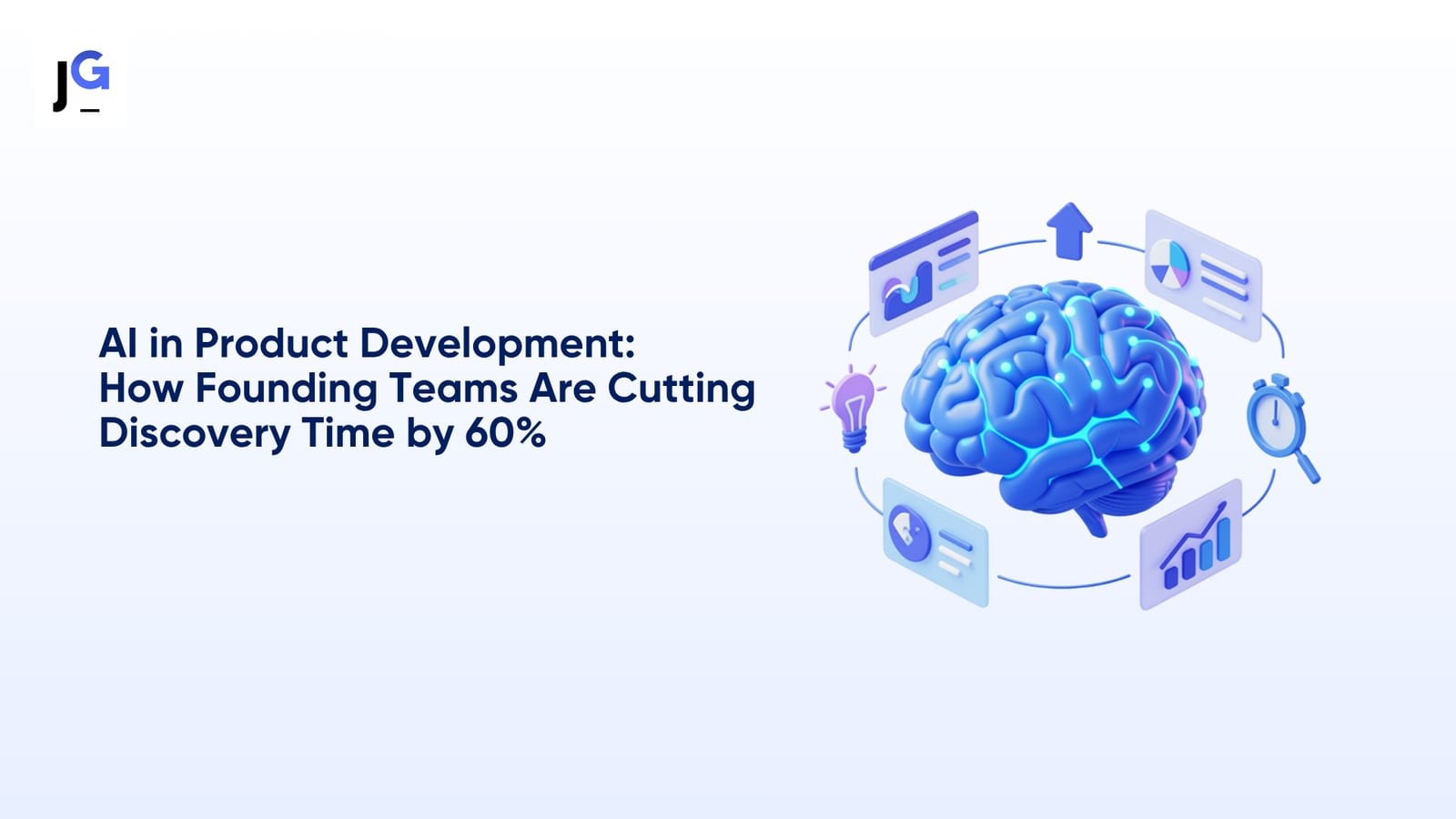
AI in Product Development: How Founding Teams Are Cutting Discovery Time by 60%
- Written by
- Hemant Madaan
- Published
- 17 July 2026
- Reading time
- 10 minutes
The Discovery Phase Is Where Most Products Die Quietly
About eight months ago a founding team came to us. Smart people. Real domain knowledge, a problem worth solving. They’d burned eleven weeks in discovery before writing a single line of code. Eleven weeks of user interviews, sticky-note sessions, contradictory Notion pages, and a Figma doc that kept getting rebuilt from scratch. By the time they reached out for product engineering services, the team was running on fumes and still couldn’t agree on a feature list with any real confidence.
That’s not a cautionary tale. That’s just a normal Tuesday for most early-stage teams working without structured AI tooling. Discovery has always been expensive in time and attention, and for a founding team watching runway shrink, it’s where momentum quietly bleeds out. So the question worth asking is whether AI agents actually change that math, or whether they’re just another layer of tooling that sounds better in a pitch deck than it works on a real project.
Honestly? It depends heavily on how you set it up. When the workflow is right, we’ve seen discovery timelines drop by more than half. Not because AI does your thinking. Because it handles the volume work that was burying your thinking in the first place.
What the Data Actually Says
The Nielsen Norman Group published research on AI-assisted UX workflows showing that synthesis tasks, specifically turning raw interview transcripts into structured insight, take experienced researchers an average of 60 to 90 minutes per participant when done manually. With AI-assisted tagging and pattern identification, that dropped to under 20 minutes in observed sessions. Their full position is worth reading directly at nngroup.com.
The Product-Led Alliance ran a practitioner survey in 2024 looking at where AI tools were genuinely being used inside product workflows, not just talked about. Fifty-eight percent of respondents had adopted AI for at least one discovery stage. Teams using AI-assisted synthesis reported a 40-55% reduction in time-to-first-validated-spec. Full methodology and findings are at productled.org. Those numbers track with what we see in client work, though I’ll be upfront that our internal benchmarks come from a smaller sample, so treat them as directional rather than statistically definitive.
The 60% figure in the headline is our observed median across roughly 20 founding team engagements over the past 18 months where we helped instrument AI-assisted discovery workflows before any development began. Median. Not the best-case outlier.
Breaking Down the Actual Workflow Stages
The table below shows where time actually goes in traditional discovery versus what happens when you embed AI agents at each stage. These are not theoretical numbers. They’re pulled from tracked hours across client projects where we had scope-of-work documentation to compare against real delivery timelines.
| Discovery Stage | Traditional Timeline | AI-Assisted Timeline | Primary AI Tool(s) Used | Time Saved |
|---|---|---|---|---|
| User interview scheduling and screening | 5-7 days | 1-2 days | Calendly AI, Dovetail intake forms | ~70% |
| Interview transcription and tagging | 3-5 hours per session | 20-35 minutes per session | Otter.ai, Dovetail AI synthesis | ~80% |
| Affinity mapping and theme clustering | 2-3 full days (team effort) | Half day with AI draft plus human review | Miro AI, Claude with custom prompts | ~65% |
| Competitive analysis write-up | 1-2 weeks | 2-3 days | Perplexity, custom GPT-4o agent | ~60% |
| Roadmap prioritization (RICE scoring) | 3-5 days of workshops | 1-day structured session with AI prep | Productboard AI, Claude | ~55% |
| Spec writing (first draft) | 1-2 weeks per feature set | 2-4 days per feature set | Notion AI, custom GPT with PRD templates | ~65% |
Interview synthesis is the single biggest unlock. Nothing else comes close in raw time savings per hour of input effort. If you’re a founding team doing your own research and you can only instrument one stage with AI tooling right now, start there before you touch anything else.
Where AI Actually Helps (And Where It Gets Founders Into Trouble)
Let me be direct about something. AI is genuinely good at volume tasks with clear structure: transcription, tagging, clustering, first-draft generation, scoring against defined criteria. It gets significantly less reliable when inputs are ambiguous or when the founder hasn’t yet developed a real mental model of who they’re building for and why. In those situations, AI-generated synthesis can create false confidence faster than almost any other tool I’ve seen. You end up with a polished-looking affinity map that represents noise, not signal.
We’ve watched this go badly when a team runs 15 user interviews, dumps the transcripts into Claude, gets back a beautifully organized set of themes, and treats that output as research. It isn’t. It’s a summary. The gap between those two things matters a lot. AI can find patterns in what people said. It cannot tell you whether you talked to the right people, or whether those people were just telling you what they figured you wanted to hear.
Teams that get real value from AI in product development treat it as an accelerant for human judgment, not a substitute for it. That sounds obvious. But operationally it means building actual review gates into your process, not just intending to review things. Every AI-generated output gets a human pass before it informs a decision. That takes more time than just trusting the model, but it catches the moments when the model confidently synthesizes something that’s simply wrong.
One specific failure mode worth naming: a client was using Claude heavily through their discovery phase, and partway through the engagement Anthropic updated the model. The behavioral shift was subtle but real. Outputs from the second half of synthesis had a noticeably different threshold for what counted as a distinct theme. Nobody caught it until we pulled early-phase and late-phase affinity maps side by side and something looked off. The lesson is that AI tooling inside a discovery workflow needs version pinning, or at minimum explicit prompt documentation so you can audit for consistency after the fact. A small operational detail that almost nobody thinks about until it bites them.
How This Changes the MVP Math for Startups
If you’re running a startup with 6-9 months of runway, discovery isn’t just a process question. It’s a capital allocation decision with a hard deadline attached. Every week in discovery is a week not building. Every week building the wrong thing is multiple weeks of remediation work that probably isn’t in your plan.
When we structure AI MVP development services for clients, embedding AI tooling into discovery from day one is not optional for us. Not as an afterthought once the research is done. The difference in time-to-first-prototype is consistent enough that we track it across projects now. A traditional discovery-to-prototype timeline for a mid-complexity product runs roughly 14-18 weeks. With AI-assisted discovery embedded throughout, we’re hitting 8-11 weeks for comparable scope on a regular basis.
That 6-7 week difference sounds abstract until you run the burn rate math. At $50k monthly overhead, you’re looking at $75k-$175k in preserved runway. In a startup MVP development context, that gap is often the difference between arriving at a fundraise with product validation in hand versus still explaining what you’re building to investors who want to see something working.
The Actual Tools and Prompting Workflow We Use
For teams wanting to implement this, here’s the rough stack we actually use with early-stage clients and the reasoning behind each choice.
- Dovetail for interview storage, AI tagging, and insight clustering. The tagging model is trained specifically on UX research data, which makes it noticeably better than general-purpose LLMs for this particular task. The auto-generated insight cards it produces are rough around the edges, but they’re a useful scaffold to react to rather than staring at a blank page.
- Claude via API with a pinned model version for synthesis prompts, affinity mapping review, and PRD first drafts. We’ve built a prompt library with explicit instructions on flagging uncertain versus confident outputs. This meaningfully reduces hallucination rates on edge cases where the data is thin.
- Productboard with AI assist for RICE scoring. Honest take here: their AI effort estimation suggestions are mediocre at best. But the prioritization framework itself, when pre-loaded with insight data from Dovetail, cuts workshop time significantly, and that’s where the actual value comes from.
- Perplexity for competitive analysis first passes, mostly because the citations let you verify claims quickly rather than chasing sources yourself. Faster than a manual search sweep by a wide margin.
Practical caveat on this stack: none of these tools integrate with each other in a way that feels intentional. You’re moving data between them manually or through Zapier in most cases. That friction is real. Budget roughly a half day per week for tooling overhead in a fully AI-assisted discovery workflow. Teams that don’t account for this time end up frustrated and wondering why the efficiency gains feel smaller than expected.
The prompt structure we use for spec writing is worth a brief mention because it’s not intuitive. Three passes: first pass generates a raw feature narrative from synthesis data. Second pass instructs the model to critique that narrative against the original user quotes, flagging anything that can’t be traced back to an actual user statement. Third pass is a human edit using both previous passes as input. This catches the moments when AI generates a feature rationale that sounds compelling but is, functionally, made up. It happens more than you’d expect, even with good source data.
For Teams Evaluating AI Product Development Services
If you’re evaluating vendors offering AI product development services, don’t ask whether they use AI tools. Everyone claims they do now. Ask them to show you their actual workflow documentation, their prompt libraries, and specific examples of where AI output was wrong and how they caught it. A team that can’t walk through that last part hasn’t seriously thought through where their failure modes live.
At JumpGrowth, we share discovery workflow documentation with clients at engagement start so there’s no ambiguity about which steps are AI-assisted and which are human-led. That transparency isn’t just good practice for its own sake. It makes the collaboration more useful because clients push back on synthesis outputs when something doesn’t match their domain knowledge, which is exactly the kind of input that keeps things from going sideways quietly.
The teams that get real value here stay engaged through discovery rather than handing it off entirely. AI reduces the time burden. It does not reduce the thinking burden. Worth keeping that distinction in mind before committing to any engagement model that promises full automation of your discovery phase. Full automation of discovery is a red flag, not a differentiator.
FAQ
01How much technical setup is required for AI-assisted product discovery?
Less than most teams expect. The core stack, Dovetail, Claude API, Productboard, can be stood up in under a week for a team with basic technical comfort. The bigger investment is building the prompt library and review checklists, which realistically takes 2-3 weeks to get to a repeatable state. If you’re working with a product engineering partner, they should bring a starter version of this to your engagement rather than making you build it from scratch. If they can’t, that’s worth noting.
02Does AI-assisted discovery work for very early stage startups, or is it better suited to teams with some existing product data?
Both, but the mechanics differ. Very early stage, the biggest value is synthesis speed during the interview phase. You’re generating insight faster, so you can run more iteration cycles inside the same time window. For teams with existing product data, think analytics, support tickets, past research, AI tools add pattern detection across historical data that’s genuinely hard to do manually at any reasonable scale. Time savings show up in both situations, just from different angles.
03What’s the biggest mistake founding teams make when adding AI to their product workflow?
Skipping the review gates. Not even close as the most common failure. The second-biggest mistake is adding too many tools at once. Pick one stage, instrument it properly, build review habits around it, then expand from there. Teams that try to AI-assist every discovery stage simultaneously usually end up with fast but unreliable outputs, which creates more rework than they saved in the first place.
Keep reading
- Startups
AI MVP Development in 2026: How Startups Can Ship a Working Product in Under 8 Weeks
11 minutes readRead article - Startups
Why Hiring Nearshore Developers is a Game-Changer for Tech Startups
6 minutes readRead article - Software Development
What Is Reverse Engineering in Software Development? Process, Benefits, Challenges, and Use Cases
14 minutes readRead article
Build your team
Share where the roadmap is blocked and the capabilities you need. We’ll map a practical team and delivery model.
Comments
Be the first to comment.