

- Software Development
What Is Reverse Engineering in Software Development? Process, Benefits, Challenges, and Use Cases
- Written by
- Hemant Madaan
- Published
- 19 October 2026
- Reading time
- 14 minutes

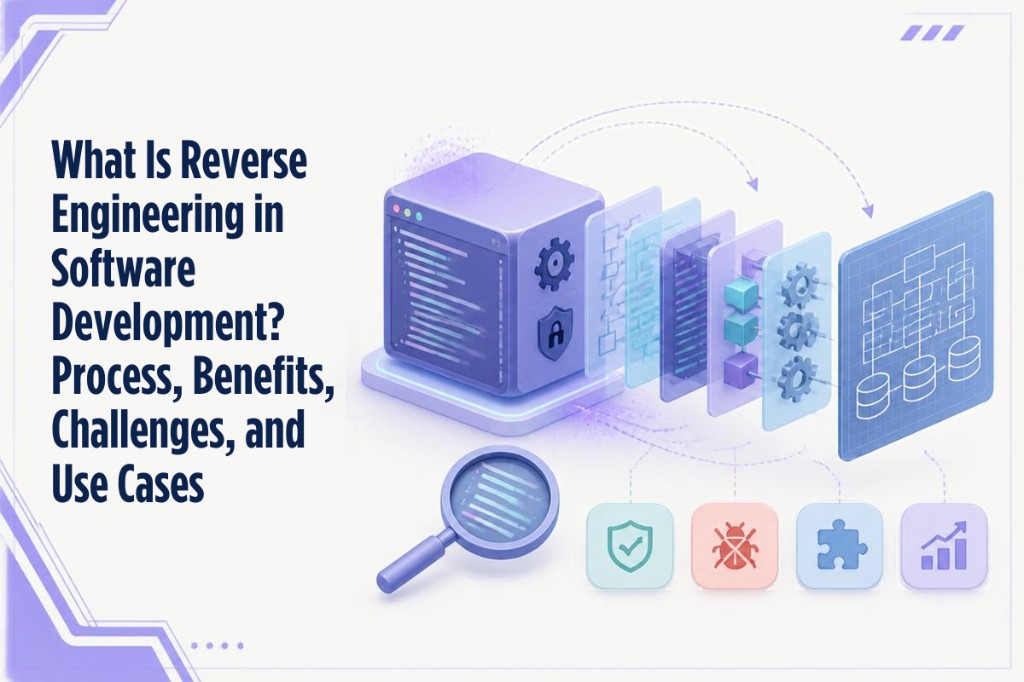
Every engineering leader eventually inherits a system nobody fully understands. The billing service was written by a contractor who left years ago. A partner integration works, but no one can explain its message format. The desktop tool operations depends on has no source code in any repository you can find.
You cannot safely modernize, integrate, secure, or replace software you do not understand. That is the problem reverse engineering solves.
The short answer: reverse engineering in software development is the disciplined analysis of an existing system, whether source code, compiled binaries, running software, or only its interfaces, to identify its components, relationships, and behavior and document them at a higher level of abstraction. Organizations use it to recover lost knowledge before modernizing legacy applications, building integrations, investigating defects, and performing authorized security assessments.
What Is Reverse Engineering in Software Development?
Software reverse engineering is the process of analyzing an existing software system to identify its components and how they interact, and to represent that system in another form or at a higher level of abstraction, such as architecture diagrams, data models, interface specifications, or documented business rules.
That definition follows the one Elliot Chikofsky and James Cross set out in their widely cited 1990 IEEE Software paper, "Reverse Engineering and Design Recovery: A Taxonomy". Their framing makes a key point: reverse engineering is examination, not modification. Changing the system is a separate step the taxonomy calls reengineering.
In practice, engineers study an application, executable, service, or component to answer questions like: What are the major modules and dependencies? What data does it read and write? Which business rules live in the logic? How does it talk to other systems?
Reverse engineering is also not copying. Analyzing a legacy claims engine to document its rules before rebuilding it is reverse engineering. Lifting proprietary code into a competing product is something else, and likely infringes someone's rights.
How Does Software Reverse Engineering Work?
A well-run reverse engineering process usually follows seven steps:
- Define the objective and scope. "Understand the system" is not a scope. "Document every outbound integration and its data contract before the cloud migration" is.
- Collect available artifacts. Gather source code (even partial), binaries, build scripts, configuration, schemas, logs, old tickets, and dependency manifests. Interview the people who operate the system.
- Analyze the architecture and components. Map deployable units, modules, libraries, data stores, and external connections.
- Examine code, runtime behavior, data flows, and interfaces. Combine static and dynamic techniques to see what the code says and what it actually does.
- Recover design information and dependencies. Produce component diagrams, call graphs, data lineage, interface specs, and extracted business rules.
- Validate findings through controlled tests. If you believe a calculation rounds per line rather than per invoice, prove it with test inputs in a non-production environment.
- Document results and recommend next steps. Record what was verified, what was inferred, and what remains unknown.
The workflow depends on your starting point. With source code but no documentation, the work is mostly code analysis and architecture recovery. With only compiled binaries, engineers rely on slower, more specialized binary analysis. With running software, dynamic observation reveals actual behavior. With only interfaces, engineers infer behavior from requests, responses, and contracts.
Common Reverse Engineering Techniques
Each technique answers a different question, and each has blind spots, so experienced teams combine them.
Static code analysis examines code or binaries without running them to reveal structure, control flow, dead code, and risky patterns. It is the natural starting point when source exists, but it cannot reliably show which paths run in production and often misses reflection or configuration-driven logic.
Dynamic analysis and runtime observation uses debuggers, tracing, profiling, and logging to study software while it runs. It shows real execution paths and state changes, but only for the inputs you trigger; rare cases such as year-end processing may never appear.
Disassembly and decompilation translate machine code into assembly, then attempt to produce higher-level, C-like or Java-like code. They are essential when source is missing. However, compilation discards names, comments, and much of the original structure, so decompiled output is a reconstruction that analysts must interpret, not the original source code, and it is rarely maintainable as-is.
Dependency and call-graph analysis maps which functions, modules, and libraries depend on each other, exposing tight coupling and outdated packages. Static graphs can miss calls made through dependency injection or message queues, so confirm them with runtime evidence.
Protocol and API behavior analysis inspects network traffic or API calls to infer message formats, sequences, and authentication flows. This API reverse engineering is central to interoperability work, though encryption and rarely triggered messages leave gaps, and third-party services require authorization.
Database schema and data-flow analysis traces stored procedures, triggers, views, and implicit relationships. Many legacy applications keep critical business logic in the database, but column names can mislead, so meaning often needs business confirmation.
Architecture and component mapping synthesizes findings into a model of services, layers, data stores, and integrations. This is software architecture recovery, and it describes what the system is, which often differs from what anyone intended.
Why Businesses Use Reverse Engineering
Most business reverse engineering is a practical response to missing knowledge. Typical scenarios include:
- Understanding undocumented legacy systems, such as an aging .NET dispatch application whose vendor no longer supports it.
- Modernizing applications, where teams must know everything the current system does, including behavior nobody wrote down.
- Replacing obsolete components, like an end-of-life database driver, by finding every place it is used.
- Improving interoperability with a system whose interface was never documented.
- Recovering architectural knowledge after turnover or an acquisition.
- Investigating defects buried in compiled dependencies.
- Supporting authorized security assessments of software you own or are permitted to test.
- Evaluating technical debt before a migration with evidence rather than estimates.
This is not a niche problem. A July 2025 US Government Accountability Office report identified 11 critical federal legacy systems roughly 23 to 60 years old; eight used outdated programming languages, and two had no modernization plan. Private companies face smaller versions of the same issue.
Reverse Engineering Tools and Technologies
Choose reverse engineering tools by the artifact you are analyzing and the question you need answered.
| Category | Example tools | What they support | Expertise required |
|---|---|---|---|
| Binary analysis | Ghidra, IDA Pro | Disassembly, decompilation to pseudocode, annotation, scripted analysis | High: assembly, compilers, CPU architectures |
| Android and Java bytecode | JADX | Decompiling APK, DEX, JAR, and AAR files to Java; browsing resources | Moderate: Java and Android internals |
| Network and protocol inspection | Wireshark | Capturing live traffic, decoding protocols, filtering packets | Moderate: networking |
| Debugging | GDB, language-specific debuggers | Stopping execution on conditions, inspecting and changing program state | Moderate to high |
| Static and dependency analysis | Language-specific static analyzers, software composition analysis tools | Code quality, call graphs, library inventories, known vulnerabilities | Moderate |
A few verified specifics: Ghidra was created by the National Security Agency's Research Directorate, is open source under the Apache 2.0 license, and can be extended with Java or Python scripts. IDA Pro is Hex-Rays' commercial disassembler and decompiler, with a free edition for basic evaluation. JADX includes optional deobfuscation, but obfuscated apps still need careful interpretation. Wireshark is passive; its guide notes it does not manipulate the network and is not an intrusion detection system.
Tools do not replace judgment. Ghidra will generate pseudocode for almost any binary, but deciding what a function means for the business still takes an experienced engineer.
Benefits and Limitations of Reverse Engineering
Benefits include replacing tribal knowledge with documented facts, surfacing hidden integrations before they break a migration, discovering outdated or undocumented dependencies, and letting leaders choose between refactoring, replatforming, and replacement based on evidence.
Limitations are just as real:
- Design intent is only partly recoverable. Analysis shows what code does, not always why. An odd conditional may be a business rule, a workaround, or a bug.
- Complex dependencies across services and shared databases make behavior hard to isolate.
- Costs add up, especially for binary-level work requiring scarce skills.
- Limited observability leaves dynamic analysis little to observe.
- Reconstruction is uncertain. Every model is a hypothesis until validated.
Most importantly, reverse engineering produces understanding, not maintainable replacement software. Recovered diagrams and rules are inputs to design; a well-tested replacement still has to be engineered.
Reverse Engineering vs. Forward Engineering
Chikofsky and Cross describe forward engineering as moving from high-level designs to a physical implementation. Reverse engineering runs the other way.
| Dimension | Reverse engineering | Forward engineering |
|---|---|---|
| Starting point | An existing system | Requirements and business goals |
| Primary objective | Understand and document what exists | Design and build what is needed |
| Typical inputs | Code, executables, logs, schemas, traffic, interviews | Requirements, user research, architecture decisions |
| Expected outputs | Architecture models, dependency maps, interface specs, business rules | Working, tested software |
| Common use cases | Legacy analysis, interoperability, defect investigation, security review | New products, features, replacement systems |
| Main challenges | Missing information, ambiguity, validation effort | Unclear requirements, scope change, delivery risk |
During modernization, they work together: reverse engineering establishes the "as-is" system, and forward engineering builds the "to-be" system. The taxonomy calls the combination reengineering.
Risks, Legal Considerations, and Best Practices
This is general information, not legal advice. Consult qualified counsel for your situation and jurisdiction.
Legality depends on jurisdiction, purpose, contracts, and method. Three reference points show how much context matters:
- United States:17 U.S.C. § 1201(f) lets a person with the lawful right to use a program circumvent technical protections solely to analyze elements needed for interoperability with an independently created program, within stated limits. Courts have also found some reverse engineering to be fair use, notably in Sega v. Accolade (1992).
- Contracts: In Bowers v. Baystate Technologies (2003), the Federal Circuit held a shrink-wrap license's anti–reverse engineering clause enforceable, even though the activity might otherwise have been fair use.
- European Union:Article 6 of Directive 2009/24/EC permits decompilation by a lawful user only when necessary for interoperability, limited to the necessary parts, and bars using the results to build a substantially similar program.
Best practices:
- Confirm IP ownership and license terms before analysis begins, and review vendor, SaaS, and acquisition contracts for restrictions.
- Use masked or synthetic data; logs, databases, and traffic captures often contain personal information.
- Grant least-privilege access and keep findings in controlled repositories.
- Label every finding verified, inferred, or unknown, and link it to supporting evidence.
- Analyze unknown or potentially unsafe binaries in isolated virtual machines with no access to production networks.
- Obtain written authorization before analyzing or testing any third-party system.
When Should a Business Consider Reverse Engineering?
It is likely useful when critical knowledge is missing: source code is lost or incomplete, documentation is stale, original developers are gone, a vendor has ended support, or you must integrate with an undocumented system.
Documentation or code review may be enough when complete source exists, the original team is available, tests are in place, and the question is narrow.
A broader application modernization assessment fits better when the real question is strategic: refactor, replatform, or replace, at what cost, and in what order. Reverse engineering then becomes one input alongside business priorities and operating costs.
Quick checklist
- Is complete, buildable source code in a repository you control?
- Is the current architecture documented and accurate?
- Can someone explain its key business rules?
- Are all integrations and data consumers known?
- Do automated tests cover critical behavior?
- Are its dependencies supported and patched?
- Do you have the legal right to analyze every component in scope?
Several "no" answers to questions 1–6 suggest reverse engineering should precede any modernization. A "no" on question 7 means talking to counsel first.
How Reverse Engineering Supports Software Modernization
Recovered knowledge feeds each modernization path:
- Application replatforming: Dependency maps show which components move together and which assumptions, such as local file paths or OS-specific APIs, will break.
- Legacy code refactoring: Call graphs and characterization tests let teams refactor without silently changing behavior.
- API integration: Recovered interface specs let teams wrap a legacy system with a documented API instead of rebuilding it immediately.
- Cloud migration: Integration and data-flow inventories reveal shared databases and batch jobs that shape migration sequencing.
- Replacing unsupported components: Usage analysis shows the true blast radius of removing an outdated library.
- AI-assisted development and documentation: Large language models can speed up summarizing unfamiliar code, but their output is inference, not evidence.
That last point applies to human analysts too. Treat any AI-generated explanation or engineer's educated guess as a hypothesis until a test, trace, or subject-matter expert confirms it. Modernization projects get into trouble when assumptions are quietly promoted to requirements.
How JumpGrowth Can Help
JumpGrowth is a Texas-based software engineering company that builds and runs product engineering teams. Two parts of its work apply directly to inherited systems:
- Production teams that take over live codebases, starting with a guided handover sprint in which engineers read the code, pipelines, and incident history before making changes.
- Product discovery that maps architecture, APIs, data, and integrations before engineering begins, with diagrams and documentation your team keeps.
JumpGrowth can also add specialist developers, including .NET, Java, QA, and DevOps engineers, to an existing team. If you are unsure what your system needs, book a discovery call.
Frequently Asked Questions
What is reverse engineering in software development?
It is the process of analyzing an existing system to identify its components, relationships, and behavior, and documenting it at a higher level of abstraction to support maintenance, integration, security review, or modernization.
What are the main steps in software reverse engineering?
Define scope, collect artifacts, analyze architecture, examine code and runtime behavior, recover design and dependencies, validate findings with controlled tests, and document results with recommendations.
What tools are used for software reverse engineering?
Common tools include Ghidra and IDA Pro for binary analysis, JADX for Android and Java bytecode, Wireshark for protocol inspection, GDB for debugging, and language-specific static and dependency analyzers.
What is the difference between reverse engineering and decompilation?
Decompilation is one technique that converts compiled code into higher-level pseudocode. Reverse engineering is the broader process, which also includes static and dynamic analysis, traffic inspection, schema analysis, and architecture recovery.
Can reverse engineering recover the original source code?
Usually not exactly. Compilation removes comments, names, and structure, so decompilers produce an approximation analysts must interpret. Behavior and design knowledge can be recovered; a perfect copy of the original source generally cannot.
How does reverse engineering help modernize legacy applications?
It reveals architecture, dependencies, integrations, data flows, and business rules, which reduces surprises during refactoring, replatforming, cloud migration, or replacement.
Is software reverse engineering legal?
It depends on jurisdiction, purpose, license terms, and method. US and EU law include interoperability allowances, but contracts can restrict reverse engineering, and third-party systems require authorization. Consult a lawyer for your situation.
Conclusion
Reverse engineering turns opaque software into documented, testable knowledge, reducing uncertainty before integration, security review, or modernization. It cannot fully recover original intent, and decompiled code is not production-ready source, so success depends on expertise, authorization, validation, and disciplined documentation.
If your team depends on a system it cannot fully explain, talk to JumpGrowth about assessing it and planning what comes next.
Sources and References
- Chikofsky, E. J., and Cross, J. H., "Reverse Engineering and Design Recovery: A Taxonomy," IEEE Software, 1990 — definitions of reverse engineering, forward engineering, design recovery, redocumentation, and reengineering. Terminology summary (Georgia Tech) · Paper summary (PDF)
- US Government Accountability Office, GAO-25-107795: Agencies Need to Plan for Modernizing Critical Decades-Old Legacy Systems (July 2025) — 11 critical systems roughly 23–60 years old; eight using outdated languages; two without modernization plans.
- 17 U.S.C. § 1201, Legal Information Institute, Cornell Law School — § 1201(f) interoperability provision.
- Lee A. Hollaar, Legal Protection of Digital Information, Chapter 4 — discussion of § 1201(f), Sega v. Accolade, and Atari v. Nintendo.
- WilmerHale, Shrink-Wrap Licenses and Reverse Engineering (2003) — analysis of Bowers v. Baystate Technologies.
- Directive 2009/24/EC, Article 6 (Decompilation) — EU conditions for decompilation for interoperability.
- National Security Agency, Ghidra repository — open-source software reverse engineering framework (Apache 2.0).
- Hex-Rays, About Hex-Rays and IDA — IDA Pro disassembler and decompiler; IDA Free.
- JADX repository — Dex-to-Java decompiler.
- Wireshark Foundation, Wireshark User's Guide — packet analyzer capabilities and stated limits.
- GNU Project, GDB directory entry — debugger capabilities.
Keep reading
- Software Development

Product Engineering Services in 2026: What They Actually Include (And What to Demand from a Partner)
11 minutes readRead article - Software Development
Custom Software Development Company vs. In-House Team: A 2026 Cost and Risk Analysis
11 minutes readRead article - Software Development
JumpGrowth vs. Other Dallas Software Development Companies: How to Evaluate Your Options in 2026
10 minutes readRead article
Build your team
Share where the roadmap is blocked and the capabilities you need. We’ll map a practical team and delivery model.
Comments
Be the first to comment.