- Technology Tips
Best Bug Bounty Programs for Developers in 2026: Top 14 Companies, Rewards, and Platforms
- Written by
- JumpGrowth
- Published
- 25 November 2026
- Reading time
- 29 minutes

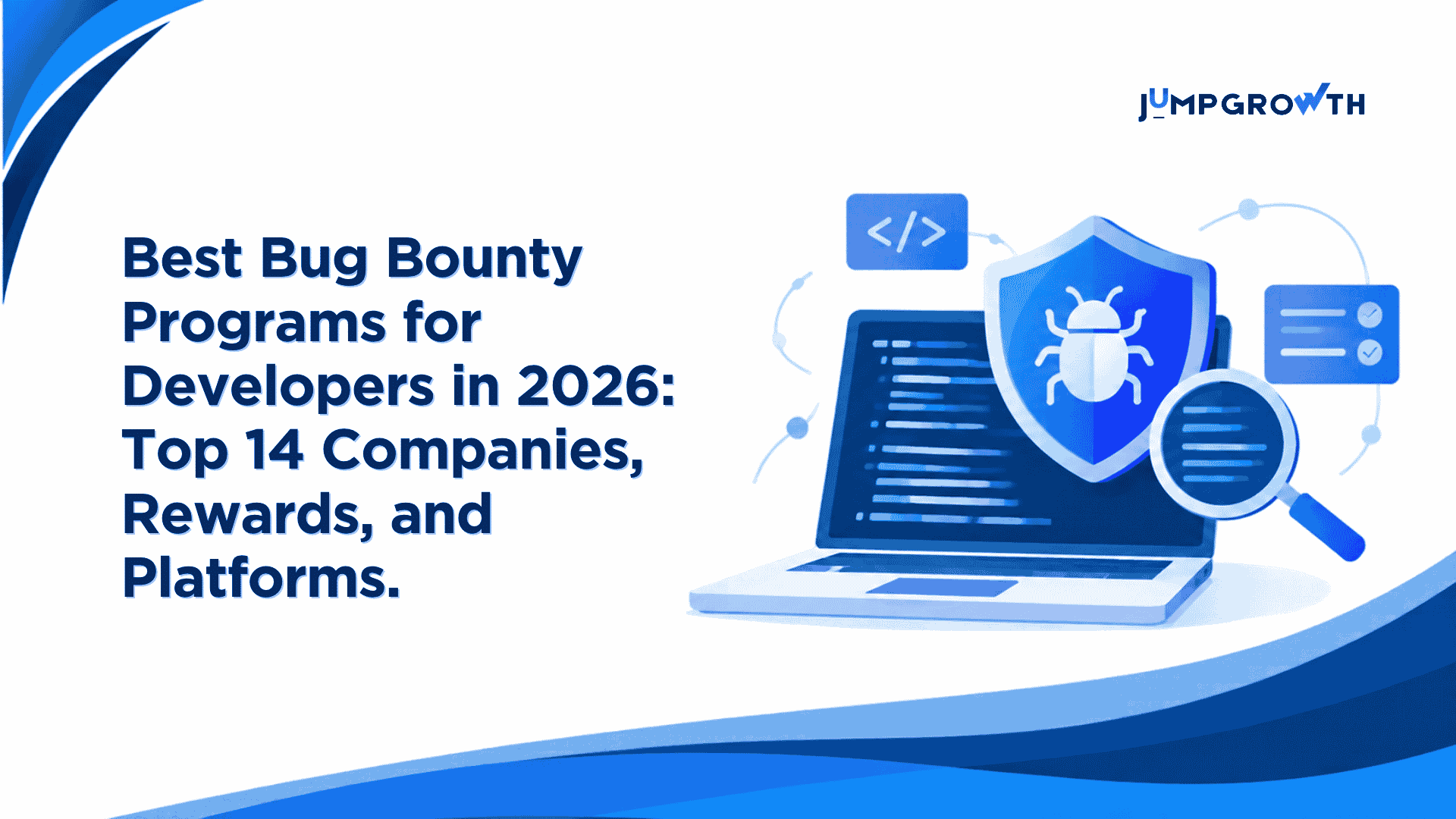
The best bug bounty programs for developers in 2026 are Apple Security Bounty (up to $2,000,000 base), Google's Android and Google Devices VRP (up to $1,500,000), Samsung Mobile Security Rewards (up to $1,000,000), Meta (up to $300,000), and Microsoft (up to $250,000) for the highest ceilings, while Shopify, PayPal, Mozilla, Atlassian, and GitHub offer the clearest entry points for web and API developers. But the headline numbers mislead: those maximums apply to rare, fully weaponized exploit chains, and 2026 has been a year of restructuring, with GitHub halving public payouts, Google cutting many Chrome rewards, and OpenAI raising its critical tier, largely in response to a surge of AI-assisted reports (secondary coverage of HackerOne's 2026 data cites a 76% year-over-year jump in submissions through March 2026).
Organizations invite ethical hackers to test their products because no internal team can anticipate every attack path. Cloud services, public APIs, mobile apps, and now AI agents that read email and execute code have expanded the attack surface faster than security teams can grow. Bug bounty programs turn that gap into a structured, legal collaboration: companies publish rules and scope, and researchers who find qualifying vulnerabilities get paid.
For developers, the value goes beyond cash. Hunting bugs teaches you how real systems fail, which makes you a better engineer. This guide covers what bug bounties are, a verified comparison of 14 major programs, the platforms that host them, realistic earnings, the bug bounty vs VDP distinction, AI security research, beginner recommendations, skills, tools, and a 90-day roadmap.
What Is a Bug Bounty Program?
A bug bounty program is a published offer from an organization to pay independent security researchers for privately reporting qualifying security vulnerabilities in specified products, under defined rules.
Every legitimate program has four building blocks:
- Scope: the exact assets you may test (domains, apps, APIs, devices) and those you may not.
- Rules of engagement: prohibited actions, such as accessing other users' data, denial-of-service testing, or social engineering.
- Reward structure: payouts tied to severity and demonstrated impact, usually from Low to Critical.
- Safe harbor: a commitment not to pursue legal action against researchers who follow the rules in good faith.
Responsible (or coordinated) disclosure means you report privately, give the company time to fix the issue, and only publish details when the program allows it.
Finding a bug is not the same as reporting an eligible vulnerability. A broken button, a typo in an error message, or a missing security header may be a bug, but it usually is not a reward-eligible vulnerability. Eligibility requires that the issue is in scope, has a demonstrable security impact, is not a known or excluded issue, and is reported first.
Practical example: A developer testing their own account on an in-scope SaaS app notices that changing a numeric ID in an API request returns an invoice belonging to a different test account they also control. They stop there, document the request and response using only their own accounts, explain the access-control root cause, and submit a report. They do not enumerate real customers' invoices. That restraint is the difference between authorized research and unauthorized access.
Top 14 Bug Bounty Programs in 2026
The table below compares each program's maximum advertised reward, scope, and access model. Programs are listed in the order of our research shortlist, not ranked purely by payout.
| Company | Bug Bounty Program | Maximum Advertised Reward | Main Scope | Participation | Official Program |
|---|---|---|---|---|---|
| Apple | Apple Security Bounty | $2,000,000 base (bonuses can exceed $5M) | iOS, macOS, iCloud, WebKit, Private Cloud Compute | Public | security.apple.com/bounty |
| Android & Google Devices VRP / Google Bug Hunters | $1,500,000 (Pixel Titan M zero-click with persistence) | Android, Pixel, Chrome, Cloud, AI products | Public | bughunters.google.com | |
| Samsung | Mobile Security Rewards Program | $1,000,000 | Galaxy devices, Knox Vault, Samsung mobile apps/services | Public | security.samsungmobile.com |
| Meta | Meta Bug Bounty | $300,000 | Facebook, Instagram, WhatsApp, Messenger, Meta AI | Public | bugbounty.meta.com |
| Microsoft | Microsoft Bounty Programs | $250,000 (Hyper-V) | Windows, Hyper-V, Azure, M365, Copilot, Identity | Public (Zero Day Quest live event is invite-based) | microsoft.com/msrc/bounty |
| Shopify | Shopify Bug Bounty | $200,000 | Core commerce platform, admin, checkout, Shop app | Public (HackerOne) | hackerone.com/shopify |
| OpenAI | OpenAI Security Bug Bounty | $100,000 base; up to ~$172,000 with bonuses | ChatGPT, Codex, API Platform, infrastructure | Public (Bugcrowd); separate Safety Bug Bounty by application | bugcrowd.com/openai |
| Salesforce | Salesforce Bug Bounty | Not publicly specified (highest paid: $60,000) | Salesforce cloud products, AI agents | Invitation-based via HackerOne (verify access) | security.salesforce.com |
| Anthropic | Model Safety Bug Bounty + public security bounty (HackerOne) | $35,000 per universal jailbreak; security bounty max not publicly specified | Claude.ai, API, Claude Code, SDKs, MCP integrations; safety classifiers | Security bounty public; Model Safety by application/invite | HackerOne / support.claude.com |
| PayPal | PayPal Bug Bounty | $30,000 | PayPal, Braintree, Venmo, Xoom, Hyperwallet | Public (HackerOne) | hackerone.com/paypal |
| Mozilla | Client Bug Bounty | $20,000 (+50% mitigation-bypass bonus) | Firefox desktop, Android, iOS | Public | mozilla.org/security |
| Adobe | Adobe Bug Bounty on Intigriti | $15,000 (per third-party trackers; confirm on Intigriti) | Adobe web apps, cloud, mobile, AI features | Public (Intigriti since Sept 1, 2026) | intigriti.com |
| Atlassian | Atlassian Bug Bounty | $12,000 (Tier 1 P1) | Jira, Confluence, Bitbucket, Trello, Rovo AI, Loom, Forge | Public (Bugcrowd) | bugcrowd.com/engagements/atlassian |
| GitHub | GitHub Security Bug Bounty | $10,000 public critical; $30,000+ invite-only VIP tier | GitHub.com, Actions, Copilot | Public tier + invite-only VIP (HackerOne) | bounty.github.com |
Maximum rewards represent the highest advertised payouts under specific program conditions. Actual payments depend on eligibility, vulnerability severity, impact, scope, duplication policies, and program rules.
1. Apple Bug Bounty Program
Overview: Apple overhauled the Apple Security Bounty in October 2025 (effective November 2025), doubling its top award and refocusing on exploit chains comparable to mercenary spyware. Apple says it has paid more than $35 million to over 800 researchers since opening the program to all researchers.
- Eligible products: iOS, iPadOS, macOS, WebKit/Safari, iCloud, wireless stacks, and related Apple platforms.
- Maximum reward: $2,000,000 for a zero-click remote exploit chain; bonuses for Lockdown Mode bypasses and beta-software findings can push totals above $5 million.
- Special categories: up to $1,000,000 for wireless proximity exploits and for broad unauthorized iCloud access; $300,000 for a one-click WebKit sandbox escape (up to $1,000,000 if extended to unsigned code execution with arbitrary entitlements); $100,000 for a full macOS Gatekeeper bypass. "Target Flags" let researchers prove capabilities objectively for accelerated awards.
- Eligibility notes: Top rewards apply only to the latest publicly available software and hardware. Individual chain components still earn smaller rewards.
- Reporting: submit through the Apple Security Research site with full reproduction details.
- Exclusions: issues in outdated software and theoretical findings without demonstrated outcome earn less or nothing.
- Last verified: November 2026.
2. Google Vulnerability Reward Programs
Overview: Google runs multiple VRPs through its Bug Hunters portal. Google's VRP 2025 Year in Review reports a record $17.1 million paid to 747 researchers in 2025, with a top single reward of $250,000. In May 2026 it restructured the Android and Chrome programs in response to AI-generated submissions, prioritizing high-impact bugs that AI tools struggle to find.
- Eligible products: Android and Pixel, Chrome, Google Cloud, Google web services, and AI products (Gemini Apps, Search, Workspace).
- Maximum reward: $1,500,000 for a zero-click Pixel Titan M exploit with persistence (up from $1,000,000); $750,000 without persistence; $375,000 for secure-element data exfiltration.
- Chrome: full-chain exploits remain eligible for up to $250,000, plus an equal MiraclePtr bypass bonus, but the base reward for memory-safety bugs dropped to $500 with multipliers.
- AI VRP: launched October 2025, with base rewards up to $20,000 for "rogue actions" on flagship products and up to $30,000 with quality and novelty multipliers.
- Reporting: concise reproducers and proposed patches are now strongly incentivized.
- Exclusions: jailbreaks, direct prompt injection, and alignment issues are explicitly out of scope for the AI VRP; Google asks researchers to report them via in-product feedback.
- Last verified: November 2026.
3. Samsung Mobile Security Rewards Program
Overview: Samsung's program, launched in 2017, pays between $200 and $1,000,000 for qualified reports, with Samsung alone determining severity and amount.
- Eligible products: Samsung mobile devices (smartphones, tablets, wearables, PCs) on the latest available firmware, active Samsung Mobile services, Samsung-signed apps, and eligible third-party apps built for Samsung Mobile.
- Maximum reward: $1,000,000 for remote code execution in Knox Vault, the isolated hardware environment that stores biometric data and cryptographic keys.
- Special categories: Samsung's Important Scenario Vulnerability Program lists tiers such as $300,000 for local Knox Vault execution and $100,000 for remote arbitrary app installation from an unofficial source.
- Eligibility notes: top-tier claims require a buildable exploit that works reliably on the latest security update of flagship models.
- Payment timing: payout can take two months or more after the rewards process starts.
- Last verified: November 2026.
4. Meta Bug Bounty Program
Overview: Meta publishes detailed payout guidelines by category, with asterisked maximums that can include bonuses.
- Eligible products: Facebook, Instagram, WhatsApp, Messenger, Threads, Meta AI, Meta hardware, and WhatsApp Private Processing.
- Maximum reward: up to $300,000 for full mobile remote code execution (0-click paid at 1x, 1-click at 0.75x) and for WhatsApp Private Processing TEE code execution or VM escape.
- Other categories: account takeover up to $130,000; Meta AI access to private user content up to $130,000; prompt smuggling up to $5,000; hardware RCE up to $45,000.
- Eligibility notes: maximum RCE payouts require a robust proof of concept on one of the last three major Android versions or a currently supported iOS version, demonstrating arbitrary code execution rather than a crash.
- Last verified: November 2026.
5. Microsoft Bug Bounty Programs
Overview: Microsoft operates a family of product-specific programs under the Microsoft Security Response Center (MSRC), each with its own scope and award table.
- Eligible products: Hyper-V, Windows, Azure, Microsoft 365, Copilot, Dynamics 365 and Power Platform, Microsoft Identity, and more.
- Maximum reward: up to $250,000 for a Hyper-V critical RCE with a functioning exploit and a complete report; the same RCE without a working exploit is capped at $200,000, and an incomplete report at $20,000.
- Cloud and events: cloud programs and Zero Day Quest findings are capped at $100,000 per vulnerability; Zero Day Quest 2026 carried up to $5 million in total potential awards.
- Reporting: Microsoft explicitly rewards complete reports with clear reproduction steps and proof-of-concept code.
- Last verified: November 2026.
6. Shopify Bug Bounty Program
Overview: Shopify runs one of the most transparent public programs on HackerOne, scoring reports with its own CVSS-based Bug Bounty Calculator.
- Eligible assets: core assets such as admin.shopify.com, accounts.shopify.com, partners.shopify.com, checkout, shop.app, and your-store.myshopify.com test stores; non-core assets are scored with lower requirements.
- Maximum reward: $200,000 for a Critical vulnerability. Published ranges: Low $500–$1,000; Medium $1,000–$14,000; High $14,000–$50,000; Critical $50,000–$200,000.
- Reality check: only about 2.5% of rewarded submissions were Critical, while roughly 56% were Medium; HackerOne lists Shopify's average bounty range at $500–$900 and total bounties paid at more than $10.4 million.
- Last verified: November 2026.
7. OpenAI Bug Bounty Program
Overview: OpenAI runs two separate Bugcrowd programs: the Security Bug Bounty for traditional vulnerabilities and the Safety Bug Bounty, launched in March 2026, for AI abuse and safety risks.
- Eligible products: ChatGPT, Codex, the API Platform, and OpenAI infrastructure.
- Maximum reward (November 2, 2026 update): up to $30,000 for a critical vulnerability in a core product; exceptional critical findings remain eligible for a $100,000 base, rising to about $172,000 with quality, priority-campaign, and loyalty bonuses ($100,000 × 1.15 × 1.30 × 1.15 = $171,925).
- Safety Bug Bounty: accepts reproducible agentic risks and abuse scenarios that are not conventional security bugs; submissions may be rerouted between the two programs.
- Exclusions: model jailbreaks and safety bypasses are not handled by the Security program; they belong in the Safety program or are out of scope.
- Last verified: November 2026.
8. Salesforce Bug Bounty Program
Overview: Salesforce launched one of the first enterprise invitation-only bounty programs in 2015 and runs it with HackerOne. It has invested over $30.4 million in the program.
- 2025 results: more than $6.2 million paid to 696 researchers for over 4,000 reports, the program's biggest year.
- Maximum reward: Not publicly specified. Salesforce states individual payouts have reached $60,000, which is a historical high, not an advertised cap.
- Participation: historically invitation-based; check Salesforce's security site and HackerOne for current eligibility before testing.
- Last verified: November 2026.
9. Anthropic Security Reporting and Bounty Programs
Overview: Anthropic now runs two distinct tracks.
- Public security bug bounty (HackerOne, launched May 2026): replaced its 2024 VDP. Rewards are determined by CVSS severity. Scope includes Claude.ai, the Anthropic API, Claude Code, official desktop and mobile clients, SDKs, internal infrastructure, and Anthropic-developed MCP integrations and Chrome extensions. Exclusions include third-party MCP servers, archived open-source repositories, social engineering, and low-severity informational findings. Maximum reward: Not publicly specified in sources reviewed.
- Model Safety Bug Bounty (application required): pays up to $35,000 per novel, universal jailbreak that defeats Anthropic's Constitutional Classifiers and reveals substantial harmful information, judged at Anthropic's sole discretion. Accepted researchers receive a HackerOne invite and a free model alias for authorized red-teaming.
- Last verified: November 2026.
10. PayPal Bug Bounty Program
Overview: PayPal's public HackerOne program covers a broad payments footprint.
- Eligible assets: *.paypal.com, Braintree, Venmo, Xoom, Hyperwallet, PayPal and Braintree SDKs, and PayPal mobile apps.
- Maximum reward: $30,000 (minimum $50). Ranges: Low $50–$1,000; Medium $1,000–$10,000; High $10,000–$20,000; Critical $20,000–$30,000.
- Fixed payouts: XSS is paid from $50 up to $6,000 depending on severity; subdomain takeover from $200 to $5,000.
- Eligibility notes: only the first valid reporter is paid, and rewards are based on demonstrated impact rather than CVSS alone. Sites scheduled for deprecation are ineligible.
- Last verified: November 2026.
11. Mozilla Security Bug Bounty Program
Overview: Mozilla has paid security bounties since 2004, making it one of the oldest programs on the internet.
- Eligible products: Firefox desktop, Firefox for Android, and Firefox for iOS in main development or release versions.
- Maximum reward: $20,000 for highest-impact bugs, including sandbox escapes; $10,000 for higher-impact and $3,000 for high-impact issues.
- Bonus: bypassing an exploit mitigation adds 50% to the payout.
- Reporting: via Bugzilla; payouts are decided by the Mozilla Bounty Committee and improve when researchers help developers resolve the issue.
- Last verified: November 2026.
12. Adobe Bug Bounty Program
Overview: Adobe moved its bug bounty program to Intigriti on September 1, 2026; all new reports must be submitted there.
- Eligible assets: Adobe web applications, cloud services, mobile apps, and AI features (per program listing).
- Maximum reward: third-party trackers list a $75–$15,000 range, with top rewards for critical issues on Tier 1 assets. We could not verify the amount directly on Adobe's Intigriti page, so confirm it before relying on it.
- Last verified: November 2026 (platform move confirmed by Adobe; reward range secondary).
13. Atlassian Bug Bounty Program
Overview: Atlassian runs a public program on Bugcrowd with tiered rewards that favor its core cloud products.
- Eligible products: Jira, Confluence, Bitbucket, Trello cloud products (Tier 1), plus Atlassian Admin, Guard, Rovo and other AI features, Loom, Forge, and Data Center products.
- Maximum reward: Bugcrowd's program page records a P1 increase from $10,000 to $12,000 and P2 from $3,600 to $4,000, while P3 fell to $325 and P4 to $250.
- Separate program: a Marketplace Bug Bounty covers third-party apps, paying $1,500 for P1.
- Exclusions: findings in Data Center products may not be eligible under cloud targets, and vice versa.
- Last verified: November 2026.
14. GitHub Security Bug Bounty Program
Overview: GitHub restructured its HackerOne program in 2026. A May 2026 change required working proofs of concept and demonstrated impact; from July 27, 2026, public payouts became fixed and lower.
- Eligible assets: GitHub.com, GitHub Actions, Copilot, and other listed in-scope services.
- Public tier: Low $250; Medium $2,000; High $5,000; Critical $10,000.
- VIP tier (invite-only): Low $1,000; Medium $7,500; High $20,000; Critical $30,000+. Eligibility requires at least one critical, two high, four medium, or seven low-severity valid findings.
- Last verified: November 2026.
Best Bug Bounty Platforms Developers Should Know
A company program is the policy a vendor publishes; a platform is the marketplace that hosts many programs, handles triage, and pays researchers. Apple, Google, Meta, Microsoft, Samsung, and Mozilla run self-hosted programs. Shopify, PayPal, and GitHub use HackerOne; OpenAI and Atlassian use Bugcrowd; Adobe uses Intigriti. The platform does not set the vendor's scope or rewards.
| Platform | Program Availability | Onboarding | Public vs Private | Payment Model | Beginner Suitability |
|---|---|---|---|---|---|
| HackerOne | Large mix of public bounties and VDPs | Free sign-up; reputation unlocks private invites | Both | Per-finding bounties | High: Hacker101 training and many public programs |
| Bugcrowd | Public and private programs, VDPs | Free sign-up; uses Vulnerability Rating Taxonomy (VRT) | Both | Per-finding bounties by priority (P1–P5) | High |
| Intigriti | Strong European base; Adobe since 2026; a CVE Numbering Authority | Free sign-up | Both | Per-finding bounties | Medium–High |
| YesWeHack | European-founded global platform | Free sign-up | Both | Per-finding bounties | Medium–High |
| Synack | Vetted researcher network (Synack Red Team) | Application, skills assessment, vetting | Private | Per-finding plus mission-based work | Low: experienced researchers |
| Open Bug Bounty | Non-profit coordinated disclosure for websites | Free | Public | No payment required; rewards are optional | High for practice, low for income |
| HackenProof | Web3 and crypto-focused programs | Free sign-up | Both | Per-finding, often crypto | Medium: requires blockchain knowledge |
| Immunefi | Leading Web3/smart-contract bounty platform | Free sign-up | Mostly public | Severity-based, often a share of funds at risk | Low–Medium: Solidity expertise needed |
HackerOne's 9th annual Hacker-Powered Security Report (October 2025) says bug bounty programs on its platform paid $81 million between July 2024 and June 2025, up 13% year over year. Web3 bounties can dwarf traditional ones: the whitehat researcher satya0x received a $10 million payout from Wormhole in 2022 after reporting a bridge flaw through Immunefi, which Immunefi described as the largest bounty payout on record.
Important Highlights from Major Technology Companies
- Apple: the most valuable research targets are complete exploit chains against iOS, macOS, and iCloud on the latest hardware. Isolated bugs still pay, but far less.
- Google: Android and Pixel hardware security (Titan M) now pays the most, while low-effort Chrome memory bugs pay less. AI products have their own VRP that excludes jailbreaks.
- Meta: Facebook, Instagram, and WhatsApp share one program; mobile RCE and WhatsApp Private Processing pay the most, and Meta AI has dedicated categories.
- Microsoft: each product (Windows, Azure, Microsoft 365, Copilot) has its own program, scope, and table; read the specific program page, not just the overview.
- OpenAI: traditional security bugs go to the Security Bug Bounty; misuse and agentic safety risks go to the Safety Bug Bounty.
- Salesforce: a large, mature program with a long invitation-based history and a published Hall of Fame; confirm your access before testing.
- GitHub: GitHub.com, Actions, and Copilot are in scope, but the best payouts now sit in an invite-only tier earned through validated findings.
How Much Can Bug Bounty Hunters Earn in 2026?
Most bug bounty hunters earn modest, irregular income; a small minority earn six figures or more a year. Rewards depend on severity, impact, exploitability, report quality, and whether you were first.
| Severity | Typical Impact | Reward Expectation |
|---|---|---|
| Informational | Low-impact observations | May not qualify for payment |
| Low | Limited security impact | Usually lower reward |
| Medium | Meaningful but constrained impact | Depends on program policy |
| High | Significant compromise or exposure | Potentially substantial reward |
| Critical | Severe compromise with major impact | May qualify for exceptional payouts |
Verified examples from current policies:
- Shopify: Low $500–$1,000; Critical $50,000–$200,000.
- PayPal: Medium $1,000–$10,000; Critical $20,000–$30,000.
- GitHub public tier: Medium $2,000; Critical $10,000.
- Atlassian: P1 $12,000; P4 $250.
- OpenAI: critical core-product finding up to $30,000; exceptional up to $100,000 base.
Why the maximum is not typical income:
- Distribution: at Shopify, Critical reports were only about 2.5% of rewarded submissions.
- Duplicates: most programs pay only the first valid report.
- Scope: out-of-scope findings are closed without payment, however clever.
- Proof of impact: Google, GitHub, and Samsung increasingly require working proofs of concept.
- Recognition instead of money: VDPs and some low-severity findings earn only credit.
- AI noise: HackerOne paused new Internet Bug Bounty submissions on March 27, 2026, citing the expansion of AI-assisted vulnerability discovery, and secondary reports say open-source projects pulled back too, with curl ending bounty payments on January 31, 2026 and Node.js pausing its bounty in April 2026.
Aggregate numbers confirm the scale but also the spread: Google paid $17.1 million to 747 researchers across its programs in 2025, and Salesforce paid $6.2 million to 696 researchers, an average under $9,000 per researcher.
Highest-Paying Bug Bounty Programs in 2026
- Apple — $2,000,000 base, over $5 million with bonuses, for zero-click remote exploit chains on current devices.
- Google Android & Devices — $1,500,000 for a zero-click, persistent Titan M exploit on Pixel.
- Samsung — $1,000,000 for remote code execution in Knox Vault.
- Meta — $300,000 for mobile RCE or WhatsApp Private Processing compromise.
- Microsoft — $250,000 for a Hyper-V RCE with a functioning exploit and complete report.
- Shopify — $200,000 for a Critical core-platform vulnerability.
- OpenAI — $100,000 base (~$172,000 with bonuses) for exceptional critical findings.
These ceilings apply to elite exploit-development work, often requiring months of effort and hardware or kernel expertise. For most web and API developers, a program with clear scope, fast triage, and $2,000–$30,000 critical tiers (Shopify, PayPal, Atlassian, GitHub, Mozilla) is a better fit than chasing seven-figure chains.
How Does a Bug Bounty Program Work?
- The company publishes scope, rules, and a reward policy.
- The researcher registers on the platform or program, or is invited.
- The researcher reviews authorized assets and exclusions.
- The researcher identifies a potential vulnerability.
- The researcher validates it safely, using only their own accounts and test data.
- The researcher submits a detailed report with reproduction steps and impact.
- The company or platform triages the report.
- The company validates, fixes, and may ask the researcher to retest.
- The researcher receives a reward, recognition, or a closure explanation.
Company publishes scope& policyResearcher registers or isinvitedReview authorized assetsIdentify potentialvulnerabilityValidate safelySubmit detailed reportTriageValidate & remediateReward or recognition
Bug Bounty Program vs Vulnerability Disclosure Program
A vulnerability disclosure program (VDP) provides an official, safe channel to report security issues but does not necessarily pay; a bug bounty program adds financial rewards for qualifying findings.
| Feature | Bug Bounty Program | Vulnerability Disclosure Program |
|---|---|---|
| Main objective | Incentivize discovery of high-impact vulnerabilities | Provide a safe, legal reporting channel |
| Financial reward | Yes, tied to severity and impact | Usually none |
| Reporting process | Platform or portal with triage and reward decisions | Form, email, or platform with acknowledgment |
| Researcher eligibility | May require registration, invitation, or vetting | Usually open to anyone |
| Scope | Defined assets, often narrower | Often broad, sometimes organization-wide |
| Recognition | Payment plus hall of fame or reputation points | Acknowledgment or hall of fame |
| Best suited for | Experienced researchers seeking rewards | Beginners, good-faith reporters, organizations starting out |
Many organizations start with a VDP and graduate to a paid bounty. Anthropic did exactly that in 2026, replacing its 2024 VDP with a paid HackerOne program.
Types of Vulnerabilities That Can Earn Bug Bounty Rewards
Severity depends on what an attacker can do and to how many users, not on the bug class alone.
- Cross-site scripting (XSS): injected scripts run in other users' browsers; impact ranges from low (self-XSS, usually excluded) to high (stored XSS leading to account takeover).
- SQL injection: untrusted input changes database queries, potentially exposing or altering data.
- Server-side request forgery (SSRF): the server is tricked into making requests to internal systems, which is especially serious in cloud environments with metadata services.
- Broken access control: users can act beyond their permissions; it is ranked #1 in the OWASP Top 10.
- Insecure direct object references (IDOR): changing an identifier exposes another user's data.
- Authentication and authorization weaknesses: login bypass, session flaws, MFA bypass, or OAuth misconfiguration.
- API vulnerabilities: broken object-level authorization, excessive data exposure, missing rate limits on sensitive actions.
- Remote code execution (RCE): running attacker-controlled code on a server or device; usually Critical.
- Sensitive information exposure: leaked secrets, tokens, or personal data.
- Business logic flaws: abusing intended workflows, such as discount or checkout manipulation; these are hard for automated tools to find.
- Mobile app vulnerabilities: insecure storage, exported components, or deep-link abuse.
- Cloud misconfigurations: exposed storage buckets or over-permissive roles on in-scope assets.
AI Security and the Future of Bug Bounty Programs
AI is changing bug bounties from both directions: AI products create new attack surfaces, and AI tools flood programs with reports. HackerOne's 2025 report found valid AI-related vulnerability reports up 210% year over year and prompt injection reports up 540%, and HackerOne says more than 1,121 programs included AI in scope or had a valid AI report in 2025, a 270% increase over the previous year.
The OWASP Top 10 for LLM Applications (2025 edition) is the standard reference. Key research areas include:
- Prompt injection (LLM01): instructions hidden in web pages, documents, or emails steer the model.
- Sensitive information disclosure (LLM02): models leak personal or proprietary data.
- Supply chain (LLM03): compromised models, datasets, plugins, or dependencies.
- Improper output handling (LLM05): model output is passed to browsers, shells, or databases without validation.
- Excessive agency (LLM06): agents have more tools, permissions, or autonomy than their task needs.
- System prompt leakage (LLM07) and vector and embedding weaknesses (LLM08): the latter is critical for retrieval-augmented generation (RAG) systems that mix documents from different trust levels.
- AI agent security: agents that browse, code, or call MCP tools can be hijacked into rogue actions.
What actually pays: programs reward AI issues with a concrete security impact, not model misbehavior alone. Google's AI VRP pays up to $20,000 base for rogue actions that modify a victim's account or data but excludes jailbreaks and direct prompt injection. Meta pays up to $130,000 when Meta AI can access private user content. Anthropic's security bounty covers Claude Code permission bypasses, while jailbreaks only pay in its separate Model Safety program. OpenAI routes jailbreaks and safety issues to its Safety Bug Bounty. Not every AI weakness qualifies for payment, so read each program's AI-specific rules first.
Best Bug Bounty Programs for Beginners
Beginners should prioritize clear documentation, public access, defined scope, and transparent rules over maximum payouts:
- Shopify: detailed scope, a public calculator, free test stores, and published statistics.
- PayPal: fixed payouts for common bug classes like XSS, so expectations are clear.
- Atlassian: you test your own cloud instance created for bug bounty work.
- Mozilla: public Bugzilla history lets you learn from past reports.
- Open Bug Bounty and public VDPs: low-pressure practice in coordinated disclosure.
Focus on learning, safe practice, and report quality. One well-written medium finding teaches more than dozens of rejected scanner outputs.
Essential Skills Developers Need for Bug Bounty Hunting
- HTTP/HTTPS: methods, headers, cookies, CORS, caching, and TLS basics.
- JavaScript: reading client code and understanding the DOM and frameworks.
- Python: scripting tests, parsing responses, and automating safe checks.
- Backend development: how frameworks handle routing, sessions, and data access.
- APIs: REST, GraphQL, authentication tokens, and object-level authorization.
- Databases: query construction and ORM pitfalls.
- Linux and networking: the command line, DNS, ports, and proxies.
- Authentication and authorization: OAuth, OIDC, SAML, sessions, and role models.
- Secure coding and the OWASP Top 10: the vocabulary programs use.
- Technical documentation and report writing: clear reproduction steps and impact statements.
Developers have an advantage: having built the same patterns, they can spot root causes such as a missing ownership check in a controller, and they can propose fixes, which Google now explicitly incentivizes.
Best Tools for Bug Bounty Researchers
| Tool | Legitimate Use |
|---|---|
| Burp Suite | Intercepting proxy for inspecting and modifying your own HTTP traffic |
| OWASP ZAP | Free, open-source proxy and scanner for web testing |
| Nmap | Network and port discovery on in-scope hosts |
| Wireshark | Packet analysis for protocol debugging |
| Postman | Exploring and documenting API requests |
| Browser developer tools | Inspecting the DOM, storage, network calls, and JavaScript |
| Subfinder / Amass | Passive subdomain enumeration for asset discovery |
| Nuclei | Template-based checks for known misconfigurations |
| Linux security tooling | curl, jq, and scripting for reproducible tests |
Always respect authorized scope and rate limits. Many programs ban or restrict automated scanning, and Atlassian's Marketplace program prohibits automated scanners outright.
How to Start Bug Bounty Hunting in 2026
Days 1–30: Fundamentals
- Learn web application architecture, HTTP, cookies, and sessions.
- Review networking and Linux command-line basics.
- Study the OWASP Top 10 and the OWASP Top 10 for LLM Applications.
Days 31–60: Practice
- Learn Burp Suite or OWASP ZAP.
- Complete labs in PortSwigger Web Security Academy, OWASP Juice Shop, OWASP WebGoat, Hacker101, and TryHackMe.
- Focus on API security and access-control bugs.
- Write a practice report for every lab you solve.
Days 61–90: Participate responsibly
- Choose one or two public programs with clear scope.
- Read the full policy, exclusions, and safe-harbor terms.
- Test only permitted assets with your own accounts.
- Document as you go, submit quality reports, and learn from triage feedback.
Why Secure Software Development Matters: The JumpGrowth Perspective
Every bounty paid is a vulnerability that shipped. The cheapest bug to fix is the one that never reaches production, which is why bug bounty programs work best as a final safety net behind disciplined engineering, not as a replacement for it.
JumpGrowth is a Dallas-headquartered software development and AI engineering company that helps US product companies hire developers and build engineering teams, with teammates across the United States, Mexico, Canada, Colombia, and India. To be clear, JumpGrowth is a software development and engineering partner. It does not run a bug bounty program, pay security researchers, or operate a disclosure platform.
Where JumpGrowth fits is upstream of vulnerability research, in how products are built:
- Secure architecture and planning: discovery work that maps architecture, APIs, data, and integrations helps teams see trust boundaries before code is written.
- Security-aware coding and code quality: JumpGrowth describes MVP squads where a senior engineer reviews every merge, and production teams where a JumpGrowth tech lead owns code quality and releases.
- Testing and QA: its QA engineers cover manual, automated, performance, and functional testing to protect releases.
- API security considerations: many access-control and IDOR bugs that dominate bounty reports come from missing authorization checks in APIs, which strong review practices are designed to catch.
- Maintenance after deployment: production teams take over live codebases and run them in two-week sprints, so vulnerabilities reported after launch have an owner to fix them.
JumpGrowth offers several engagement models. Dedicated development teams are senior squads that build, test, release, and run a product. Software development staff augmentation embeds engineers in your existing team, tools, and stand-ups on month-to-month terms. Companies that need depth in one area can hire specialist developers in AI, data, cloud, or product engineering, each vetted through a four-stage process.
How to evaluate an engineering partner for security-conscious products: ask who reviews code and how often, how testing is automated in CI/CD, how secrets and access are managed, how the team handles a vulnerability report after launch, and whether engineers know the OWASP Top 10 and OWASP LLM Top 10 for AI features.
Building secure digital products starts with the right engineering approach. Explore JumpGrowth's software development services to learn more about its development and dedicated engineering team capabilities.
Key Takeaways
- Bug bounty programs help organizations discover vulnerabilities that internal teams miss.
- Rewards depend on severity, demonstrated impact, scope, and program policy.
- Maximum rewards like Apple's $2,000,000 are not guaranteed or typical earnings.
- Developers can turn programming knowledge into an edge in finding and explaining root causes.
- AI products create new application security challenges, but not every AI weakness pays.
- Responsible disclosure and staying within authorized scope are essential.
- Secure development complements vulnerability research. When you're choosing among the best bug bounty programs for developers in 2026, remember that engineering partners like JumpGrowth help prevent bugs before bounty hunters find them.
Frequently Asked Questions
01What are the best bug bounty programs in 2026?
For top rewards: Apple, Google, Samsung, Meta, and Microsoft. For accessible web and API research: Shopify, PayPal, Atlassian, Mozilla, and GitHub. For AI security: OpenAI, Anthropic, Google's AI VRP, and Meta AI categories.
02Which company offers the highest bug bounty reward?
Apple, with up to $2,000,000 base for a zero-click remote exploit chain, and over $5 million with bonuses.
03Can developers earn money through bug bounty programs?
Yes, but income is irregular. Developers who focus on access control, APIs, and business logic in well-scoped programs have the best odds.
04How much can a beginner bug bounty hunter earn?
Often nothing in the first months. Early valid findings are typically Low or Medium, such as $500–$1,000 at Shopify or $250–$2,000 on GitHub's public tier.
05Which bug bounty platform is best for beginners?
HackerOne and Bugcrowd, because of their public programs and free training such as Hacker101.
06Does Apple offer a bug bounty program?
Yes. The Apple Security Bounty is open to all researchers and covers iOS, macOS, iCloud, and more.
07How much does Google pay for bug reports?
It varies by program: up to $1,500,000 for top Android/Pixel exploits, up to $250,000 for full Chrome chains, and up to $30,000 for AI product issues with multipliers. Google paid a record $17.1 million to 747 researchers in 2025, according to its VRP 2025 Year in Review.
08Does OpenAI have a bug bounty program?
Yes. Its Security Bug Bounty on Bugcrowd pays up to $30,000 for critical core-product bugs and up to about $172,000 with bonuses for exceptional findings; a separate Safety Bug Bounty covers abuse and safety risks.
09What is the difference between a bug bounty and vulnerability disclosure?
A bug bounty pays for qualifying findings; a VDP provides a safe reporting channel but usually does not pay.
10Which programming language is best for bug bounty hunting?
JavaScript for understanding web apps and Python for scripting and automation; knowing the backend language of your target helps too.
11What types of vulnerabilities qualify for rewards?
In-scope issues with real security impact, such as broken access control, IDOR, XSS, SQL injection, SSRF, authentication flaws, and RCE.
12Are bug bounty programs legal?
Yes, when you follow the program's rules and scope; safe-harbor terms protect good-faith research. Testing outside scope can violate laws such as the US Computer Fraud and Abuse Act.
13What tools do bug bounty hunters use?
Burp Suite, OWASP ZAP, browser developer tools, Postman, Nmap, Subfinder, Amass, and Nuclei, used within authorized scope.
14Can AI vulnerabilities qualify for bug bounty rewards?
Yes, when they have security impact, such as data exfiltration or unauthorized actions. Jailbreaks are usually excluded or handled by separate safety programs.
15How can a software developer start bug bounty hunting?
Learn web fundamentals and the OWASP Top 10, practice in free labs, then join one public program and submit carefully documented reports.
Source References
Company programs
- Apple Security Bounty — https://security.apple.com/bounty/
- Google Bug Hunters — https://bughunters.google.com · VRP 2025 in review: https://bughunters.google.com/blog/google-vrps-in-review-2025 · AI VRP: https://bughunters.google.com/blog/announcing-googles-new-ai-vulnerability-reward-program
- Samsung Mobile Security Rewards — https://security.samsungmobile.com/rewardsProgram.smsb
- Meta Bug Bounty payout guidelines — https://bugbounty.meta.com/payout-guidelines/
- Microsoft MSRC bounty programs — https://www.microsoft.com/en-us/msrc/bounty · Hyper-V: https://www.microsoft.com/en-us/msrc/bounty-hyper-v
- Shopify (HackerOne) — https://hackerone.com/shopify
- OpenAI — https://openai.com/index/rewarding-defenders-with-bigger-bug-bounties/ · https://bugcrowd.com/openai
- Salesforce — https://www.salesforce.com/news/stories/bug-bounty-10-year-anniversary/
- Anthropic Model Safety Bug Bounty — https://support.claude.com/en/articles/12119250-model-safety-bug-bounty-program
- PayPal (HackerOne) — https://hackerone.com/paypal
- Mozilla Client Bug Bounty — https://www.mozilla.org/en-US/security/client-bug-bounty/
- Adobe (move to Intigriti) — https://blog.adobe.com/security/a-new-home-for-the-adobe-bug-bounty-program
- Atlassian (Bugcrowd) — https://bugcrowd.com/engagements/atlassian · Marketplace: https://developer.atlassian.com/platform/marketplace/marketplace-security-bug-bounty-program/
- GitHub Security Bug Bounty — https://bounty.github.com
Standards and training
- OWASP — https://owasp.org/
- OWASP Top 10 for LLM Applications — https://owasp.org/www-project-top-10-for-large-language-model-applications/
- PortSwigger Web Security Academy — https://portswigger.net/web-security
- CISA — https://www.cisa.gov/
- NIST CSRC — https://csrc.nist.gov/
Secondary coverage used for 2026 changes
- SecurityWeek on Google Chrome/Android changes — https://www.securityweek.com/google-adjusts-bug-bounties-chrome-payouts-drop-as-android-rewards-rise-amid-ai-surge/
- The Hacker News on GitHub payout cuts — https://thehackernews.com/2026/07/github-cuts-public-bug-bounty-payouts.html
- The New Stack on Anthropic's public bug bounty — https://thenewstack.io/anthropic-public-bug-bounty/
Keep reading
- Technology Tips

Swift vs SwiftUI vs UIKit: What Your iOS Developer Should Know in 2027
27 minutes readRead article - Technology Tips
Cost to Hire Java Developers: USA vs India vs Eastern Europe (2027 Rates)
27 minutes readRead article - Technology Tips
100+ Programming Languages to Know in 2026: Popular, Emerging, and Specialized Languages
45 minutes readRead article


Build your team
Share where the roadmap is blocked and the capabilities you need. We’ll map a practical team and delivery model.
Comments
Be the first to comment.