
- Startups
Full-Stack vs Backend vs AI Engineer: Which Engineer Should Your Early-Stage Startup Hire First?
- Written by
- JumpGrowth
- Published
- 22 October 2026
- Reading time
- 17 minutes
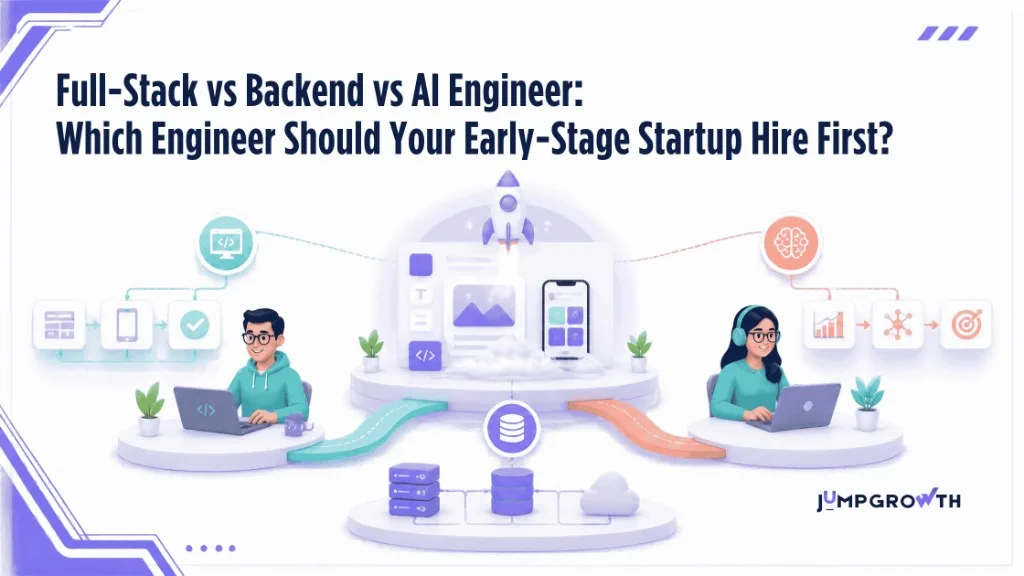
Short answer: For a full-stack vs backend vs AI engineer decision, most early-stage startups that still need to build and validate an MVP should hire a product-minded full-stack engineer first. Hire a backend engineer first when data integrity, integrations, security, or reliability is already the main risk. Hire an AI engineer first only when AI behavior is the product, meaning model quality, retrieval accuracy, or agent reliability determines whether customers get value. The rule underneath all three: hire for your most important technical constraint, not for the most fashionable job title.
Picture a typical founder. Twelve to eighteen months of runway, a pilot customer waiting, and a backlog that includes a sign-up flow, a payments integration, and an AI assistant investors keep asking about. One hire is affordable right now. Get it right and the product ships. Get it wrong and the startup spends months paying someone to solve a problem it does not have yet.
This guide compares the three roles, then walks through a seven-question decision framework, stage-by-stage guidance, the skills to test in interviews, common mistakes, and how to choose between an in-house hire, a contractor, and a dedicated development team.
Full-Stack vs Backend vs AI Engineer: Quick Comparison
| Comparison factor | Full-stack engineer | Backend engineer | AI engineer |
|---|---|---|---|
| Core responsibility | Builds complete features, from user interface to database | Builds the systems, data, and APIs the product runs on | Makes AI-powered features accurate, reliable, and affordable |
| Primary technical focus | Frontend, backend logic, APIs, databases, deployment | API design, data modeling, security, integrations, performance | Model integration, retrieval, evaluation, prompt and agent design, inference cost |
| Best startup stage or situation | Pre-MVP to early product-market fit | Complex data, payments, or integrations; scaling pain | AI is the core value proposition or main technical risk |
| Typical deliverables | Working MVP, dashboards, user flows, rapid iterations | Stable APIs, clean data models, secure auth, monitored services | RAG pipelines, evaluation suites, agent workflows, quality metrics |
| Key skills | Breadth, product judgment, shipping speed | Depth in systems, data, and failure handling | Evaluation methodology, retrieval, model behavior, LLM security |
| Main advantage | One person can deliver end-to-end value | Prevents costly data and reliability failures | Turns AI from a demo into a dependable product feature |
| Potential limitation | May lack depth in security, scale, or machine learning | Less focused on user-facing polish and speed of iteration | Often unnecessary for a simple model API integration |
| Signals that it is time to hire | You have no product, or features are the bottleneck | Bugs in data, payments, or integrations are costing customers | AI output quality is the reason users stay or leave |
In plain English: a full-stack engineer maximizes speed and breadth, a backend engineer maximizes correctness and reliability, and an AI engineer maximizes the quality of AI behavior. Startup stage is a useful indicator, not a rigid rule. A pre-seed fintech company may need backend depth on day one, while a Series A SaaS company may still be best served by another full-stack generalist.
What Does a Full-Stack Engineer Do?
A full-stack engineer works across the whole application: the frontend (what users see and click), the backend (the business logic and APIs behind it), the database, third-party integrations, testing, and deployment. Depth varies by person. Most full-stack engineers lean toward one side, but they can carry a feature from requirements to release without handing it off.
For an early-stage startup, that typically means:
- Building and iterating on an MVP quickly, with fewer handoffs.
- Connecting user interfaces to application logic and data, so features work end to end.
- Owning a feature from requirement through release, including bug fixes after launch.
- Working directly with founders and customers, translating feedback into product changes.
- Making practical trade-offs when requirements change mid-sprint.
Best fit: You need to build, test, and improve a product quickly, and one engineer can realistically cover the scope. If you need to move faster than recruiting allows, you can also hire full-stack developers on a flexible basis.
Example: A B2B SaaS startup needs user authentication, a customer dashboard, subscription billing through a payment provider, and a basic reporting workflow. None of this is exotic, and a strong full-stack engineer using mature frameworks and managed services can own all of it.
Limitations: A full-stack title does not guarantee depth in security, distributed systems, complex infrastructure, or machine learning. The breadth that makes a generalist valuable early can become a ceiling when one part of the system becomes genuinely hard.
Full-stack is also the most common developer role. In the Stack Overflow 2025 Developer Survey, 27% of respondents identified as full-stack developers, compared with 14.2% back-end and 1.4% AI/ML engineers. That does not make full-stack hires easy to evaluate, but it does mean the candidate pool is broader.
What Does a Backend Engineer Do?
A backend engineer is responsible for the parts of the product users never see but always depend on. In business terms, they make sure orders do not vanish, data stays correct, customer information stays protected, and the system keeps working when usage grows.
Core responsibilities include:
- API design and business logic: clear, versioned interfaces that the frontend, mobile apps, and partners rely on.
- Database design and data integrity: schemas and transactions that prevent duplicate charges, orphaned records, and inconsistent states.
- Authentication, authorization, and security: who can access what, and how that is enforced.
- Third-party integrations and transaction processing: payments, ERPs, shipping, banking, or healthcare systems, including what happens when those systems fail.
- Performance, reliability, scalability, and observability: logging, metrics, and alerts that tell you what broke before customers do.
Best fit: Backend complexity is already blocking product delivery, or failures in data, integrations, or reliability create significant business risk. When the stack is already chosen, teams often hire Python developers or hire Node.js developers for that specific backend rather than a generalist title.
Example: A marketplace has growing transaction volume, complex inventory rules, two payment integrations, and orders that sometimes end up in inconsistent states. Adding more features on top of that foundation makes the problem worse. A backend specialist who redesigns order state and integration handling unlocks everything else.
Why a backend engineer might be the first hire: Some products are backend-heavy from day one, regardless of user count. Fintech, insurtech, healthtech, logistics, and B2B integration platforms often face regulatory, financial, or data-integrity requirements before they have many users. If one data error could cost a customer money or trigger a compliance issue, backend depth is not a later problem.
What Does an AI Engineer Do?
An AI engineer builds product features on top of AI models, most often large language models (LLMs), and makes them work reliably in production. This is different from conventional application development, which follows deterministic logic, and from AI or machine learning research, which creates or trains new models.
Practical AI engineering work includes:
- Integrating and orchestrating model APIs, including routing requests between models.
- Retrieval-augmented generation (RAG): retrieving relevant information from a company's own documents and supplying it to the model so answers are grounded in real data.
- Model selection and evaluation: choosing models based on measured quality, cost, and latency rather than reputation.
- Data preparation and retrieval quality: chunking, indexing, and searching content so the right context reaches the model.
- Agent workflows, where a model takes multi-step actions using tools, built only when the product justifies the extra complexity.
- Latency, inference cost, monitoring, and reliability: AI calls can be slow and expensive at scale.
- Testing output quality and handling failures, including hallucinations (confident but incorrect output) and security risks such as prompt injection, which leads the OWASP Top 10 for LLM Applications (2025).
Best fit: AI behavior is central to the product's value or represents the main technical risk.
Example: An AI-native SaaS product must answer questions from thousands of internal company documents, cite its sources, and complete multi-step workflows such as drafting and filing a report. If retrieval is poor or the agent fails silently, the product fails. That calls for dedicated AI engineering.
The important distinction: Adding a chatbot or calling an existing model API does not automatically require a dedicated AI engineer. A capable full-stack or backend engineer can integrate a model API, write prompts, and ship a useful first version. Anthropic's guidance on building effective agents makes a similar point: find the simplest solution possible, and only increase complexity when needed.
Applied AI engineering vs machine learning research: Most startups need applied AI engineering, which means building with existing models. You need machine learning research or training expertise only when existing models cannot do the job, and you have proprietary data and a clear reason to train or fine-tune your own.
Which Engineer Should Your Startup Hire First?
Answer these seven questions before writing a job description. They are the practical test for a first engineering hire:
- What must the startup deliver in the next three to six months? A launch, a pilot, a compliance milestone, or a fundraising demo?
- Is the biggest blocker building features, backend complexity, or AI quality?
- Is AI the core product capability or an additional feature?
- What technical skills do the founders and current team already have? A technical co-founder with backend depth changes the answer.
- What can the new hire own independently? Early hires need ownership, not constant direction.
- What budget and runway are available? Specialists typically take longer to recruit and cost more.
- What business milestone should this hire help achieve? If you cannot name one, you may not be ready to hire.
Then match your main constraint to a likely starting point:
| Current startup challenge | Likely best-fit hire | Why |
|---|---|---|
| MVP has not been built | Full-stack engineer | Can develop and validate end-to-end workflows |
| Product needs rapid feature iteration | Full-stack engineer | Reduces unnecessary handoffs |
| Complex data models or integrations | Backend engineer | Provides deeper system ownership |
| Performance and reliability problems | Backend engineer | Focuses on architecture and operational quality |
| AI is the product's main differentiator | AI engineer | Addresses model behavior and evaluation |
| Simple LLM API integration | Full-stack or backend engineer | A specialist may be unnecessary at first |
| Existing technical team lacks a critical capability | Hire for the demonstrated skills gap | Complements current strengths |
These are starting points, not universal hiring rules. The best answer is the one that removes your biggest bottleneck in the next two quarters.
Which Engineer Should You Hire at Each Startup Stage?
Pre-seed: validating the idea
The goal is the smallest useful product that tests whether customers want it. A product-minded full-stack engineer is often the sensible default because speed of learning matters more than architectural perfection.
Exceptions exist. Hire backend expertise from day one when the MVP handles money, regulated data, or critical integrations. Hire AI expertise from day one when the core promise, such as accurately answering questions from your contracts, cannot be tested without strong retrieval and evaluation. A technical plan for that kind of product is covered in AI MVP development: a technical roadmap.
Seed stage: building a repeatable product
Paying customers change the priorities. Maintainability, security, integrations, and smooth onboarding start to matter as much as new features. This is often when a backend specialist becomes valuable, especially if integration bugs or data issues keep pulling the team away from roadmap work.
If AI features are live, evaluation and monitoring become ongoing responsibilities. Someone has to measure whether answers are correct, catch regressions when models or prompts change, and control inference costs. When that work becomes a constant drain on generalists, a dedicated AI engineer starts to make sense.
Early growth: supporting real customers
Reliability, observability, deployment, performance, and security become daily concerns. Specialist hires should respond to measured bottlenecks such as rising incident counts, slow releases, or AI quality complaints, not to a predetermined hiring sequence copied from another company.
Funding stage alone does not determine the right hire. Your constraint does.
Full-Stack vs Backend vs AI Engineer: Cost and Hiring Trade-Offs
Exact compensation varies widely by geography, seniority, and employment type, so use current local data when you budget. The trade-offs below hold regardless of the numbers:
- Salary and total employment cost: Specialists, particularly experienced AI engineers, generally command a premium. Total cost also includes benefits, equity, payroll taxes, and tooling.
- Recruitment time and scarcity: AI engineers with production experience are a much smaller pool than full-stack developers, so searches usually take longer.
- Onboarding and management overhead: Specialists need meaningful, well-scoped problems. Without them, you are paying for idle depth.
- Contractor or dedicated-team options: These can provide specialist skills for a defined period. Agency rates, contractor rates, and full-time salaries are not directly comparable, because each bundles different costs, risks, and commitments.
- The cost of delay and a wrong hire: A mismatched hire costs salary plus months of lost delivery, which often matters more than the salary itself.
- One generalist vs multiple specialists: Early on, one strong generalist usually beats two specialists who need coordination. As complexity grows, the balance shifts.
Essential Skills to Evaluate Before Hiring
Full-stack engineer
- Demonstrated end-to-end feature delivery, with shipped products you can see.
- Solid frontend and backend fundamentals.
- API design and database knowledge.
- Testing and deployment experience.
- Product judgment and prioritization.
- Ability to explain technical trade-offs to non-engineers.
Backend engineer
- API and data modeling.
- Security and access control.
- Integration design and failure handling (retries, idempotency, timeouts).
- Database performance tuning.
- Testing, observability, and reliability practices.
- Ability to design for current needs without needless complexity.
AI engineer
- Practical model integration or machine learning experience relevant to your product.
- Evaluation methodology with measurable quality criteria.
- Data and retrieval fundamentals where relevant.
- Hallucination and failure handling.
- Awareness of latency and inference cost.
- Production monitoring and reproducible experiments.
Across all three roles, assess real problem-solving and past outcomes rather than treating a long list of technologies as proof of ability. Ask candidates to walk through something they built, what broke, and what they would change.
Common Hiring Mistakes Early-Stage Startups Should Avoid
- Hiring an AI engineer because AI is trending. Risk: expensive expertise with no hard AI problem to solve. Fix: confirm that AI quality is a real constraint first.
- Hiring a specialist before there is enough specialist work. Risk: idle time or misallocated effort. Fix: use a contractor or fractional specialist until the workload is sustained.
- Expecting one engineer to be an expert in everything. Risk: burnout and shallow work everywhere. Fix: define the two or three areas that matter most.
- Writing an unrealistic job description. Risk: strong candidates opt out. Fix: describe the problems, not a wish list of tools.
- Ignoring product thinking and communication. Risk: technically correct work that solves the wrong problem. Fix: test how candidates prioritize and explain trade-offs.
- Underestimating security, testing, and deployment. Risk: breaches, outages, and fragile releases. Fix: include these in interviews and the first 90-day plan.
- Hiring without a clear first-90-day outcome. Risk: no way to judge success. Fix: define one or two concrete deliverables before you hire.
- Ignoring the founding team's existing skills. Risk: duplicating strengths and leaving gaps. Fix: hire to complement what founders already do well.
Should You Hire In-House, Freelance, or Use a Dedicated Team?
| Model | Best suited for | Benefits | Trade-offs |
|---|---|---|---|
| Full-time in-house hire | Long-term ownership of core product and architecture | Continuity and institutional knowledge | Recruitment time and ongoing employment costs |
| Freelancer or specialist contractor | A defined task, prototype, or short-term skills gap | Flexibility and targeted skills | Availability and continuity may vary |
| Dedicated development team or staff augmentation | Building an MVP, adding delivery capacity, or filling skills gaps | Flexible capacity and complementary expertise | Requires clear ownership, communication, and quality controls |
These options are not interchangeable. Sensitive intellectual property, security requirements, regulatory obligations, technical leadership, and long-term ownership should shape the choice. Many startups combine them, for example keeping architecture and product ownership in-house while adding external capacity for delivery or a specialist skill. Where the work can sit outside the founding team, staff augmentation embeds individual engineers, and a longer look at the trade-off is in whether hiring offshore developers is worth it.
How JumpGrowth Can Help Startups Build the Right Engineering Team
If recruiting your first engineer would take longer than your runway allows, or you need a skill your team lacks, an external team can bridge the gap.
JumpGrowth builds development teams for US product companies using onshore engineers in the United States, nearshore engineers in Mexico, Canada, and Colombia, and offshore engineers in India. Founders who need to get to a first release can work with an MVP development team of product, design, and full-stack specialists. Teams with a product already in market can add a dedicated development team or embed individual engineers through staff augmentation. For AI-heavy products, JumpGrowth offers generative AI engineers experienced in RAG, agent workflows, and evaluation.
To assess fit, ask yourself:
- Do you need end-to-end delivery (a dedicated team) or extra hands inside your existing team (staff augmentation)?
- Who on your side will own product priorities and architecture decisions?
- Which skills must stay in-house long term, and which can be flexible?
If you are weighing your first engineering hire, talk to JumpGrowth about your product roadmap, engineering gaps, and development priorities.
Final Verdict: Which Engineer Should You Hire First?
- Hire a full-stack engineer when you need to build and validate a product quickly.
- Hire a backend engineer when data, integrations, system complexity, or reliability is the main constraint.
- Hire an AI engineer when AI behavior and model performance are central to the product's value or technical risk.
The right first hire depends on what the company must accomplish next, what the existing team can already do, and which capability will unlock the most progress. If you want a second opinion on your roadmap and team requirements, JumpGrowth is happy to talk it through.
Frequently Asked Questions
01Should a startup hire a full-stack developer first?
Usually, if you still need to build and validate an MVP. A full-stack developer can ship complete features without handoffs. Backend-heavy or AI-native products may need a specialist first.
02Can one full-stack engineer build an MVP?
Often, yes, for a focused MVP built on mature frameworks and managed services. Complex integrations, regulated data, or advanced AI may need additional expertise.
03When does a startup need a backend engineer?
When data integrity, integrations, security, performance, or reliability problems are slowing delivery or creating business risk. In fintech, health, or other regulated products, that can be from day one.
04Does every AI startup need an AI engineer?
No. If you are calling a model API for a supporting feature, a capable full-stack or backend engineer may be enough. You need dedicated AI engineering when output quality, retrieval, or agent reliability determines product value.
05Can a full-stack developer build AI-powered features?
Yes, for many integrations, such as calling model APIs, building chat interfaces, and basic prompt design. Systematic evaluation, complex retrieval, and production agent reliability usually benefit from AI engineering experience.
06What is the difference between an AI engineer and a machine learning engineer?
AI engineers typically build products on top of existing models, using integration, retrieval, and evaluation. Machine learning engineers more often train, fine-tune, and deploy models and manage the data pipelines behind them. Titles overlap, so assess actual experience.
07Is it better to hire one senior engineer or multiple junior developers?
For a first hire, a senior engineer is usually safer. Early-stage work needs independent judgment, and junior developers need mentorship that a founding team may not be able to provide.
08Should a startup hire in-house developers or use a dedicated development team?
Keep long-term product ownership and core architecture in-house where possible. A dedicated team or staff augmentation can speed delivery or fill skills gaps, as long as ownership and quality controls are clear.
09When should a startup hire its second engineer?
When the first engineer's work is consistently blocked by capacity or by a specific skill gap, or when there is a single point of failure in critical systems. Hire for the gap you can name.
10How can a non-technical founder evaluate an engineer?
Focus on shipped outcomes, clear explanations of trade-offs, and a realistic paid trial or work sample. Bring in a trusted technical advisor for the technical interview.
Sources
- Stack Overflow, 2025 Developer Survey: Developers (Developer roles). Role share among all respondents: full-stack 27%, back-end 14.2%, front-end 4.3%, AI/ML engineer 1.4%. Accessed 22 October 2026.
- Anthropic, Building Effective Agents (19 December 2024).
- OWASP Gen AI Security Project, 2025 Top 10 Risk and Mitigations for LLMs and Gen AI Apps.
Keep reading
- Startups
AI MVP Development in 2026: How Startups Can Ship a Working Product in Under 8 Weeks
11 minutes readRead article - Startups
AI in Product Development: How Founding Teams Are Cutting Discovery Time by 60%
10 minutes readRead article - Startups
Why Hiring Nearshore Developers is a Game-Changer for Tech Startups
6 minutes readRead article
Build your team
Share where the roadmap is blocked and the capabilities you need. We’ll map a practical team and delivery model.
Comments
Be the first to comment.