

- Artificial Intelligence
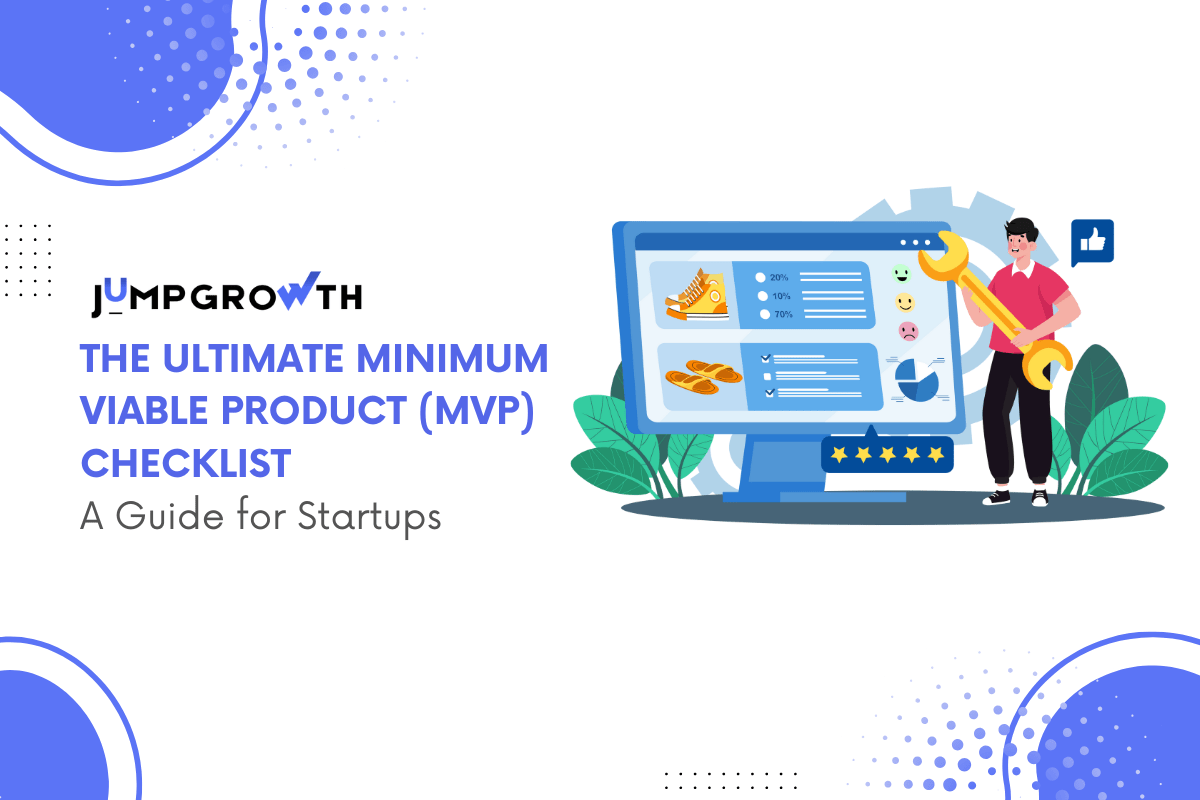
The Ultimate Minimum Viable Product (MVP) Checklist: A Guide for Startups
- Written by
- Hemant Madaan
- Published
- 25 August 2025
- Reading time
- 9 minutes
We are in a digital world where everything is digitalized. We can say every human being once in their lifetime has that brilliant idea buzzing in their head, the one that could change the game. But one thing that is also prominent is that we all do not know where to begin converting our ideas into reality.
Although today there are several ways to build our idea into a product, building a product from scratch always feels overwhelming, especially when resources are tight and time is of the essence. The best way to launch or test our product with the minimum budget and least amount of time is building an MVP Minimum viable product.
In today’s JumpGrowth blog, we will dive deep into what a minimum viable product is and why it is crucial for your success. We will also provide a comprehensive minimum viable product checklist to guide you every step of the way. So, let’s start our blog by understanding what MVP is:
What is Minimum Viable Product (MVP)
Minimum Viable Product as well as MVP is the simplest version of your application. By building it you can test your market idea by using minimum resources and investing the lowest budgets. The MVP of any product can deliver the core values of your idea.
Think of MVP as a prototype that is good enough to gather feedback, validate assumptions, and iterate without burning through your budget. MVP is not just a smart approach; it is that one factor which can make difference between thriving and failing.
No matter what you are building, Mobile application, web application, cloud platform, or even something hardware, MVP allows you to only focus on what really matters and test it without any heavy investment. Also, by building an MVP, you can avoid pitfalls and validate your idea before launching the final product.
Understanding the Basics: What Makes a Minimum Viable Product So Essential?
Imagine you are a chef testing a new menu. Now, you know you will be testing one or two bites of each dish, not the entire dishes. That is not possible, as it will take too much time and effort, and there is no guarantee that each dish will be tasty. Same with the MVP, we do not build each function or feature; instead, we provide a little bit of everything to know whether our application or product really needs that thing or what the customer will respond to about it. Once the users are satisfied with the MVP, we build the entire product.
Now you might be wondering why does an MVP matter this much? So as mentioned above we are in the technology driven where everyday thousands of startups try to make a change, but not all ideas are enough to adapt. Also, in today’s fast world, time, and money both are important, and you just cannot lose both by building a product which later gets neglected by the users.
According to various industry reports, about 90% of startups fail, often because they build products no one needs. By building an MVP, we can completely change the script, like we build an MVP with the least effort. When we build an MVP for any product, we launch quickly, collect real-user data, and refine based on evidence, not guesswork. This process reduces risk and increases your chances of hitting product-market fit.
Also, in today’s world, users’ needs change very quickly and by launching MVP, we can identify the trends, users’ expectations, etc. and if required we can make the changes in our final product.
Your Go-To MVP Development Checklist: Covering All Bases
Right now, that we have set the base, let us get into the practical details. The minimum viable product checklist is your ultimate tool for organization and efficiency. According to my assessment of best practices from a number of successful startups, I assure you that this mvp development checklist is complete yet actionable. For clarity, I would be breaking them down into categories so that you can follow along.
Ideation and Validation Phase
- Validate Your Idea: Is there demand? This question comes first. Use different tools such as Google Trends, surveys, or polls. See if the interest is legitimate. The question you need to be asked is: Does this solve a real problem?
- Define Core Problem and Solution: Make it clear what the problem is and how your MVP claims to solve it. Write a one-pager: Problem, Solution, Target Users.
- Market Research: Who are your competitors? Any gaps? Use the SEMrush tool to identify opportunities.
- User Personas: Develop 2-3 profiles of your ideal users. Description should cover demographics, behaviors, and pain points.
This phase sets strong foundations so that your hard work is never wasted. Moving forward, it goes well in the process of planning your features.
Feature Prioritization and Planning
- List all the must-have Features: Identify all the must-have features that you think are necessary for your application and categorize them.
- Identify MVP Essentials: pick 3 or 4 features from the must-have list and implement them in your MVP. Make sure these 3-5 core features should deliver 80% of the value of your application. Avoid feature creep!
- Set Success Metrics: Define KPIs, such as user sign-ups, retention rates, and feedback scores. Aim for goals that can be measured.
- Budget and Timeline: Always make a rough estimation of the cost and time you can afford to build your MVP.
Design and User Experience
- Wireframing: Sketch basic layouts, make sure your MVP is user oriented.
- User Flow Mapping: Diagram of how users interact from start to finish.
- Accessibility Check: Ensure usability for all, including mobile responsiveness.
- Branding Basics: Give it a basic logo and colors to keep it professional.
A good design, ideally, is simple and intuitive, bringing us to build things.
Development and Technical Setup
- Choose Tech Stack: Pick scalable options like React for the front-end or Node.js for the back end. If you need to use AI in your Minimum viable product development, then choose specialized MVP development services.
- Core Functionality Development: Could be acquired via coding or no-code platforms. Testing happens on the way.
- Security Aspects: At least basic security practices like data encryption and authentication.
- Integration Points: Add essential APIs especially if you are thinking of using a payment gateway. Always make sure you test your MVP continuously for better results and to provide enhanced experience.
Testing and Quality Assurance
- Internal Testing: Create a different environment to test the MVP and detect bugs.
- User Testing: Get 10 to 20 actual users to give feedback. You can use tools like User Testing.
- Performance Testing: Test whether your MVP is loading fast and working without any bugs and can handle the traffic.
- Fixing Bugs: Address all critical issues.
Testing is a must-have for any application or minimal viable product MVP to avoid launch disasters and pave the way for a successful rollout.
Launch and Feedback Gathering
- Deployment Plan: Choose hosting from AWS, Heroku, etc.
- Hype Marketing: Use social media or email lists to stir some excitement.
- Feedback Channels: Surveys and/or analytics.
- Post-Launch Monitoring: Once your MVP is launched, the track is real time usage.
No doubt launching is fun, but the real value is what happens afterward.
Iteration and Scaling
- Data Analysis: Track and analyze metrics each week.
- Update Prioritization: Rely on feedback to choose features for the next release and fix bugs.
- Pivot if Necessary: Be prepared to alter direction.
- Scale on Your Mind: Think about future growth, like adding users.
This MVP development checklist is not static; you can also use it once you launch your MVP. It will help you even when developing the real product. By following this minimal viable product checklist, you will be not only creating a product; you will create a machine that will learn and adapt things with time.
Avoiding Pitfalls: Common Mistakes in MVP Development
Even with a solid MVP development guide for startups, mistakes happen. Let us connect this to our checklist by highlighting what to watch out for, so you can sidestep them.
- One big error is overbuilding. Founders often add too many features, delaying launch and inflating costs. Stick to your prioritized list!
- Another is ignoring user feedback. Launching without validation is like flying blind. Always loop back to users.
- Poor planning leads to scope creep. Without clear timelines, projects drag on. Use your checklist to stay disciplined.
- Tech choices can bite you – picking complex stacks without expertise slows things down. Start simple.
- Lastly, neglecting metrics means you cannot measure success. Define them early.
I’ve heard stories from founders who learned these the hard way, but you don’t have to. By being aware, your minimum viable product development journey will be smoother.
Conclusion
So, here the blog on MVP development checklist ends. Remember one thing minimal viable product MVP is more than a buzzword in today’s fast-paced world – it is a mindset for smart growth. We hope now you understand what a minimum viable product is, detailed MVP development checklist and tools which can enhance the MVP output.
If you still have questions or need help to bring your idea into real life, let JumpGrowth engineers help you. Our MVP development services can guide you through every step, ensuring a seamless process. For tailored MVP software development services, reach out today. let’s turn your vision into a viable reality.
FAQs
01What is an MVP in development?
An MVP (Minimum Viable Product) is the simplest version of your idea. Your product’s MVP will be equipped with core features and is mainly built to validate the idea and gather user feedback before developing the final product.
02What are the phases of MVP development?
MVP development has different phases, such as Idea validation, Market research, Feature prioritization, prototype design, MVP building, and User testing with feedback iteration.
03How to develop an MVP fast?
The best way to build an MVP fast is to focus on the core problem you’re trying to solve and then pick the most important features that you think will make a difference. Apart from this, you outsource your MVP development for faster release.
04Q. When should you pivot after MVP?
Pivot if users aren’t engaging, your MVP’s retention is low, or you found a bigger opportunity in the market. Measure churn rate, activation, and feedback loops for the changes you plan to take before making that decision. It ought to be pivoting on the facts.
05How can we build an MVP and raise funding in 2025?
Start with a problem-focused MVP, validate it with some actual users, and compile some metrics on traction: downloads, early signups, and early revenue. Once MVP development is completed, create a pitch deck for investors and pitch it to them.
Keep reading
- Artificial Intelligence

AI Engineers' Consulting Rates in 2026: What You're Really Paying For and How to Benchmark Fairly
11 minutes readRead article - Artificial Intelligence
AI App Development Cost in 2026: Full Breakdown by Feature Set, Stack, and Team Model
11 minutes readRead article - Artificial Intelligence

Manufacturing AI Software in 2026: Use Cases, ROI Data, and How to Choose the Right Development Partner
11 minutes readRead article
Build your team
Share where the roadmap is blocked and the capabilities you need. We’ll map a practical team and delivery model.
Comments
Be the first to comment.