

- Nearshore
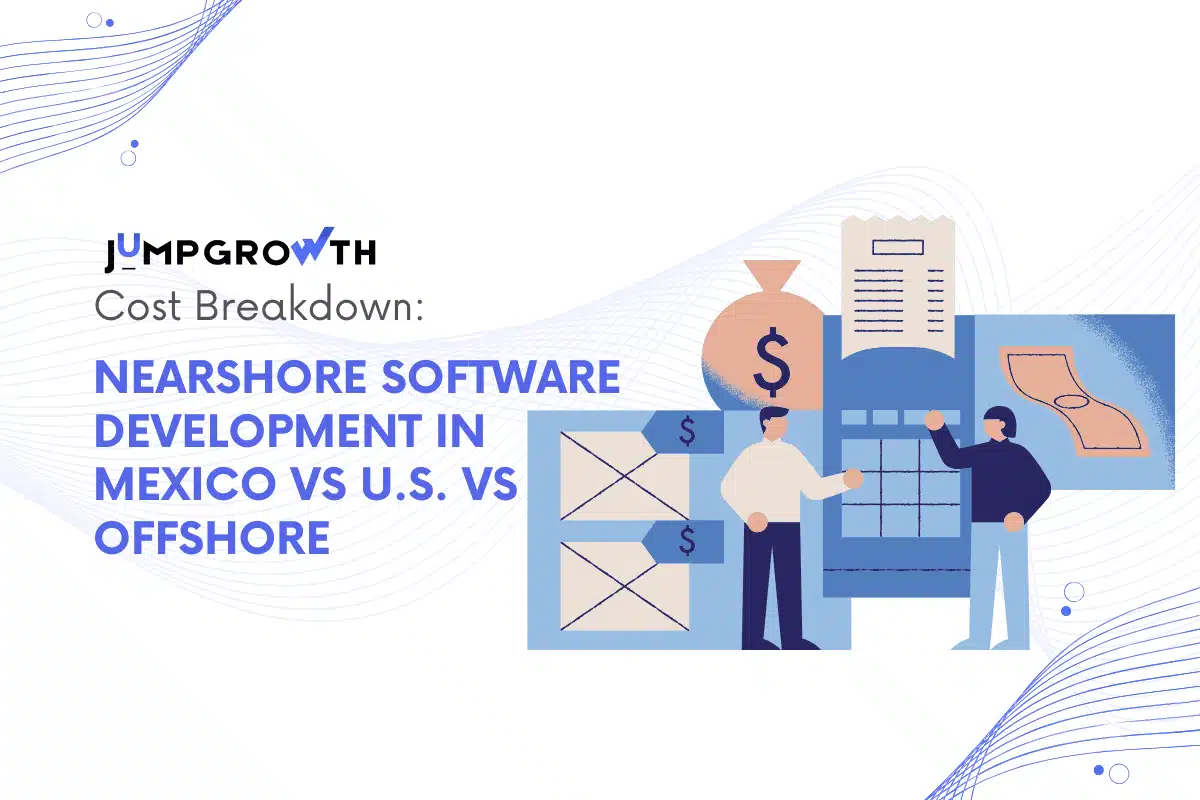
Cost Breakdown: Nearshore Software Development in Mexico vs. U.S. vs. Offshore
- Written by
- Hemant Madaan
- Published
- 28 October 2025
- Reading time
- 9 minutes

What is Nearshore vs. Offshore?
Before diving into the cost factors, let’s start with the basics and that is what is Nearshore and Offshore. So Nearshore is when you hire IT teams to tackle your projects from the nearby country following the same or similar time zone. Nearshore is renowned due to its mixture of in-house and freelancing approach. On the other hand, offshore is when you hire professionals to work on your project from any country following the different time zone. The only benefit of offshore is it gives access to a wider pool of professionals and sometime cheaper. However, there are a few complications with the offshore which exclude its cheap factor. Let’s understand why nearshore software development in Mexico vs. U.S. hires and offshore costs matter now.Why This Mexico vs. U.S. Software Development Cost Chat Matters Now
We all know outsourcing is no longer a buzzword, and almost everyone is familiar with this term. But in 2025, when AI technology is at the pinnacle and eating routine tasks, and with the boom of IT start-ups, talent wars are raging. Also, with the latest, H1B visa fee increase U.S. companies are forced to reconsider their way of hiring developers and other IT professionals to survive and thrive in this competitive market. Nearshore outsourcing has become a savior in today’s circumstances; I mean it is affordable, aligned, and agile. Working with the nearshore teams feels like working with a team next to your office. Let’s understand it with an example, think of it as if you are doing grocery shopping, U.S. hires provide top-notch talent, but take out almost every penny of your entire development budget. Offshore? Cheaper but comes with a lot of risks, like some freelancers’ ghosts about their work during the mid-project, and communication and collaboration are like Everest climbing tasks. Mexico Nearshore? The best groceries from nearby countries are affordable and meet the same quality as U.S. ones; solid value. According to the Deloitte global outsourcing survey in 2024, 25% of execs are cutting down the development cost with the smarter sourcing like Mexico Nearshore.Cost Breakdown: Nearshore Software Development in Mexico vs. U.S. vs. Offshore
Cutting down is not always about the hourly prices; it is way more than that like time zones for seamless communication, working culture compatibility for better results and other things, which are mentioned below. Factor 1: Hourly Rates First thing first, Hourly rates. This is the best way to break down the cost. Hourly rates set the tone for your software development cost comparison. Hiring an U.S. developer costs between 100-120$ per hour. Whereas Nearshore outsourcing costs between $40 and $60 per hour for the same level of skills. Why is this price? Because Mexico is cheaper compared to the U.S., but talent that’s well-trained and English-fluent. Offshore depends on the country. For example, let us take India, the price dips to $20-40 with the same level of skills, but the hassle of communication and time zone difference makes it expensive and slows down the development process. Factor 2: Time Zone Alignment Yes, this is the second factor and the biggest differentiator among the nearshore and offshore. Many organizations thinks that offshore is cheaper but imagine you have to post pone an urgent task because your developer is in India and behind 8 hours of your time and sleeping. Time zone is a silent business killer in offshore and sometimes it takes weeks to finish the 2days work due to delayed feedback loops and other issues. Several organizations have said that time zones task on 20-30% to project timelines. On the other hand, in Nearshore we are talking about 0-2 hours of difference which hardly makes any difference in the feedback loops and implementation. Honestly, the nearby feels like working with another team on the next floor. U.S. wins on zero lag, obviously. But three times the Rate? Offshore lags hard, literally. Factor 3: Hidden Fees Hidden fees are the budget killers. Although every nearshore and offshore service provider makes their charges very clear at the beginning, most professionals forget about the travel charges. For example, if you need to visit your offshore partner, you have to spend between $10-20k per trip. On the other hand, with nearshore Mexico, you can take a quick flight or drive to your nearshore team office without spending a heavy amount. Ah, the plot twists. Upfront rates dazzle, but hidden fees turn fairy tales’ sour. Factor 4: Scalability Scalability is king for agile firms, and almost every business dreams of scaling its business to the pinnacle. The U.S. has a deep pool of professionals, but at very expensive rates. Whereas offshore slows down the hiring process and takes months to find the perfect fit, and then you have to manage the communication, etc. Nearshore? Mexico’s IT talent is booming, and govt. is also favoring IT students with several schemes to promotes IT talent. Also, Nearshore means you can scale your team without time zone issue and within weeks that too with the same work culture and no language barrier. Factor 5: Quality and Cultural Fit We all agree on one thing; that cost without quality is nothing more than a dead end. No matter whether you are paying less or more, if the quality is lacking, you are just putting your cash into a flowing river without any motive. No doubt that U.S. professionals hold cutting edge skills but at what premium three times compared to Nearshore. Mexico Nearshore? They have the same accent as U.S. with the high English proficiency and same time zones perfect for any business. On the other hand, offshore quality varies with the location. There are countries that are not well IT-trained or aligned and that cannot match your competitors’ level. So, here, the Nearshore software development in Mexico is the best option for many businesses, Factor 6: Infrastructure Overhead Setting up remote teams? U.S. is plug-and-play but expect high cloud bills. Offshore demands VPNs and compliance tools, so add $2K-5 monthly for secure stacks. Mexico nearshore leverages U.S.-grade infra at LATAM prices: Reliable fiber, AWS hubs in Querétaro. So, these are the few cost factors which make nearshore and offshore cheaper and costly. Whenever you decide to choose an outsourcing model, make sure you consider all these factors. Below is a comparison table for you, which will make it easier for you to understandSide-by-Side Software Development Cost Comparison Table
| Factor | U.S. (Onshore) | Mexico Nearshore | Offshore | Key Savings Insight |
|---|---|---|---|---|
| Hourly Rate | $100-200/hr. ($150K total) | $40-70/hr. ($55K total) | $20-50/hr. ($35K total) | Nearshore: 63% off U.S.; Offshore edges but… |
| Time Zone Overhead | $0 (full overlap) | $0-2K (minimal) | $5-10K (delays/rework) | Nearshore avoids a 20% timeline bloat. |
| Hidden Fees | $0 (local) | $2-5K (rare travel) | $10-20K (management) | Offshore “savings” evaporate here |
| Scalability Cost | $10-15K (recruiting) | $5-8K (quick hires) | $3-7K (vetting) | Nearshore: Faster ROI on growth |
| Quality/Rework | $0 (top-tier) | $2-4K (low rework) | $5-15K (late rework) | Nearshore cultural win cuts fixes |
| Legal/IP Setup | $1-3K | $1-2K (USMCA ease) | $3-6K (extra clauses) | Nearshore: Simpler, cheaper peace |
| Infrastructure | $10-15K/month | $1-3K/month | $2-4K/month | Nearshore: U.S. reliability, LATAM price |
| Total Est. Cost | $170-185K | $66-82K | $60-97K | Nearshore nets 55% U.S. savings, 10-20% over offshore hidden charges excluded. |
Wrapping Up
Offshore is the cheapest option at first glance, but if we consider other factors, such as ease of communication, faster time to market, faster feedback loops, scalability, and ease, Nearshore is tilting organizations towards it. We hope this guide has helped you to break down the cost factors of nearshore software development in Mexico, as well as offshore and U.S. hires. With a reliable nearshore development partner like JumpGrowth, you can hire teams that will feel like working next door to your office. We have worked with over 200+ organizations from the U.S. (start-ups and mid-sized), and most of them are ruling their industries and hold our professionals in high regard for their skills and professionalism. Check out our nearshore engineers’ page for real client stories.FAQs
01What’s the total cost of ownership (TCO) for nearshore vs. offshore?
TCO covers rates, training, tools. Mexico nearshore runs 40-50% below U.S. TCO, beating offshore by 10-15% after delays and fixes. We’ve modeled TCO for JumpGrowth clients, showing payback in 6-9 months. It’s the full picture, not just hourly rates.
02Does cheaper nearshore software development cost mean lower quality?
Not in Mexico. 70%+ of tech pros are English-fluent, many U.S.-trained. JumpGrowth teams hit under 2% bug rates, matching U.S. standards. Offshore’s hit-or-miss; nearshore’s consistent. You get quality without the premium price tag, saving big.
03How flexible are nearshore contracts?
Very think month-to-month with no lock-ins. Mexico’s USMCA setup allows quick pivots. We offer 2-4 week pilots at JumpGrowth, with 70% of clients tweaking scopes penalty-free. It’s agility that keeps your project moving, not stuck.
04How fast can I scale a nearshore team?
About 2-4 weeks vs. 6-8 for offshore. Mexico’s time zone and shared tools like Jira make it snappy. We launched a client’s team in 18 days faster than U.S. hires. Proximity is your secret weapon.
05Is IP protection solid with nearshore?
Yup! Mexico’s USMCA aligns with U.S. laws, ensuring fast enforcement. JumpGrowth’s NDAs and secure repos had zero leaks in 50+ projects. Offshore needs pricier audits. Nearshore’s safer, cheaper, and stress-free.
06When’s nearshore better than offshore?
Pick nearshore for collaborative projects needing real-time sync saves on delays. Offshore’s fine for isolated tasks with tight specs. Mid-sized firms see 55% savings with nearshore’s fit. We’ve guided 30+ clients to nearshore wins.
Keep reading
- Nearshore

Nearshore Software Development Companies in 2026: How to Evaluate, Vet, and Onboard the Right Partner
11 minutes readRead article - Nearshore
Nearshore Software Development in 2026: Cost Savings, Time Zone Alignment and How to Pick the Right Partner
10 minutes readRead article - Nearshore
Nearshore Software Development Teams in 2026: Time Zone, Cost, and Talent Quality Compared to Offshore
10 minutes readRead article
Build your team
Share where the roadmap is blocked and the capabilities you need. We’ll map a practical team and delivery model.
Comments
Be the first to comment.