

- Artificial Intelligence
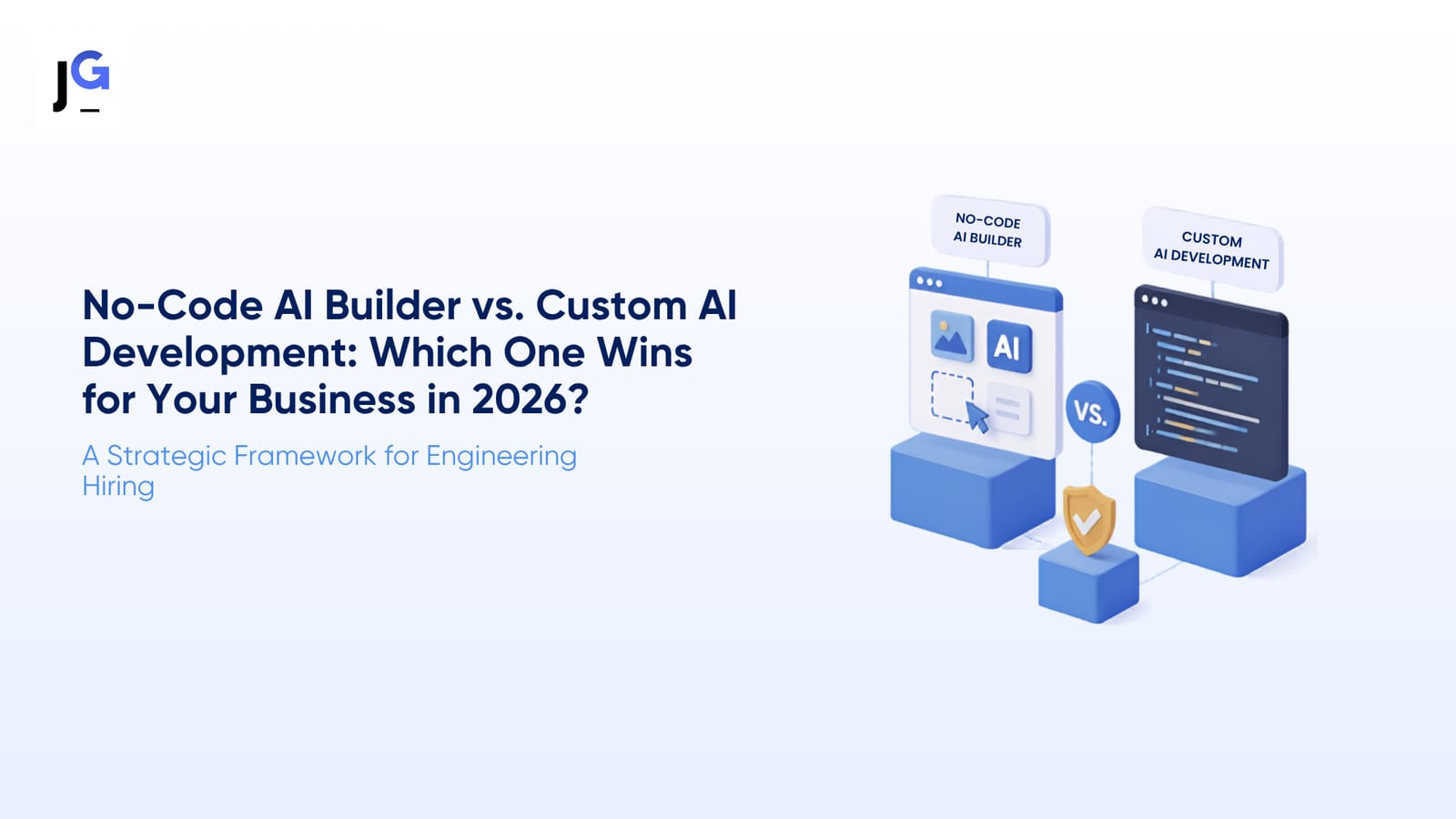
No-Code AI Builder vs. Custom AI Development: Which One Wins for Your Business in 2026?
- Written by
- Hemant Madaan
- Published
- 12 August 2026
- Reading time
- 9 minutes
Let’s Be Honest About What’s Actually Happening Out There
A founder we worked with last year was dead certain Bubble AI would replace his entire dev budget. Six weeks in, he had a working prototype. Twelve weeks in, he was calling us asking why his app timed out under 200 concurrent users and why bolting on a custom RAG pipeline felt like duct-taping a jet engine to a bicycle. The prototype was fine. The product was not.
That gap between prototype and actual product is where this whole debate gets messy. People treat “no-code vs. custom” as a cost question. It isn’t. It’s a trajectory question. Where do you need to be 18 months from now, not next Tuesday?
This piece covers real numbers, real platform comparisons, and what we’d actually tell someone depending on their situation. We work in AI software development services, so yes, we have a perspective. But the decision framework below is genuinely neutral, because pushing the wrong solution on a client costs us more in rework than we ever make upfront.
The No-Code AI Builder Market Right Now
Gartner projected that by 2026, 75% of new applications would be built using low-code or no-code tools, up from under 25% in 2020. Meanwhile, Forrester’s tracking of enterprise no-code adoption found that developer productivity gains from low-code platforms average 50-70% for standard CRUD-type applications. That’s real. But notice “standard CRUD-type” is doing a lot of heavy lifting in that sentence. A lot.
Three platforms are getting the most traction for AI-adjacent builds right now: Bubble AI, Glide, and Softr. They each have distinct sweet spots, and conflating them is a genuine mistake that I see constantly.
Bubble AI is the most capable of the three for anything logic-heavy. It added AI workflow connectors for OpenAI, Anthropic, and Cohere through its API Connector, and there’s a growing plugin ecosystem around it. Building something like a content generation tool or an internal AI assistant with moderate workflow complexity? Bubble can get you there. But the ceiling is real. Custom vector database integrations, fine-tuned model endpoints, agent orchestration through LangChain or LlamaIndex, these get painful fast and sometimes become outright impossible without dropping into custom code that effectively kills the whole no-code premise.
Glide works better for data-driven internal tools. Operational dashboards, AI-assisted sales tools pulling from Sheets or Airtable, lightweight CRM overlays. It added native AI columns, which are genuinely useful for things like auto-summarizing customer records or classifying inbound leads. But Glide is not where you go if the AI feature is the product itself, not just a feature bolted onto something else.
Softr sits closest to the client portal and marketplace use case. Good for building AI-assisted member directories or client-facing tools on top of Airtable or HubSpot data. Less relevant the moment your generative AI behavior needs any real customization under the hood.
Benchmark Comparison: No-Code AI vs. Custom AI Development
We put this comparison together based on projects we’ve observed or worked on directly, cross-referenced against published platform pricing and publicly available Forrester and Gartner data. The cost ranges reflect real-world scope, not vendor marketing decks.
| Dimension | Bubble AI | Glide | Softr | Custom AI Development |
|---|---|---|---|---|
| Typical MVP Cost | $3,000 – $15,000 | $1,500 – $8,000 | $1,000 – $6,000 | $25,000 – $150,000+ |
| Time to First Working Build | 4 – 10 weeks | 2 – 6 weeks | 2 – 5 weeks | 12 – 32 weeks |
| Scalability Ceiling (concurrent users) | ~500 – 2,000 (with optimization) | ~200 – 800 | ~200 – 1,000 | Virtually unlimited (infra-dependent) |
| Custom Model Fine-Tuning | Very limited | Not supported | Not supported | Full support (GPT-4 fine-tune, open-source LLMs) |
| RAG Pipeline Integration | Partial (via plugins) | No | No | Full (Pinecone, Weaviate, pgvector, etc.) |
| Data Privacy / On-Premise Option | No | No | No | Yes |
| Ongoing Monthly Platform Cost | $32 – $349/mo (Bubble plans) | $49 – $499/mo | $49 – $323/mo | Infra only ($50 – $5,000+/mo depending on scale) |
| Vendor Lock-in Risk | High | High | Medium-High | Low (if built with portable stack) |
A few things worth flagging. The “time to first working build” numbers for no-code platforms can be genuinely misleading in practice. Getting to a demo-able prototype is fast, no argument there. But getting to something production-ready with proper error handling, rate limit management on API calls, and a sensible user permission model can take just as long on Bubble as in a leaner custom stack. We’ve watched timelines stretch badly when clients underestimate the edge cases their actual users will hit once things go live.
Where No-Code AI Actually Makes Sense
Pre-revenue startup trying to validate a concept before raising? No-code is almost always the right call. The speed and cost advantages at that stage are real. You’re not trying to handle 10,000 users. You’re trying to prove that 100 people will pay for this thing. Glide and Softr in particular are solid for internal tools that help your team do AI-assisted work without requiring you to build software from the ground up.
There’s also a legitimate use case for SMBs that need AI business software but don’t have a technical co-founder or an engineering team on staff. A Bubble-based AI customer onboarding tool or an AI-assisted proposal generator can honestly run for years without needing custom development, so long as your user base stays manageable and your AI requirements don’t drift too far from where they started.
Here’s the honest caveat though, and I’d rather say it plainly than bury it: no-code AI builders are priced for access, not for scale. Bubble’s Production plan runs $349/month, and that’s before you factor in OpenAI API costs, which scale directly with usage volume. A no-code tool with heavy generative AI usage can get expensive faster than most people expect. Run the unit economics before you commit. Seriously.
Where Custom AI Development Is the Right Call
If the AI is the product, you almost certainly need custom development. Full stop.
Generative AI app development that requires a fine-tuned model, a proprietary knowledge base via RAG, agent-based workflows using something like AutoGen or CrewAI, or compliance with HIPAA, SOC 2, or GDPR for sensitive data, none of that is achievable on Bubble, Glide, or Softr today. These aren’t feature gaps that a quarterly update closes. They’re architectural constraints baked into how those platforms were designed at their core, and that’s not changing.
Migration costs also catch people badly off guard, more than I’d expect given how often it happens. A client who built a reasonably complex AI tool on Bubble over 18 months came to us wanting to migrate. Bubble has no exportable codebase by design, so we were essentially rebuilding from scratch while reverse-engineering their existing feature set at the same time. The migration ran $60,000 and took four months. That’s not a horror story either. That’s a fairly typical outcome when a product outgrows its platform with no planned off-ramp.
Custom development through an experienced team in AI software development services gives you ownership of the stack, portability, and the ability to swap model providers when something better comes out. And something better always comes out. When GPT-5 or Claude 4 launches, you want to test and swap without waiting on a platform vendor to update their integration timeline on their schedule.
Decision Framework for Startups and SMBs
Here’s how we’d actually walk through this if a client brought it to us today.
| Scenario | Recommended Path | Why |
|---|---|---|
| Pre-revenue startup, need to validate in under 8 weeks | No-code AI builder (Bubble or Glide) | Speed and cost efficiency outweigh scalability concerns at this stage |
| SMB building internal AI tools for a team under 50 | No-code AI builder (Glide or Softr) | Internal tools rarely hit scalability ceilings; faster deployment wins |
| AI is the core product, not a feature | Custom AI development | Model customization, RAG, and agent orchestration require full control of the stack |
| Regulated industry (healthcare, fintech, legal) | Custom AI development | Data privacy and compliance requirements rule out no-code platforms entirely |
| Post-seed startup, expecting 10x user growth in 12 months | Custom AI development | Platform scalability limits become a genuine crisis at that growth rate |
| SMB needing AI business software but has no tech team | No-code builder plus a technical consultant for setup | Managed no-code reduces ongoing overhead while keeping the product functional |
One thing people tend to forget: these paths aren’t mutually exclusive forever. We’ve helped teams ship a Bubble prototype, use it to raise a seed round, then migrate to a custom Python/FastAPI backend with a properly integrated LLM stack at Series A. That’s a legitimate playbook. Just plan for the migration cost in your fundraising math, because it will show up whether you planned for it or not.
“Custom development” also doesn’t mean a 12-person engineering team grinding for two years. A well-scoped AI feature built by a focused team in 10 to 14 weeks can end up more cost-effective than three years of Bubble plan fees plus the migration costs you’ll stack on top later. The math usually surprises people when they actually sit down and run it out.
FAQ
01Can I really build a production-ready AI app on a no-code platform?
Depends entirely on what “production-ready” means for your specific product. If you’re building an internal tool for 30 employees or a simple AI-assisted workflow for external users with light concurrent load, yes, Bubble or Glide can handle that reasonably well. If you’re expecting thousands of simultaneous users, need custom model behavior, or operate in a regulated industry, you will run into hard architectural walls. The prototype-to-product gap tends to surface around the six-month mark, usually at the worst possible moment.
02How do I estimate the real cost of no-code AI vs. custom development?
For no-code: add up the platform subscription, your expected OpenAI or Anthropic API costs at projected usage volume, and any plugin or connector fees you’re relying on. Then factor in the opportunity cost of rebuilding when you eventually migrate, because most products do eventually migrate. For custom: get a scoped estimate from a development partner, not a ballpark, an actual spec review, then model out monthly infrastructure costs at your target scale. In our experience, for applications expecting serious growth, the total 3-year cost of custom development is often lower than it first appears once you account for platform lock-in and the migration you’ll almost certainly need anyway.
03What’s the fastest way to get started with custom AI development without a big upfront commitment?
A discovery sprint. Most serious AI development partners, including us at JumpGrowth, will run a 2 to 4 week scoping engagement where you get an architecture recommendation, a technology stack decision, and a phased build plan before you commit to full development. This gives you real information to make an actual decision without betting $100k on a direction you haven’t validated yet. It also surfaces the complexity that no-code builders tend to paper over until you’re already locked in and out of good options.
Disclosure: JumpGrowth provides AI software development services and has a commercial interest in custom AI development engagements. The platform comparisons and benchmark data in this article are based on publicly available pricing, independent research citations, and direct project experience. All third-party research is cited and linked to primary sources.
Keep reading
- Artificial Intelligence
AI Engineers' Consulting Rates in 2026: What You're Really Paying For and How to Benchmark Fairly
11 minutes readRead article - Artificial Intelligence
AI App Development Cost in 2026: Full Breakdown by Feature Set, Stack, and Team Model
11 minutes readRead article - Artificial Intelligence
Manufacturing AI Software in 2026: Use Cases, ROI Data, and How to Choose the Right Development Partner
11 minutes readRead article
Build your team
Share where the roadmap is blocked and the capabilities you need. We’ll map a practical team and delivery model.
Comments
Be the first to comment.