- Software Development
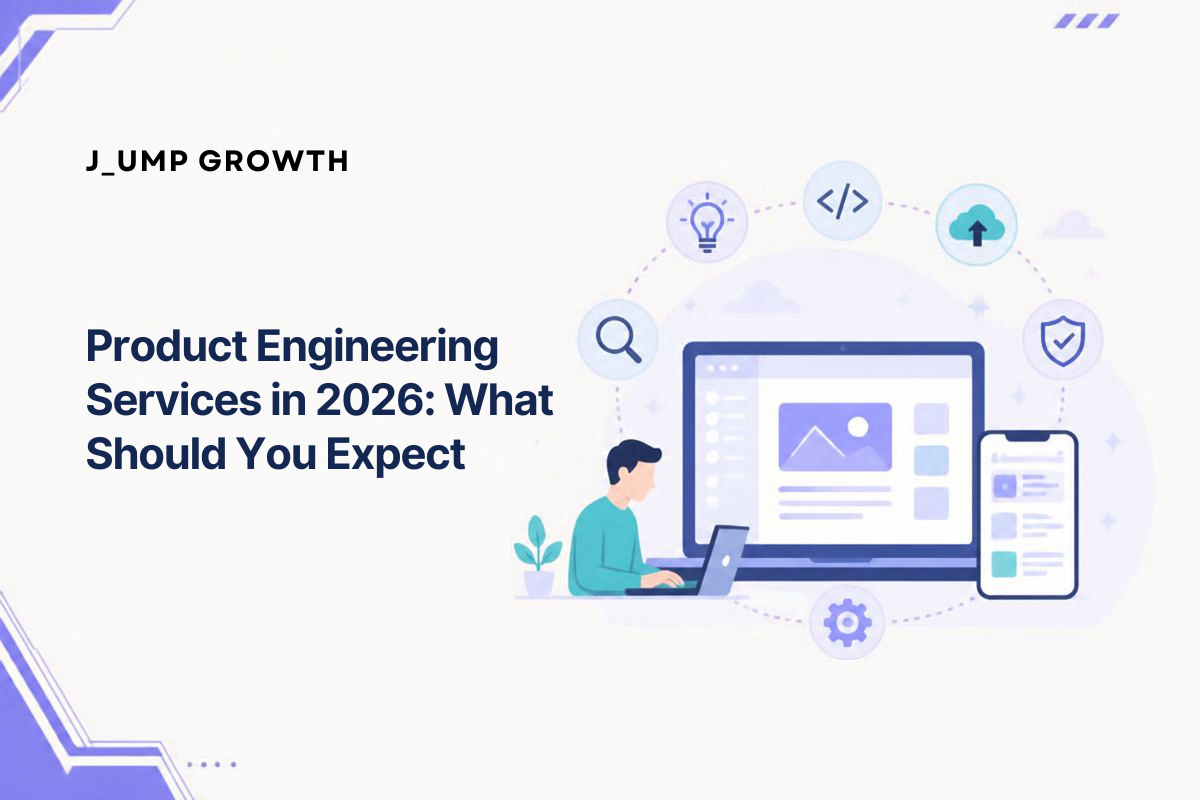
Product Engineering Services in 2026: What They Actually Include (And What to Demand from a Partner)
- Written by
- Hemant Madaan
- Published
- 22 September 2026
- Reading time
- 11 minutes
Let’s Get One Thing Straight First
A client came to us last year after burning eight months with a vendor calling itself a product engineering firm. What they actually got: a working prototype and a Slack message that more or less said good luck. No CI/CD pipeline. No observability setup. No record of why any architectural decision was made. Just a GitHub repo and the ghost of a pitch deck.
That’s not product engineering.
That’s glorified freelancing with better branding. The term gets thrown around constantly right now, mostly because pure outsourcing developed a bad reputation and agencies needed something shinier to put on their homepage. But there’s a real discipline underneath the buzzword. In 2026 it actually means something specific, and this piece is about what it should include, where vendors quietly cut corners, and how to tell the difference before you sign something you’ll spend the next year regretting.
What Modern Product Engineering Services Actually Cover
The scope has expanded considerably over the past three years. Some of that comes from AI tooling maturing faster than most teams expected. Some of it is just market reality catching up: shipping fast on a shaky foundation creates expensive problems five or six months out, and clients have started noticing the pattern. Here’s what a legitimate engagement looks like end to end, from someone who’s been inside enough of them to have actual opinions about it.
Architecture Design and Technical Strategy
Not just “we’ll use microservices” scrawled on a Miro board during a discovery call. Real architecture work means documented decisions about service boundaries, data models, API contracts, and failure modes. A credible software product development company produces Architecture Decision Records from day one. Not optional. Not nice-to-haves.
When your team doubles in eighteen months or you bring in a new CTO who wants to understand why certain calls were made, those records are what prevent a full rewrite. We default to event-driven patterns for anything with high-write throughput and synchronous REST only where latency tolerance gives us actual room to breathe. That’s an opinionated call. A real partner makes opinionated calls. If your vendor never pushes back on your architecture ideas, that’s a warning sign, not a sign that they agree with you.
AI Integration – Not a Feature, a Layer
AI stopped being optional somewhere around 2023. It’s now baked into the engineering layer itself on most serious product builds. Vector search embedded into data pipelines. LLM APIs wired into user-facing features with real latency budgets defined upfront. ML inference getting tested in CI/CD the same way any other code change does. Not a ChatGPT wrapper slapped onto an input form.
The implementation specifics are what separate teams who actually do this from teams who put it on slide seven of their deck. If a vendor claims AI integration but goes quiet when you ask about prompt versioning, model observability, or what happens when an inference call times out, walk away. These are solved problems in 2026. Any team doing this at real scale has formed strong opinions about them, and those opinions should surface unprompted during a technical conversation, not after you ask three follow-up questions.
DevOps and Infrastructure as Code
Terraform or Pulumi for infrastructure. GitHub Actions or ArgoCD for pipelines. Prometheus and Grafana for observability, or something defensible in their place. The specific tools matter less than whether they’re automated, documented, and actually owned by the product team rather than a single contractor who takes all the tribal knowledge with them when the engagement ends.
One thing we push for on every single engagement: real runbooks. Written by the engineer who built the system, not a vague wiki page copy-pasted from Stack Overflow at two in the morning. When something breaks at 2am (and it will), you want step-by-step instructions from someone who has already seen that exact failure mode. Not a document that says “check the logs” and wishes you luck.
QA That’s Built In, Not Bolted On
End-of-sprint QA is a 2015 approach. Modern product engineering runs tests in the pipeline, uses contract testing for service boundaries (Pact is still the standard here in most stacks), and treats performance testing as a non-negotiable pipeline gate. Some teams we work with introduce chaos engineering as early as month two. That’s not excessive if you’re building anything with real SLA requirements attached to it.
Shift-left QA also means QA engineers sitting in sprint planning, not showing up for the first time at sprint review. The difference in defect detection rate is measurable. Not subtle. Teams that skip this step usually find out why they shouldn’t have about four sprints in.
Post-Launch Iteration and Product Lifecycle Support
This is where most outsourcing relationships quietly fall apart. Contract wraps up, team rolls off, and the client is left maintaining a codebase nobody on their side fully understands. A real engineering partner structures knowledge transfer as continuous work throughout the engagement, not a frantic two-week scramble at the finish line. Pair programming between their engineers and yours. Documentation sprints built into the regular cadence. On-call rotations that include both teams during transition windows.
Post-launch iteration also means using actual usage data to drive what gets built next. Not stakeholder gut feel, not the loudest voice in the room. Session analytics, error rates, user path analysis feeding directly into the backlog. The vendors who skip this part are almost always the ones whose former clients show up talking to us eight months later.
Product Engineering vs. Traditional Software Outsourcing: A Direct Comparison
People use these terms interchangeably. They shouldn’t. The operational and contractual differences are significant enough to change outcomes, not just semantics. The table below breaks down where the real gaps are.
| Dimension | Traditional Software Outsourcing | Product Engineering Services |
|---|---|---|
| Engagement Model | Fixed-scope, deliverable-based contracts | Outcome-based, iterative, milestone-driven |
| Team Structure | Dedicated headcount assigned to tasks | Cross-functional pod with shared ownership across disciplines |
| Architecture Ownership | Vendor-defined, rarely documented for the client’s benefit | Co-owned, ADRs handed over as actual deliverables from day one |
| AI/ML Integration | Typically an add-on, scoped and priced separately after the fact | Built into the engineering layer from sprint one, not appended later |
| QA Approach | End-of-sprint testing cycle | Automated, shift-left, pipeline-gated throughout |
| DevOps Responsibility | Client-side or handed off to a separate DevOps contractor | Inside the pod, IaC from day one |
| Post-Launch Support | Optional retainer, often billed at a higher rate than the build phase | Structured handover with continuous knowledge transfer built into the cadence |
| Success Metrics | On-time delivery, staying in budget | Engineering velocity, uptime, feature adoption rates in production |
| Pricing Model | Time-and-materials or fixed price | Hybrid: capacity base plus outcome bonuses is increasingly standard |
The pricing row is worth sitting with for a minute. Outcome-based pricing aligns incentives in a way that fixed-price or T&M simply doesn’t replicate. When a vendor gets paid the same whether your feature ships successfully or quietly fails in production, they optimize for shipping. Not for outcomes. That misalignment is structural. No amount of good intentions from the delivery team fixes a bad contract structure underneath it.
What the Data Actually Says About Engineering Velocity
McKinsey’s Developer Velocity Index research found that companies in the top quartile of engineering velocity grow revenue four to five times faster than those sitting in the bottom quartile. The practices separating those groups: automated testing, trunk-based development, and integrated platform tooling. All of these are standard in a product engineering model. All of them are uncommon in basic outsourcing arrangements. (McKinsey Developer Velocity Report)
Forrester’s research on outcome-based technology partnerships found that organizations using outcome-oriented vendor contracts reported 30% higher satisfaction with delivery quality and 25% fewer post-launch defects compared to traditional time-and-materials models. The causality isn’t complicated: vendors with skin in the outcome make fundamentally different architectural trade-offs from the start, because those trade-offs eventually become their problem too. (Forrester: State of Technology Outsourcing)
Then there’s DORA data, which is the most concrete measure we have. Google’s DevOps Research and Assessment program consistently shows elite-performing teams deploying 973 times more frequently than low performers, with lead times for changes running 6,570 times faster. (DORA State of DevOps 2023) Any partner who can’t tell you their own DORA benchmarks probably isn’t tracking them. Ask anyway. The reaction to the question alone is informative. Discomfort is data.
How to Actually Evaluate a Vendor: A Scorecard
Stop evaluating vendors on slide decks and case study PDFs. Here’s a practical scorecard we use when helping clients choose a software development partner. Score each dimension one to five, then weight the ones that matter most for your specific situation rather than treating everything equally.
| Evaluation Dimension | What to Actually Ask | Red Flag Answer | Weight (1-3) |
|---|---|---|---|
| Architecture Documentation | Can you show us ADRs from a past project? | “We document everything at the end of the engagement” | 3 |
| AI Integration Depth | How do you handle prompt versioning and model drift in production? | Blank stare, or some version of “we use the OpenAI API” | 3 |
| DevOps Maturity | What’s your average deployment frequency on current active projects? | “It really depends on what the client prefers” | 3 |
| QA Integration | Where does QA actually sit in your sprint cycle? | “We have a dedicated QA phase at the end of each sprint” | 2 |
| Knowledge Transfer | How do you structure team transition as the engagement winds down? | “We do a two-week handover period” | 3 |
| Pricing Model | Is any part of your fee actually tied to product outcomes? | “We only work on fixed price or T&M” | 2 |
| Reference Quality | Can we speak with a client whose product is two or more years post-launch? | References only from recent or still-active engagements | 3 |
| Security Practices | How is security integrated into your SDLC, not just reviewed before launch? | “We run a security review before we ship” | 2 |
The reference quality question is the one most people forget. A vendor who delivered a solid MVP two years ago, whose client’s product is still running reliably in production today, tells you something fundamentally different than a vendor with a lot of recent happy clients and no long-term track record to speak of. Post-launch durability is a product engineering metric. It doesn’t show up anywhere in a six-month case study PDF.
And if a vendor genuinely can’t produce a reference who’s two years post-launch, that’s also useful information. Maybe they’re newer. Maybe clients don’t stay. Either way, you’ve learned something before signing anything.
Honest Caveat Before You Go Evaluate Anyone
Here’s what vendor sales conversations won’t surface: even a genuinely good product engineering firm will underperform if your internal team isn’t equipped to be a real counterpart. We’ve watched this play out when clients treat an external engineering partner like a vending machine. Requirements go in, working software is supposed to come out, nobody on the client side engages on trade-offs, and then everyone acts surprised when the product doesn’t actually fit the use case.
If you don’t have a technical product manager or an internal engineer who can review architecture proposals and push back intelligently, you will get taken advantage of. Probably not through bad intent. More through the path of least resistance: partners optimize for decisions that get approved quickly, and without someone on your side whose job is to slow that down when it matters, you’re not really a counterpart. You’re a checkbox.
Get that person in place before you sign. Seriously. It’s the single highest-value thing a client organization can do to get real results from a product engineering engagement, and almost nobody does it first.
FAQ
01What is the difference between product engineering services and custom software development?
Custom software development usually means building something to a client’s spec, with a defined scope and a handover at the end. Product engineering services implies ongoing co-ownership across the product lifecycle: architecture decisions, DevOps, QA integration, AI layer management, post-launch iteration driven by real usage data. The relationship model is fundamentally different. One is vendor-client. The other is closer to a technical co-founder arrangement, which sounds like marketing language until you’ve actually been through both and felt the difference in how trade-off conversations go.
02How does AI in product development actually get integrated by engineering partners in 2026?
The practical implementation varies but usually includes embedding vector search and retrieval-augmented generation into data pipelines, integrating LLM API calls with defined latency budgets and fallback logic for when inference fails or hangs, setting up model observability through tools like LangSmith or Weights and Biases, and treating prompt templates as versioned artifacts in the codebase rather than strings somebody typed into a config file and forgot about. The core distinction from older approaches is that AI gets treated as an infrastructure layer with the same operational rigor as any other service dependency. Not a plugin. Not something you revisit after launch when it starts behaving strangely.
03How long should a product engineering engagement last before expecting measurable outcomes?
Engineering velocity improvements typically show up in DORA metrics within 60 to 90 days if the partner already has solid DevOps practices in place and isn’t building those from scratch. Business outcome metrics like feature adoption and error rate reduction take longer, usually four to six months minimum, because you need enough post-launch data to make any comparison meaningful rather than just directional. Be skeptical of vendors promising visible ROI inside the first 30 days. That almost always means they’re measuring something easy rather than something that actually matters to the business.
Keep reading
- Software Development
What Is Reverse Engineering in Software Development? Process, Benefits, Challenges, and Use Cases
14 minutes readRead article - Software Development
Custom Software Development Company vs. In-House Team: A 2026 Cost and Risk Analysis
11 minutes readRead article - Software Development
JumpGrowth vs. Other Dallas Software Development Companies: How to Evaluate Your Options in 2026
10 minutes readRead article
Build your team
Share where the roadmap is blocked and the capabilities you need. We’ll map a practical team and delivery model.
Comments
Be the first to comment.