

- Software Development
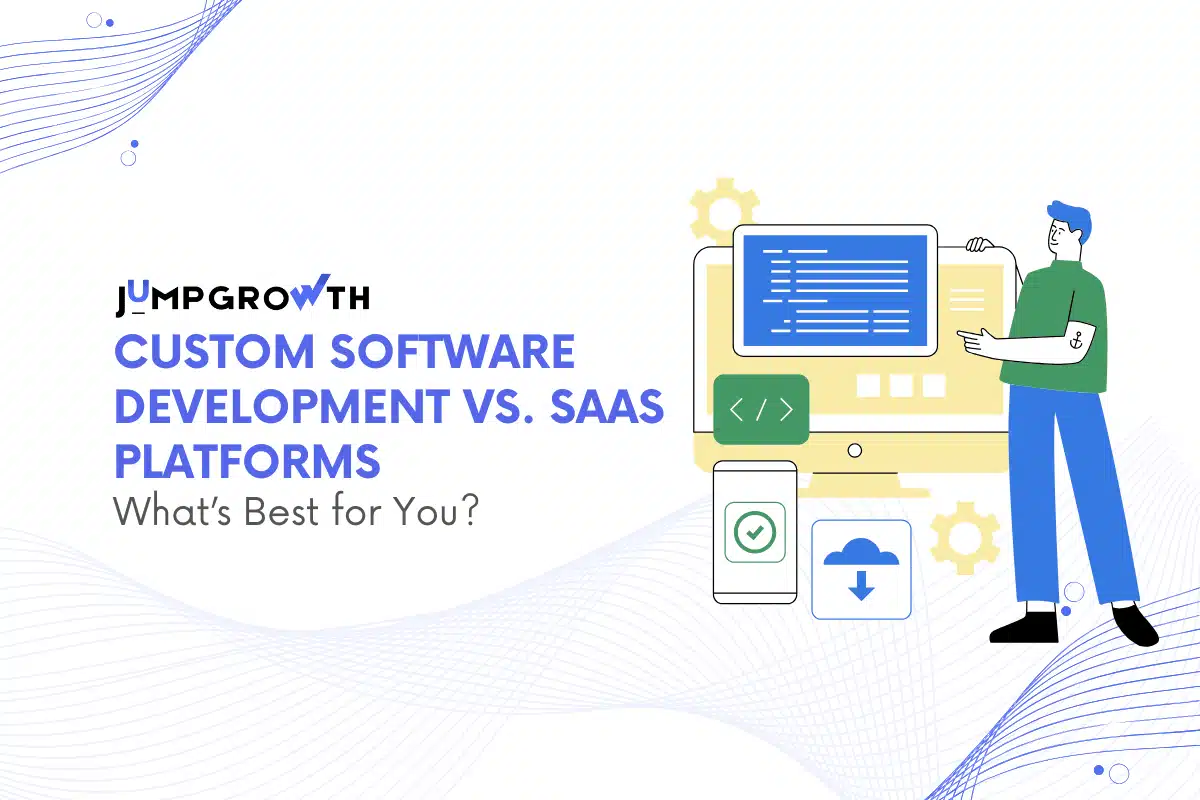
Custom Software Development vs. SaaS Platforms: What’s Best for You?
- Written by
- Hemant Madaan
- Published
- 1 October 2025
- Reading time
- 9 minutes
Factor 1: Cost – The Upfront Sting vs. the Subscription Squeeze
Let’s talk about money first, because that’s what matters for everyone, a kind of elephant in the room. SaaS platforms for businesses shine here with low entry barriers. You pay a monthly fee think $10 to $100 per user and you’re off to the races. No big developer bills eating your capex. According to a Statista report in 2022, the average initial cost per user for SaaS hovers around $170, a steal compared to custom software development’s $4,200 kickoff. That’s the SaaS advantage in a nutshell: Predictable opex that scales with users, without the shock of a massive build. But flip the coin, and custom software benefits kick in over time. Sure, that upfront hit stings; hiring devs, scoping requirements but once built, you own it. No endless subscriptions draining your wallet as features pile up. We’ve crunched numbers on projects where clients recouped costs in 18-24 months through efficiency gains, dodging those sneaky SaaS price hikes (which averaged 10-15% annually last year, per industry chatter). The catch? If your needs change fast, custom can lock you into rework fees. SaaS? It is flexible at the beginning but as your business grows you have to opt for a customs solution for better accuracy and smoother workflows.Factor 2: Flexibility and Customization – One-Size-Fits-Most vs. Your Wildest Dreams
Flexibility, the heart of the custom software vs SaaS debate. SaaS platforms are like Swiss Army knives, can handle 800% of your tasks and for remaining 20% you can use add-ons and plug ins. You tweak dashboards, automate workflows via no-code tools, and boom, you’re customized. The advantages? Quick wins without coding headaches. But here’s where SaaS disadvantages rear up: You’re stuck in their ecosystem. It’s like renting an apartment, you can paint the walls, but don’t knock down that load bearing one. Custom software development? That’s your blank canvas. We build exactly what you envision: Algorithms tuned to your data quirks, UI flows that match your team’s quirks (we’ve even coded in coffee-break reminders for night-owl coders). A 2024 Gartner report notes pre-built platforms cut upfront costs by up to 60%, but custom delivers 35% higher operational efficiency for tailored fits. The trade-off is time more on that later. If your business thrives on unique processes, like a logistics firm tracking perishable goods with AI predictions, custom lets you innovate without vendor vetoes. SaaS keeps it simple, but at the cost of feeling boxed in.Factor 3: Scalability – Growing Pains or Smooth Sailing?
Scalability is where many SaaS romance sours. Platforms scale effortlessly at first; add users, pay more, done. But hit a growth spurt, and you might slam into limits. A 2023 Gartner study found 41% of execs struggle scaling SaaS due to data quality snags, especially in AI-heavy tools. It’s great for steady climbs, but explosive needs? Those tiered plans can jack up costs 5x overnight, and custom integrations might not play nice. Enter custom software benefits: Built to your blueprint, it scales like a well-oiled machine. We design for bursts say, holiday surges in e-commerce without bloating fees. Companies using custom solutions report 20% revenue bumps over three years from seamless growth, per recent benchmarks. Downside? Poor planning leads to costly refits. We’ve seen this in our projects a mid-sized retailer who outgrew their SaaS inventory tool and switched to custom, slashing stockouts by 40%. If predictability is your jam, SaaS edges out. For ambitious expansion, custom’s your growth partner.Factor 4: Maintenance and Updates – Hands-Off Ease vs. Full Control
Maintenance: The unglamorous grind that keeps software humming. SaaS handles this like pro vendors push updates automatically, patching bugs and adding bells overnight. No IT team sweating server downtimes. That’s a huge SaaS advantage for busy CTOs juggling fires elsewhere. Per a 2024 Zylo report, orgs juggle 275 SaaS apps on average, with auto-updates keeping chaos at bay. Custom software flips the script. You call the shots on updates, tweaking for your pace not the vendor’s roadmap. But it means budgeting for ongoing dev support, maybe 15-20% of initial costs yearly. The perk? No forced changes disrupt workflows. It’s like owning a classic car: You maintain it your way, avoiding those surprise recalls. SaaS disadvantages show when updates break integrations frustrating, right? Custom gives peace of mind if compliance is key.Factor 5: Integration with Existing Systems – Plug-and-Play vs. Bespoke Bridges
Your tech stack is a patchwork quilt, right? SaaS platforms boast APIs galore for quick plugs Zapier this, webhook that. It’s speedy for mid-sized setups, linking CRM to email in hours. But deep dives? Vendor lock-in can force workarounds, hiking costs. Custom software development excels here: We weave it into your legacy systems like a custom graft. No compromises. A real-world example: One of our old clients was using an ERP and honestly at the first glance that looked like a dinosaur; everything was cluttered, and newbies can even perform a single operation on it. We understand their workflows and requirements and designed custom bridges to their new inventory tool. Our ERP allows their systems to synchronize data in real data, which effectively reduces manual error by 60%.Factor 6: Security and Compliance – Shared Umbrella vs. Your Fortress
Security’s non-negotiable in B2B land. SaaS spreads the load vendors invest in top-tier encryption, SOC 2 compliance, the works. A 2024 Gartner insight shows 45% of firms ditched software over security gaps, but SaaS often dodges that bullet with shared responsibility. Easy peas for most. Custom? It’s your vault: Built to exact regs like HIPAA or GDPR, with code you audit. No third-party blind spots. The flip: Your foot the security bill, but it pays in trust. For sensitive data handlers, customs’ edge is clear.Quick Comparison: Custom Software vs SaaS at a Glance
To make this software solution comparison pop, here’s a handy table. It stacks up our six factors side-by-side grab a screenshot for your next team huddle.| Factor | SaaS Platforms for Businesses | Custom Software Development |
|---|---|---|
| Cost | Low upfront ($170/user avg.); ongoing subs rise with scale. | High initial ($4,200/user); long-term savings via ownership. |
| Flexibility | Good for basics; limited deep tweaks. | Fully tailored; matches unique needs perfectly. |
| Scalability | Easy user adds; caps on advanced growth. | Built-in for surges; cost-effective expansion. |
| Maintenance | Auto-updates; vendor-managed. | Self-paced; full control but requires support. |
| Integration | API-friendly; shallow depth. | Seamless with legacy; no compromises. |
| Security | Shared model; strong defaults. | Custom fortress; precise compliance. |
Your Decision-Making Checklist: Pick the Right Path
Still torn? Run through this quick checklist, it’s designed for mid-sized movers like you.- Budget Check: Can you swing a big upfront for 2–3-year payback, or need opex now? (Lean: SaaS; Invested: Custom)
- Uniqueness Quiz: Do 70% of your processes match off-the-shelf tools? (Yes: SaaS; No: Custom)
- Growth Gauge: Expect 50%+ headcount jump in 18 months? (Steady: SaaS; Explosive: Custom)
- Tech Savvy: Got in-house devs for tweaks? (Yes: Custom; No: SaaS)
- Risk Radar: Vendor dependency a nightmare? (Yes: Custom; Fine: SaaS)
- Timeline Test: Need live in weeks? (SaaS; Months: Custom)
Wrapping up
Choosing between custom software and SaaS isn’t about perfection, it’s about alignment, whatever goes best with your needs is the best for you. We’ve walked this road with clients who started regretting SaaS lock-in and flipped to custom for that “aha” efficiency surge. Or stuck with platforms that freed them to focus on core biz. Weigh your factors, and you’ll land right. Curious how this plays out for your setup? Dive deeper into our custom software development services to see real-world wins. Better yet, drop us a line for a free consultation, we’ll map a tailored software solution over virtual coffee, no strings. What’s one burning question on your mind?FAQs
01What are the typical costs for each option, beyond the basics?
SaaS often starts cheap but layers on fees for premium features, storage, or support expect 20-30% annual hikes. Custom involves dev teams ($100K-$500K initial for mid-sized projects) plus 15% yearly maintenance. Factor in ROI: Custom can pay back faster via efficiencies, while SaaS suits variable needs without capex shocks. Always model your usage.
02How long does implementation take for custom vs. SaaS?
SaaS deploys in days to weeks sign up, configure, go. Custom? 3-12 months, depending on scope, with agile sprints keeping it iterative. Pro tip: Start with an MVP to test waters quickly. Delays hit custom harder if requirements shift, but the end fit is worth it for complex builds.
03Can these solutions integrate with my legacy systems easily?
SaaS uses APIs for solid surface-level links, but deep merges might need middleware like MuleSoft, adding cost. Custom builds direct bridges, handling quirky data flows seamlessly. Assess your stack’s age modern APIs favor SaaS; ancient mainframes scream custom. Test with proof-of-concept early.
04What are the main risks of choosing SaaS over custom?
Vendor lock-in tops the list: Switching costs soar if they hike prices or drop features. Scalability walls and data silos follow. Mitigate with multi-vendor strategies and exit clauses in contracts. It’s a low-risk entry but watch for over-reliance on one tool.
05When should I lean toward custom software benefits?
Go custom if your ops are niche think regulated industries or proprietary workflows. It shines for IP protection and exact fits, boosting efficiency 30%+ long-term. Skip if you’re in flux; SaaS’s agility wins there. Hybrid approaches (SaaS core + custom add-ons) bridge gaps nicely.
06How do I handle ongoing support for either?
SaaS bundles it in 24/7 tickets, auto-fixes. Custom needs a retainer with your dev partner for updates and bug hunts. Budget 10-20 hours monthly post-launch. Train your team early; both benefit from clear docs to cut dependency.
Keep reading
- Software Development
What Is Reverse Engineering in Software Development? Process, Benefits, Challenges, and Use Cases
2 minutes readRead article - Software Development
Product Engineering Services in 2026: What They Actually Include (And What to Demand from a Partner)
11 minutes readRead article - Software Development
Custom Software Development Company vs. In-House Team: A 2026 Cost and Risk Analysis
11 minutes readRead article
Build your team
Share where the roadmap is blocked and the capabilities you need. We’ll map a practical team and delivery model.
Comments
Be the first to comment.