

- Software Development
Hiring Freelancers vs Nearshore Engineers: What Works Better for Scaling Products?
- Written by
- Hemant Madaan
- Published
- 28 August 2025
- Reading time
- 9 minutes

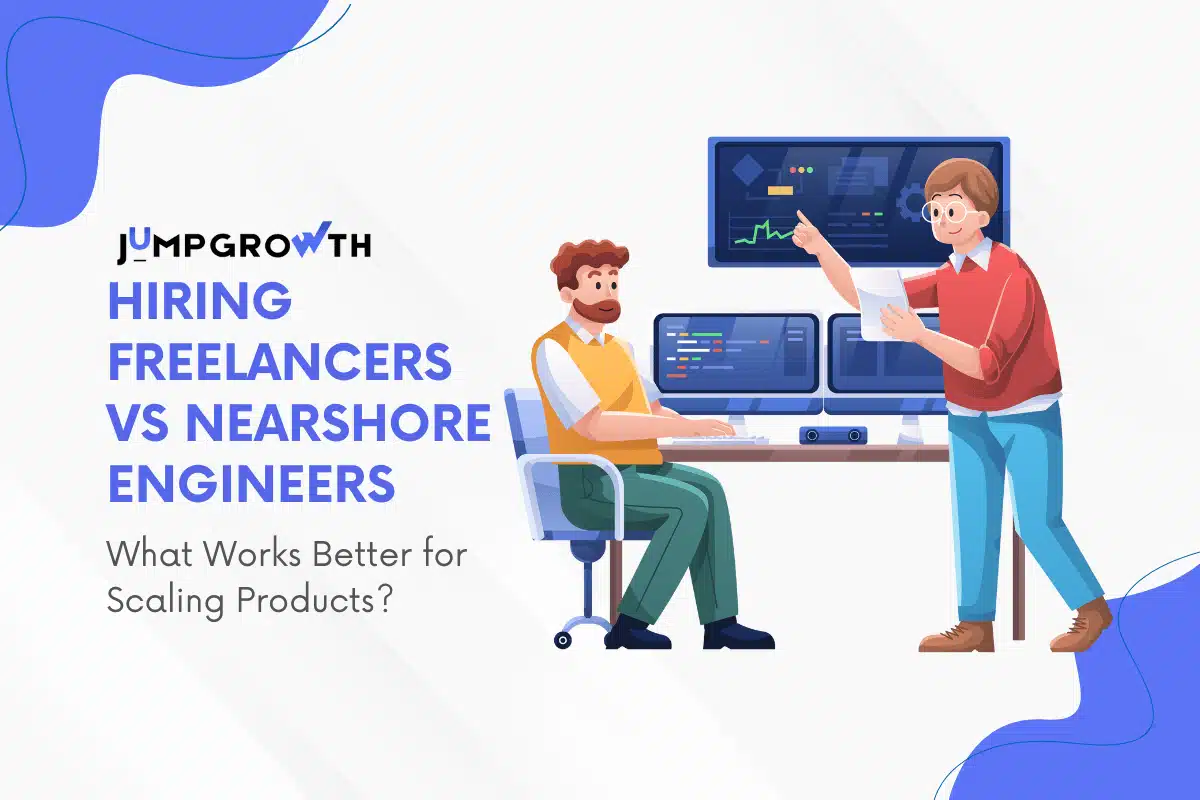
Freelancers vs. Nearshore Engineers
With the evolving technology companies also need to evolve their way of hiring new talent. There was a time when everyone considered outsourcing tasks to freelancers but today the time has been changed and there is a way better than outsourcing to handle the project requirements: Nearshore Outsourcing. Many companies get confused between outsourcing and nearshore outsourcing and take them as the same thing, with the only difference being location. However, Nearshore outsourcing is way more than just nearby locations; it is about cost, speed, collaboration, and quality. Honestly, if you choose the wrong model to hire or scale your team, you will end up losing a fortune, or you might end up wasting months by messing up with your team and project. So, let’s start our Freelancers vs. Nearshore outsource guide.What Exactly is Nearshore Outsourcing?
Nearshore outsourcing is an upgraded version of outsourcing where organizations hire developers or required talent from nearby countries that share similar time zones and working culture. For example, A U.S.-based company hires a development team in Mexico or Costa Rica, or a U.K.-based startup works with developers in Poland or Portugal. Now you might be wondering why organizations prefer hiring teams from nearshore countries instead of hiring from faraway countries, so the reasons are:- Real-time collaboration: When you hire talent from nearby countries both your in-house and nearshore team will be working in the same or similar time zone which means your teams can work concurrently without waiting for hours for a simple response.
- Cultural alignment: Companies from the nearby countries will be following the same work ethics, communication style and most importantly the same holidays.
- Quality and accountability: Compared to Outsourcing, nearshore outsourcing allows businesses to hire a complete team under the same roof with a dedicated project manager. Whereas when you hire freelancers, you have to hire them solely and managing them really becomes a hassle.
Freelancers: Who Are They and Why Do Businesses Love Them?
Freelancers are individuals professionals who work on multiple projects simultaneously, they can live in any corner of the world and any time zone.- They’re affordable for short-term tasks.
- They offer flexibility – You can hire them only for a specific task when needed.
- They bring specialized skills for specific problems.
Nearshore Outsourcing vs Freelancing – The Key Differences
| Factor | Nearshore Engineers | Freelancers |
|---|---|---|
| Team Structure | Full team (PM, QA, DevOps) | Independent professionals |
| Time Zone | Same or similar | Varies globally |
| Communication | Real-time, quick syncs | Asynchronous, delays possible |
| Scalability | Easy to add/remove engineers | Hard to manage multiple freelancers |
| Quality Control | Vendor-managed, structured processes | Individual responsibility only |
| Cost | Predictable, slightly higher upfront | Lower initial but can balloon with delays |
| Security & IP Protection | Strong legal contracts | High risk without NDAs |
Pros and Cons of Hiring Freelancers
Pros of Freelancers- Low initial cost – Hiring a freelancer is cheaper but only if you have quick bug fixes or small tasks that can be done within a week.
- Flexibility – They are truly flexible, and you can hire them only when you have workload without any long-term commitments.
- Global talent pool – You can hire freelancers from all around the globe without any time zone constraints.
- Communication delays – If you’re looking to reduce the project cost by hiring freelancers then most of the time, you’ll end up hiring freelancers from countries with different zones. Hence, you have to wait for hours to get a simple reply or fix.
- Quality inconsistency – Every work differently and in different zones so your team of freelancers will find difficulties to work simultaneously.
- No scalability – Managing a team of freelancer is a hectic task specially when they are from different countries, Sometime communication and culture compatibility also become an issue. Managing 5-10 freelancers is a nightmare.
- Security risk – Freelancers live in a different country, and there will be no security or privacy. If you hire the wrong guy, they may share your source code and sensitive data with their other clients.
Why Companies Prefer Nearshore Engineers for Scaling Products
You will always find a cheaper option in freelancing, which is not a great option in the long run, especially when you want to scale. Any organization that wants to scale its business needs speed, consistency, accountability, and expertise. That’s where nearshore software engineers shine.- Shared Time Zones = Better Collaboration: As mentioned earlier, nearshore developers will be following same time zones which means you can work simultaneously. With nearshore teams you can do daily stand-ups, sprint planning, and real-time debugging without any hassle.
- Full Team Support: Most nearshore software development services provide full team solely working on your projects including project managers, QA testers, DevOps, etc. In nutshell you got a mini software house without any investment in infrastructure and training.
- Scalability Without Chaos: This is the best thing which nearshore offers you can scale your team as per need without doing anything. If you think you want to add 3 developers next month? Done, just ask your nearshore service provider and they will give you the best options. With freelancers, you must find, onboard, train them and then hope they will stick to your project with all dedication.
- Higher Quality Standards: Every nearshore service provider maintains their goodwill in the market and follows strict security and privacy compliances with coding standards, CI/CD pipelines.
Cost Comparison: Freelancers vs Nearshore Engineers
| Model | Average Hourly Rate | Hidden Costs |
|---|---|---|
| Freelancers | $20–$80 | Project delays, rework, lack of availability |
| Nearshore Teams | $35–$70 | Minimal hidden costs, predictable monthly fees |
- Freelancers = Best for small, isolated tasks.
- Nearshore Engineers = Best for long-term scaling and complex projects.
Which Option Should You Choose? (Decision Framework)
There is no exact answer for this question, but to find out which model you should prefer, ask yourself a few questions:- Do I need one-time tasks or continuous development?
- Is real-time communication critical for me?
- Do I want predictable costs or cheap but risky flexibility?
- How important is security and IP protection?
FinalThoughts
At the end of the day, the freelancers vs nearshore engineers debate ends with one thing that is your growth goals. If you want quick fix with cheap and flexible professionals, you can go with the freelancer but if you are looking for reliable, scalable, and perfect option for product growth then only hire nearshore engineers from reliable nearshore service provider like JumpGrowth.FAQs
01Is nearshore outsourcing expensive?
Not really. It’s slightly more expensive than freelancers but cheaper than hiring in-house. Plus, you save on management and quality issues.
02Can I start with freelancers and later switch to nearshore engineers?
Yes, but transitions take time and cost. If you know you’ll scale, start with Nearshore.
03How do I hire nearshore engineers quickly?
You can use trusted partners offering
nearshore development servicesto get a vetted team within days.
04What is the difference between Nearshore and outsourcing?
Outsourcing is a general term for hiring external vendors (from any location) to handle business tasks or services. Nearshoring is a type of outsourcing, specifically to companies in nearby or neighboring countries (usually in a similar time zone).
05What is better than a freelancer?
If you’re looking for a reliable scalable and solely committed professional working on your project, then nearshore engineers are better than a freelancer.
06What is nearshore work?
Nearshore work refers to business operations (like software development, customer support, etc.) that are outsourced to a nearby country usually sharing a similar time zone, culture, or language.
Keep reading
- Software Development

What Is Reverse Engineering in Software Development? Process, Benefits, Challenges, and Use Cases
2 minutes readRead article - Software Development

Product Engineering Services in 2026: What They Actually Include (And What to Demand from a Partner)
11 minutes readRead article - Software Development
Custom Software Development Company vs. In-House Team: A 2026 Cost and Risk Analysis
11 minutes readRead article
Build your team
Share where the roadmap is blocked and the capabilities you need. We’ll map a practical team and delivery model.
Comments
Be the first to comment.