

- Software Development
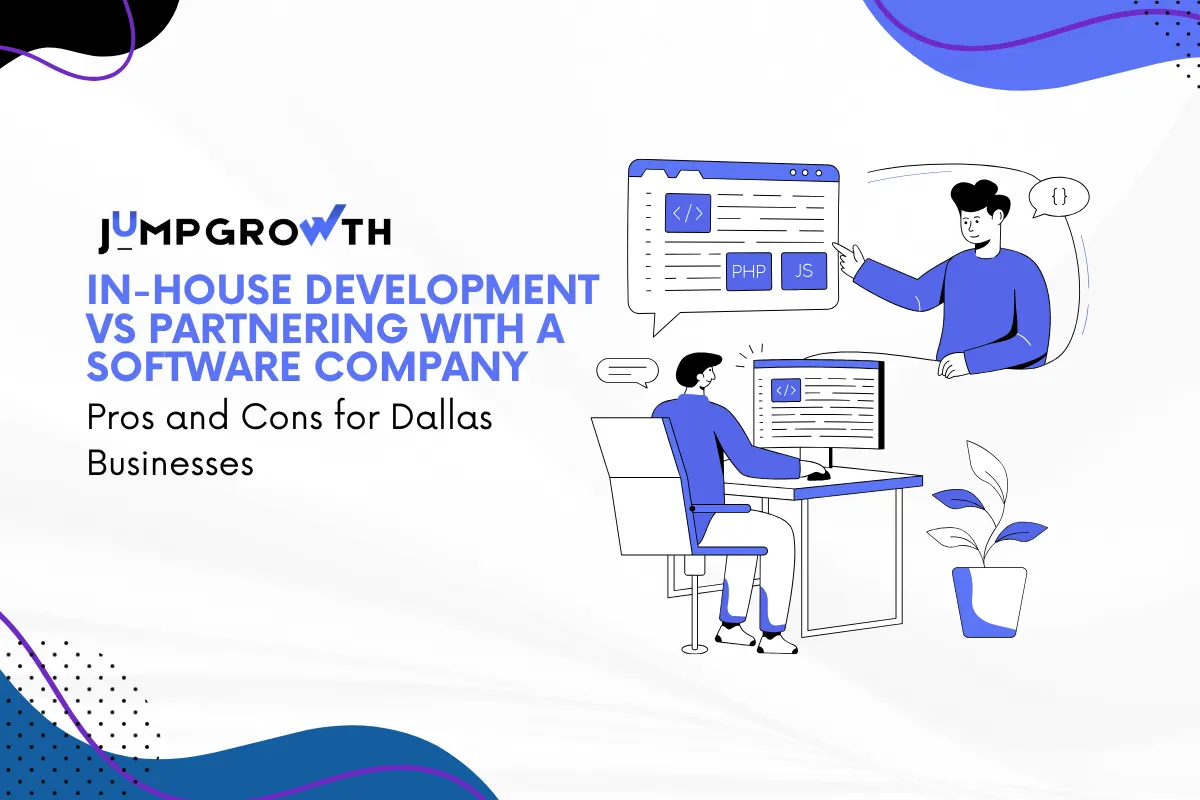
In-House Development vs Partnering with a Software Company: Pros and Cons for Dallas Businesses
- Written by
- Naval Madaan
- Published
- 21 April 2026
- Reading time
- 9 minutes
| $120K+ Average Dallas senior dev salary in 2026 | 3–6 months Typical time to hire a senior engineer locally | 40–60% Potential savings by outsourcing software development | +30–50% Overhead on top of salary (benefits, taxes, tools) |
If you’re running a tech product, or any business that depends on software development, you’ve had this conversation. Do we build the team internally, or do we find a software development company in Dallas to partner with? Both answers can be right. And both can be catastrophically wrong if you choose for the wrong reasons.
This isn’t a guide that’s going to tell you, “It depends” and leaves you where you started. We’re going to look at the actual numbers for the Dallas market, lay out the real trade-offs, and give you a framework for making the call that fits your specific situation.
The real strategic questionThe real question isn’t “which model is better?” It’s “which model fits this project, this team, and this moment in your company’s growth?”
What in-house software development actually costs in Dallas
Dallas has a strong and growing tech scene, which is great for business and painful for hiring. The DFW market sits somewhere between Austin’s startup intensity and a more traditional enterprise hiring environment. Either way, in-house software development is not cheap.
The salary is just the beginning. Add 30–50% for benefits, payroll taxes, equipment, software licenses, office space, and the hidden cost of HR overhead, and your true annual cost per engineer is significantly higher than the number in the offer letter.
| Role | Dallas Base Salary / yr | True Cost (+30–50% overhead) | Outsourced Equivalent (annual all-in) |
|---|---|---|---|
| Full-Stack Developer | $95K–$140K | $142K–$210K | ~$50K–$90K / yr (outsourced) |
| Frontend / Backend Dev | $85K–$130K | $128K–$195K | ~$40K–$80K / yr (outsourced) |
| Mobile Developer | $100K–$145K | $150K–$218K | ~$50K–$90K / yr (outsourced) |
| DevOps / Cloud Eng. | $115K–$160K | $173K–$240K | ~$55K–$100K / yr (outsourced) |
| Data / ML Engineer | $120K–$170K | $180K–$255K | ~$60K–$110K / yr (outsourced) |
| QA / Automation Eng. | $80K–$115K | $120K–$173K | ~$35K–$65K / yr (outsourced) |
| Engineering Manager | $140K–$200K | $210K–$300K | Not typically outsourced |
And that’s before your account for the time of hiring. Finding a senior full-stack developer in Dallas right now takes an average of 3–6 months. During that window, your product isn’t being built. If you need to move fast, in-house software development has a structural disadvantage that no amount of recruiting budget fully solves.
The cost nobody puts in the spreadsheetTurnover is one of the most overlooked costs in software hiring. The median tenure of a software engineer is often just 2–3 years. When they leave, replacement costs can reach 50–200% of their annual salary once you include recruiting, training, onboarding time, and the temporary drop in team velocity.
One of the less obvious advantages of outsourcing or staff augmentation is shifting this risk to a delivery partner.
Pros and cons, the honest head-to-head
You must not look through a vendor pitch or a recruiting brochure before you make the call between in-house software development and outsourcing software development. The following are the actual appearances of both the models:
| In-House Development | Partnering with a Software Company |
|---|---|
| ✔ Full control over team & culture | ✔ Access to a ready-vetted, senior team on day one |
| ✔ Deep domain knowledge builds over time | ✔ No recruiting, onboarding, or HR overhead |
| ✔ Faster internal communication | ✔ 40–60% lower cost vs. equivalent Dallas team |
| ✔ Easier IP protection in some contexts | ✔ Scale up or down without hiring/firing cycles |
| ✘ Expensive to hire in Dallas market | ✔ Access to specialists you can’t source locally |
| ✘ Months to recruit senior engineers | ✘ Requires clear brief and strong project management |
| ✘ Fixed overhead whether busy or not | ✘ Time zone overlap needs planning (if offshore) |
| ✘ Hard to find niche skills locally | ✘ Less embedded in your day-to-day culture |
| ✘ Exit costs: severance, notice periods | ✘ Finding the right partner takes due diligence |
A few things worth expanding on from that table:
On control, it’s more nuanced than you think
The ‘control’ argument for in-house is real but often overstated. Yes, you have direct management of an internal team. But if that team has knowledge of silos, depends on one critical engineer, or builds technical debt because they’re too busy to refactor, you’re not really in control. A well-run software development company in Dallas in partnership with clear contracts and defined deliverables can give you more predictability than a rushed internal hire.
On cost, the outsourcing benefits are real
The outsourcing benefits on cost aren’t just about offshore rates. Even Dallas-based software partners carry costs across multiple clients, so you’re not paying for their office, HR team, or bench time between projects. You pay for what you use. For most companies, that’s meaningful efficiency.
On culture, stop using this to avoid the math
Culture fit is a legitimate consideration for permanent hires. It’s not a good reason to avoid outsourcing when you need to ship fast or access skills you can’t hire locally. The companies that use ‘culture’ as the reason they only hire in-house are often the ones that take 8 months to build something a good partner could deliver in 10 weeks.
How to actually make the decision, a scenario-by-scenario guide
Stop thinking about this in the abstract. Map your situation to one of these scenarios and the right answer becomes much clearer:
| Your situation | Go-to choice | Why |
|---|---|---|
| Core product, long-term IP ownership | In-House | This is your crown jewel. You want the team embedded in the product’s past, present, and future. |
| MVP or v1, tight timeline, lean budget | Partner | A good software company in Dallas can ship in weeks. Building an in-house team takes months. |
| Need a niche skill for one project | Partner | Hiring a Rust developer or ML engineer full-time for a 4-month project rarely makes sense. |
| Scaling fast but cash is tight | Partner | Outsourcing benefits kick in hard here; senior talent at 40–60% of the local cost. |
| Regulated industry, strict data residency | Either | Both models can work with the right contracts. Get legal input on your specific requirements. |
| You need someone in the Dallas office | In-House | Some projects require physical presence. If that’s your situation, hire locally. |
| Ongoing product iteration post-launch | Both | Many Dallas companies use a core in-house team + a partner for burst capacity and specialist work. |
The honest take away from this table: most Dallas businesses end up using both. A small core in-house team for long-term product ownership and culture, combined with a trusted software development company in Dallas for velocity, specialist work, and scale. It’s not either/or.
Why Outsourcing Software Development Makes Sense for Dallas Businesses
The outsourcing benefits argument is always somewhat market specific. Here’s why the Dallas context in 2026 makes partnering especially compelling:
- Competition for talent is fierce. Talent competition is intense. There are large technological presences by AT&T, Toyota, JPMorgan, Goldman Sachs, and hundreds of others in Dallas. You are competing against firms with massive recruiting budgets and brand names. Outsourcing avoids the talent war altogether.
- The Dallas tech salary floor has risen fast. Median software engineering salaries in DFW have climbed 18–24% over the last three years. The gap between what a good engineer costs locally and what a software partner charges has widened, in favor of partnering.
- Speeding to the market is a competitive advantage. Dallas is a business-first city with a lot of companies trying to digitize legacy operations and build new products simultaneously. The ones that ship first win. Outsourcing compresses the timeline.
- Specialist skills are hard to find locally. If your project requires ML engineers, blockchain developers, or AR/VR expertise, the Dallas local market is thin for these roles. A good software partner gives you access to those skills without a national search.
How to hire a software development company in Dallas
Not all software partners are equal. A bad hire software development company in Dallas with experience, missed deadlines, poor code quality, communication breakdowns, tends to push companies back toward in-house hiring, sometimes permanently. Here’s how to avoid that.
What to look for
- A portfolio of shipped products, not just agency work. Ask to see live products they’ve built, not just landing page mockups.
- References you can actually call. Not testimonials on a website, real conversations with real clients who’ll give you honest feedback.
- A discovery process before they quote. Any serious software development company in Dallas will want to understand your requirements before naming a price. If they quote without asking questions, that’s a red flag.
- Clear IP and confidentiality terms in the contract. Your code, your IP. Non-negotiable. Make sure it’s explicit.
- Honest scoping conversations. The best partners will tell you when you’re trying to build too much for your budget. If they agree with everything without pushbacks, be skeptical.
Questions to ask before you sign
- “What does your QA process look like?”, the answer should be specific, not vague
- “How do you handle scope changes?”, there will be scope changes; you want a clear process, not a surprise invoice
- “Who actually works on my project?”, make sure you’re talking to the people who’ll be building, not just sales
- “Can we start with a small paid pilot?”, any confident partner will agree to prove themselves on a bounded piece of work
JumpGrowth works with Dallas businesses to design, build, and launch software products with honest scoping, clear contracts, and teams that actually understand what they’re building.
FAQs
011: Is Dallas cheaper to construct an in-house or outsource?
In the majority of the projects, it is much cheaper to outsource software development. Companies who outsource their project have reported a 40-60% lower development cost compared to teams within Dallas.
022: What kind of projects can a software development company partner best carry out?
MVPs, product launches, projects specific to abilities (mobile apps, data pipelines, API integrations), emergencies where you have to expand quickly and you cannot spend months hiring. A hybrid can sometimes be preferable to ongoing core product work, where the strategy and product decisions are handled by a small in-house team, and the execution capacity is handled by a software development company in Dallas.
033: How do I protect my IP if I outsource it?
With a well-written agreement. In any decent software partnership agreement, IP assignment clauses, NDAs, and work-for-hire provisions are to be found. Specifically, before signing, a lawyer must review the IP and confidentiality sections. This is not a place to boilerplate.
044: Can a Dallas-based software company work with us even if their developers are offshore?
Yes, and this is actually the most common structure. Many software development company Dallas firms have local account management and project leadership, with development teams across India, Eastern Europe, or Latin America. You get the time-zone and communication benefits of a local relationship with the cost and talent access benefits of an offshore team.
055: What is a reasonable timeline to ship a first version with a software partner?
The ideal time to ship your first version depends on your project requirements and complexity. Also, it depends on the approach your software partner is using. A reliable partner like JumpGrowth can build the first version of your software within 8-14 weeks.
Keep reading
- Software Development
What Is Reverse Engineering in Software Development? Process, Benefits, Challenges, and Use Cases
14 minutes readRead article - Software Development
Product Engineering Services in 2026: What They Actually Include (And What to Demand from a Partner)
11 minutes readRead article - Software Development
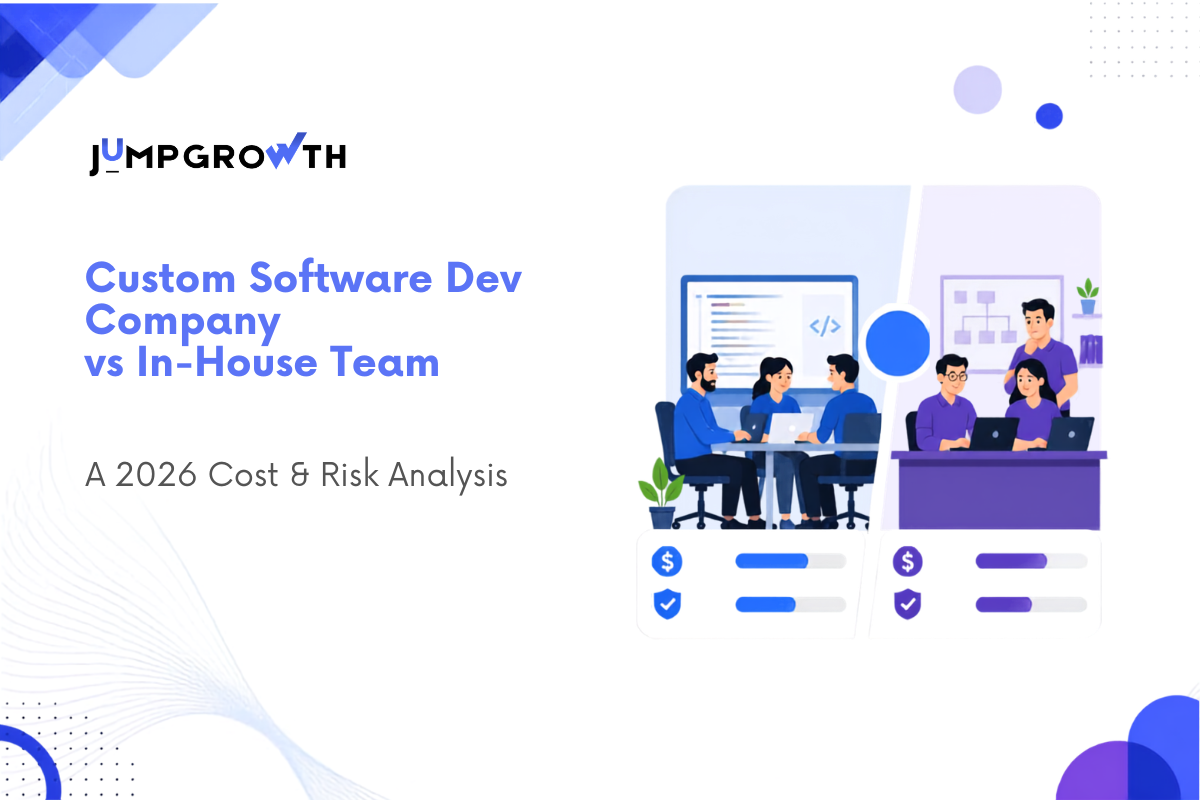
Custom Software Development Company vs. In-House Team: A 2026 Cost and Risk Analysis
11 minutes readRead article
Build your team
Share where the roadmap is blocked and the capabilities you need. We’ll map a practical team and delivery model.
Comments
Be the first to comment.