

- Software Development
Lending Platform Development: The Complete 2026 Guide to Features, Architecture, Cost, and Timeline
- Written by
- Hemant Madaan
- Published
- 4 November 2026
- Reading time
- 34 minutes
Lending platform development is the process of designing, building, integrating and maintaining software that runs the lending lifecycle: borrower onboarding, application, identity and credit checks, underwriting, approval, disbursement, repayment, servicing, collections and compliance reporting. Before building one, a lender needs to define its loan products, map its origination and servicing workflows, identify the third-party data and payment providers it will depend on, and understand which federal and state rules apply to its business model. Those decisions shape the architecture, cost and timeline far more than the choice of programming language.
A lending platform is not a loan application with a payment button. A basic loan app collects an application and shows a status. A lending platform calculates interest correctly every day for years, produces legally required disclosures, records why every credit decision was made, reconciles every payment against a bank file, and survives a regulator's or auditor's review. That is why businesses build custom lending software: off-the-shelf systems often can't model a new product, a niche borrower segment or an embedded-finance flow without heavy workarounds.
This guide covers what a lending platform is, the features that matter for a first release, how loan origination and loan management systems fit together, the integrations and architecture choices involved, how AI is used responsibly, what drives cost and timeline, how to decide between building and buying, the US compliance landscape as of November 2026, and how to choose a development partner.
What Is a Lending Platform?
A lending platform is a software system that supports some or all stages of the lending lifecycle, from the moment a borrower applies until the loan is paid off or closed. Its core functions are:
- Borrower onboarding and identity verification
- Loan applications and document collection
- Credit assessment, underwriting and decisioning
- Loan origination, agreements and e-signature
- Disbursement and repayment processing
- Loan servicing, collections and account closure
- Reporting, audit trails and compliance records
The term is often confused with related products:
| Product | What it does | What it usually does not do |
|---|---|---|
| Loan application | Captures borrower data and shows status | Underwrite, service or account for loans |
| Loan marketplace | Matches borrowers with multiple lenders | Own the loan or service it |
| Loan management system (LMS) | Services loans after approval | Capture and underwrite applications |
| Lending platform | Connects origination, decisioning, servicing and reporting end to end | — |
What Is Lending Platform Development?
Lending platform development covers every step needed to turn a lending business model into working, compliant software. In practice it includes:
- Workflow discovery: documenting loan products, eligibility rules, approval hierarchies and servicing processes.
- Functional requirements: user roles, screens, calculations, notifications and reports.
- System architecture: how modules, data stores and integrations are structured.
- User experience: borrower journeys and back-office tools.
- Backend engineering: the loan ledger, decision engine, schedules and workflows.
- Financial integrations: credit bureaus, identity, bank data, payments and e-signature.
- Security and regulatory requirements: encryption, access control, disclosures, adverse action and record retention.
- Testing and deployment: including calculation testing against known amortization results.
- Ongoing maintenance: rule changes, provider updates, rate changes and new products.
How Does a Digital Lending Platform Work?
A digital lending platform moves a borrower through twelve connected stages, each backed by a specific system component.
| Step | What happens | System component behind it |
|---|---|---|
| 1. Registration | Borrower creates an account | Identity and access management, MFA |
| 2. Application | Borrower selects a product and submits data | Application service, form engine |
| 3. Identity and document verification | ID, address and documents are checked | KYC/IDV integration, document OCR |
| 4. Credit data retrieval | Credit report and score are pulled | Credit bureau connector |
| 5. Eligibility | Knock-out rules are applied | Rules engine |
| 6. Underwriting | Risk, affordability and pricing are evaluated | Decision engine, scorecard or model |
| 7. Decision | Approve, decline or refer to a human | Workflow engine, adverse action generator |
| 8. Agreement | Disclosures and contract are signed | Document generation, e-signature |
| 9. Disbursement | Funds are sent | Payment rails (ACH, RTP, card) |
| 10. Repayment scheduling | Schedule is created and autopay set | Loan ledger, amortization engine |
| 11. Servicing | Payments posted, statements issued | LMS, reconciliation |
| 12. Collections and closure | Delinquency handled, loan closed | Collections workflow, reporting |
ApproveReferDeclineRegistrationApplicationID & Document VerificationCredit Data RetrievalEligibility RulesUnderwriting & RiskAgreement & E-SignatureManual ReviewAdverse Action NoticeDisbursementRepayment ScheduleServicingCollections / Closure
What Are the Types of Lending Platforms?
Lending platforms differ by borrower type, collateral, data sources and regulation, so a "lending platform" for BNPL looks very different from one for commercial real estate.
| Platform type | Key workflow trait | Typical integrations | Regulatory weight |
|---|---|---|---|
| Consumer / personal loans | Fast, mostly automated decisions | Credit bureaus, open banking, ACH | High (TILA, ECOA, FCRA, state licensing) |
| Mortgage | Long, document-heavy, many parties | Appraisal, title, pricing engines | Very high (RESPA, TRID, HMDA) |
| Small-business lending | Cash-flow and business data analysis | Accounting software, business bureaus | Medium to high; Section 1071 data-collection rule (compliance dates delayed, under CFPB reconsideration) |
| Commercial lending | Relationship-driven, covenants, syndication | Core banking, document management | Medium; heavy credit policy |
| Peer-to-peer marketplace | Two-sided: borrowers and investors | Payments, investor accounting | High; securities questions may arise |
| BNPL | Point-of-sale, short-term instalments | Merchant checkout, card rails | Evolving |
| Embedded lending | Credit offered inside another product | Partner APIs, bank partner (BaaS) | Depends on bank partner model |
| Auto lending | Dealer channel, vehicle collateral | Dealer portals, title/lien systems | High |
| Microfinance | Small loans, often group lending | Mobile money, field-agent apps | Varies by jurisdiction |
What Is the Difference Between LOS and LMS?
A loan origination system (LOS) handles everything up to the moment a loan is approved and booked. A loan management system (LMS) handles everything after: disbursement, repayment, servicing and collections.
| Factor LOS LMS | ||
| Primary purpose | Application and origination | Post-approval loan lifecycle |
| Main users | Applicants, loan officers, underwriters | Servicing and operations teams |
| Core workflows | Application, verification, underwriting | Disbursement, repayment, servicing |
| Main integrations | Identity, credit bureaus, verification | Payment, banking, accounting |
| Typical output | Approved and originated loan | Managed loan account |
The two connect at booking: the LOS hands the LMS the approved terms (principal, rate, fees, schedule, borrower record), and the LMS becomes the system of record for the loan. Clean data contracts at that handoff prevent most reconciliation problems later. Vendors use these terms loosely; some "LOS" products include servicing and some "LMS" products include basic origination, so compare capabilities, not labels.
Essential Features of a Digital Lending Platform
A lending platform needs features for borrowers, underwriters, servicing staff and administrators, but the exact set depends on the lending model, customer type, jurisdiction, loan products and operating workflows.
Borrower Registration and Onboarding
Account creation with email and phone verification, multi-factor authentication, identity verification and KYC where applicable, recorded digital consent (including E-SIGN consent for electronic disclosures), document upload and a borrower profile that can be reused for repeat loans.
Loan Application Management
Product selection, dynamic application forms, eligibility questions, document submission, saved applications, status tracking and notifications. Configurable forms save engineering time each time a product changes.
Credit Assessment and Underwriting
Credit bureau data, income verification, debt-to-income (DTI) calculations, affordability checks, underwriting rules, manual review queues and automated decisioning. Which criteria are allowed depends on the loan product and applicable law. ECOA, for example, prohibits discrimination on protected characteristics regardless of how a decision is automated.
Loan Origination and Approval
Application validation, workflow and approval hierarchies, offer management (multiple amounts or terms), document generation, digital signatures and a permanent approval record showing who or what approved the loan, and on what basis.
Loan Disbursement and Repayment
Disbursement workflows, payment scheduling, ACH and other relevant rails, partial payment handling, late fee logic, autopay and payment reconciliation against bank files. Regulation E generally prohibits making preauthorized electronic transfers a condition of consumer credit, so autopay is usually offered, not forced.
Loan Servicing and Collections
Outstanding balances, interest accrual, amortization schedules, payment history, delinquency buckets, collections workflows, payment plans, account adjustments, payoff quotes and loan closure.
Reporting and Analytics
Portfolio reporting, origination funnels, approval rates, delinquency and roll rates, repayment performance, risk dashboards, operational reports and immutable audit trails.
Admin and Operations Dashboard
Role-based access management, workflow monitoring, case management, exception handling, product and rate configuration, and maker-checker controls for sensitive changes.
What Are the Must-Have Features of a Loan App?
A borrower-facing loan app needs secure registration, a loan calculator, an application flow, document upload, status tracking, notifications, a repayment schedule, payments, statements, support and account security. The app is only the front end; the platform behind it does the underwriting, ledger and compliance work.
| Feature | MVP or Later Phase | Business Value |
|---|---|---|
| Secure registration and MFA | MVP | Protects accounts and reduces fraud |
| Loan calculator | MVP | Sets expectations, improves conversion |
| Application and document upload | MVP | Core revenue path |
| Status tracking and notifications | MVP | Cuts support load |
| Rules-based decisioning | MVP | Consistent, auditable decisions |
| Repayment schedule and payments | MVP | Required to service loans |
| Admin dashboard (basic) | MVP | Lets staff operate the book |
| Loan statements | MVP or early phase | Borrower transparency |
| Open banking cash-flow data | Later phase | Better decisions for thin-file borrowers |
| ML risk models | Later phase | Needs performance data to train |
| Advanced collections automation | Later phase | Value grows with portfolio size |
| Self-service refinancing | Later phase | Retention |
Not every feature belongs in the first release. The MVP needs to originate, service and report on loans correctly, nothing more.
Loan Origination System and Automated Underwriting
What Is a Loan Origination System?
A loan origination system (LOS) manages a loan from application capture to approval and booking. It automates workflows, processes documents, runs credit checks, applies underwriting rules, routes approvals and keeps an auditable record of every step. Auditability is the feature buyers underestimate: when an examiner asks why a specific applicant was declined two years ago, the LOS must reproduce the exact data, rules version and outcome.
How Does Automated Underwriting Work?
Automated underwriting collects applicant data, verifies it, applies eligibility rules and risk models, and returns approve, decline or refer, logging every input and reason. The sequence is:
- Data collection from the application
- Identity and income verification
- Credit data retrieval
- Eligibility (knock-out) rules
- Risk evaluation and pricing
- Decision engine execution
- Manual review for referred cases
- Final approval or rejection, with adverse action reasons if declined
- Decision logging with model and rule versions
| Approach | How it works | Strength | Limitation |
|---|---|---|---|
| Rule-based | If/then credit policy | Transparent, easy to explain | Rigid, misses nuance |
| Scorecard | Weighted points per attribute | Explainable, industry standard | Needs periodic redevelopment |
| Statistical / ML model | Learns patterns from outcomes | Can improve risk ranking | Needs data, validation, explainability |
| Hybrid | Rules gate the model; humans review edge cases | Balances control and accuracy | More components to govern |
Automation reduces manual effort and inconsistency; it does not remove credit risk or legal responsibility. Automated decisions need validation, explainability, ongoing monitoring and a human escalation path.
What Integrations Does a Lending Platform Need?
A lending platform typically integrates with identity, credit, bank data, payment, e-signature, accounting, fraud and communication providers; the exact list depends on product type, geography, banking partners and operations.
| Integration | Purpose | Where It Fits in the Lending Lifecycle |
|---|---|---|
| Identity verification / KYC | Confirm the borrower is real | Onboarding |
| AML and sanctions screening | Screen against watchlists (e.g., OFAC) | Onboarding, ongoing |
| Credit bureaus | Credit reports and scores | Underwriting |
| Open banking / data aggregators | Bank transactions, balances | Underwriting, verification |
| Income and employment verification | Confirm income | Underwriting |
| Bank account verification | Confirm ownership before funding | Pre-disbursement |
| Payment gateways / ACH processors | Move money in and out | Disbursement, repayment |
| Banking-as-a-Service partner | Bank charter, accounts, funding | Whole lifecycle (embedded lending) |
| E-signature | Execute agreements | Origination |
| Document management | Store and retrieve documents | Whole lifecycle |
| Accounting / ERP | General ledger entries | Servicing, finance |
| Fraud detection | Device, identity and behavior risk | Onboarding, servicing |
| CRM | Borrower relationships | Sales, servicing |
| Notifications (SMS, email) | Reminders and alerts | Whole lifecycle |
| Analytics / data warehouse | Portfolio reporting | Reporting |
How Do You Integrate Credit Bureaus into a Lending App?
You integrate a credit bureau by getting approved as a data subscriber, then connecting to its API with secure authentication, a documented permissible purpose and consumer consent where required. In the US, the nationwide consumer reporting agencies are Equifax, Experian and TransUnion; many lenders connect through a reseller or aggregator. The steps are:
- Provider selection: direct bureau, reseller or tri-merge provider.
- Commercial agreement and credentialing: bureaus vet subscribers, often including a site inspection and information security review.
- Permissible purpose and consent: the Fair Credit Reporting Act allows consumer reports only for specific purposes, such as a credit transaction the consumer initiates.
- Identity matching: send accurate identifiers and handle "no hit" and partial matches.
- Secure authentication: mutual TLS or OAuth, stored secrets, IP allow-listing.
- Report retrieval and normalization: map bureau-specific formats into one internal model.
- Score and attribute handling: store only what underwriting and compliance require.
- Error and timeout handling: retries with idempotency, fallbacks and manual review routes.
- Audit logging: record who pulled what, when and why.
- Retention and privacy: set retention periods and restrict access.
If the lender will report payment data back to bureaus, the LMS must also produce furnishing files (commonly in the Metro 2 format) and handle disputes under FCRA's furnisher accuracy rules.
How Does Open Banking Help Lending Platforms?
Open banking lets borrowers authorize a lender to read their bank account data, which speeds up income verification, cash-flow analysis, affordability checks and account ownership confirmation. It is especially useful for thin-file borrowers and small businesses whose credit reports don't reflect their real repayment capacity.
Design for explicit consent, data minimization (pull only what you need), token security, revocation and gaps in provider coverage. On regulation: the CFPB finalized its Personal Financial Data Rights rule under Section 1033 in October 2024, but as of mid-2026 the rule is enjoined by a federal court and under CFPB reconsideration, with its compliance dates suspended (Cozen O'Connor, April 2026). Build to aggregator APIs and contractual consent terms today, and keep the data-access layer modular so it can adapt when a revised rule arrives.
Lending Platform Architecture and Technology Stack
No single tech stack or architecture is best for every lender. The right choice depends on loan complexity, expected volume, team skills, integration needs, regulatory obligations and total cost of ownership.
Core Lending Platform Architecture
| Layer | Responsibility |
|---|---|
| 1. Presentation | Borrower web/mobile apps, back-office portal |
| 2. API and integration | API gateway, authentication, third-party connectors, webhooks |
| 3. Application / business logic | Applications, customers, products, fees |
| 4. Lending workflow and decision engine | Rules, scorecards, models, approval routing |
| 5. Data and persistence | Transactional database, loan ledger, document store, warehouse |
| 6. Security and identity | IAM, MFA, RBAC, encryption, key management |
| 7. Monitoring and observability | Logs, metrics, traces, alerts, audit trails |
The loan ledger deserves special design attention: it should be append-only (corrections are new entries, not edits), use exact decimal arithmetic rather than floating point, and record effective dates separately from posting dates so backdated payments recalculate interest correctly.
Monolithic vs. Microservices Architecture
| Architecture | Advantages | Limitations | Suitable Scenario |
|---|---|---|---|
| Modular monolith | One deployable, simple transactions, faster to build | Must enforce module boundaries; scales as one unit | MVPs and most early-stage lenders |
| Microservices | Independent scaling and deployment per domain | Distributed transactions, network failures, heavy DevOps | Large teams, high volume, many products |
| Event-driven | Loose coupling, strong audit history, async integrations | Eventual consistency, harder debugging | Payment events, notifications, analytics feeds |
Should a Lending Platform Use Microservices?
Not by default. Microservices add value when separate teams own separate domains (origination, servicing, payments) and those domains need to scale or release independently. For an MVP, a well-structured modular monolith is usually faster, cheaper and easier to keep financially consistent, because moving money across services introduces distributed transaction problems. Whichever style you choose, plan for idempotency (a retried payment request must never post twice), the outbox pattern or sagas for cross-module workflows, reliable event processing, end-to-end tracing and tested failure recovery.
What Is the Best Tech Stack for a Lending Platform?
The best tech stack is one your team can build securely, maintain for years and integrate with your providers. Illustrative options:
| Layer | Common options |
|---|---|
| Frontend | React, Next.js, Angular, Vue.js |
| Mobile | React Native, Flutter, native iOS (Swift) and Android (Kotlin) |
| Backend | Java/Spring Boot, C#/.NET, Node.js/TypeScript, Python (Django/FastAPI), Go |
| Database | PostgreSQL, MySQL, Microsoft SQL Server; Redis for caching |
| Cloud and infrastructure | AWS, Microsoft Azure, Google Cloud; Docker; Kubernetes where justified; Terraform or Bicep for infrastructure as code |
| Data and analytics | Cloud data warehouse, ETL/ELT pipelines, event streaming (e.g., Kafka), BI tools |
| Security and monitoring | Cloud IAM, KMS/HSM key management, centralized logging, APM, SAST/DAST tools |
Strongly typed backends (Java, C#, TypeScript, Go) are common in lending because financial calculations benefit from compile-time checks and mature decimal libraries. Python is a frequent choice for data science and model services. Choose based on team expertise, security requirements, performance, scalability, maintainability, provider SDK support, cloud preference, regulatory obligations and total cost of ownership, not popularity alone.
AI and Machine Learning in Lending Platforms
AI is used in lending for credit risk assessment, fraud detection, document extraction, income verification support, default prediction, collections prioritization, borrower segmentation, customer support and portfolio analytics. The highest-value early uses are usually operational (document extraction, fraud signals, collections prioritization) because they carry less regulatory risk than fully automated credit decisions.
How Does AI Credit Scoring Work?
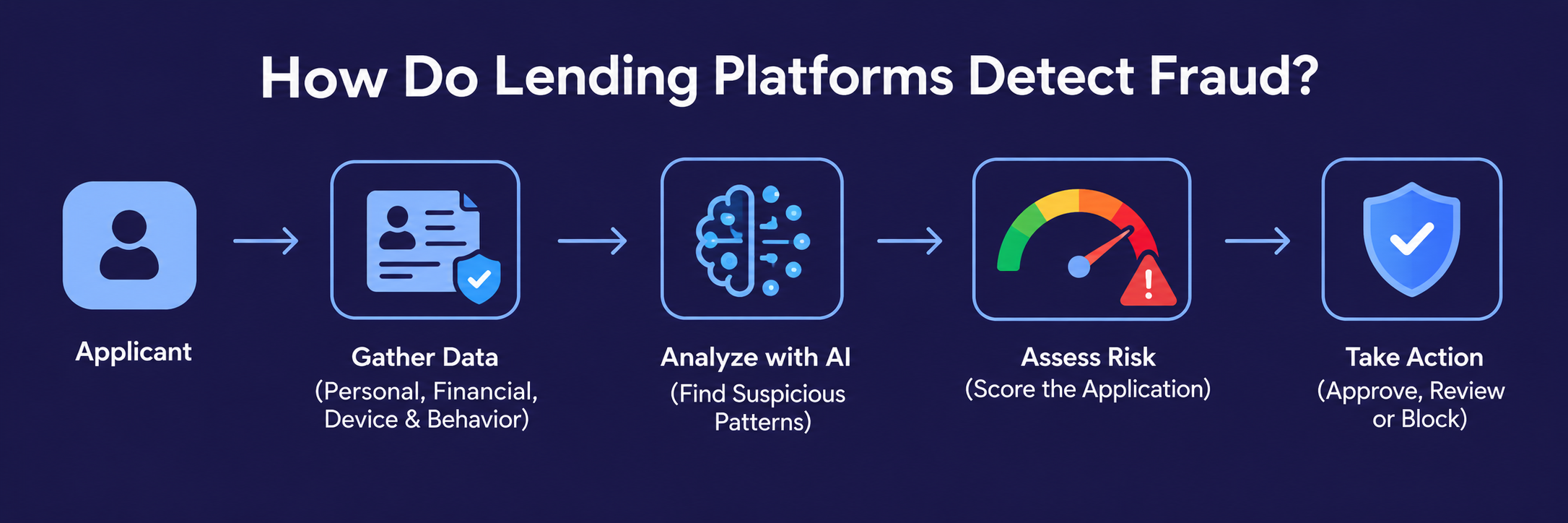
AI credit scoring trains a model on historical loan outcomes to estimate a new applicant's probability of default, then converts that estimate into a decision or price. The process covers data inputs, feature engineering, model selection (often gradient-boosted trees), training, out-of-time validation, performance evaluation, decision thresholds, explainability, production monitoring for drift, and fairness testing.
Traditional scores such as bureau scores are general-purpose and widely understood. Custom ML models can rank risk more precisely for a specific product, but they must be explainable. Under ECOA and Regulation B, a creditor must give declined applicants the specific principal reasons for adverse action. The CFPB's Circular 2023-03 states that using complex algorithms does not exempt a lender from giving accurate, specific reasons. Alternative data must be lawful to use, relevant to creditworthiness and tested for disparate impact.
How Do Lending Platforms Detect Fraud?
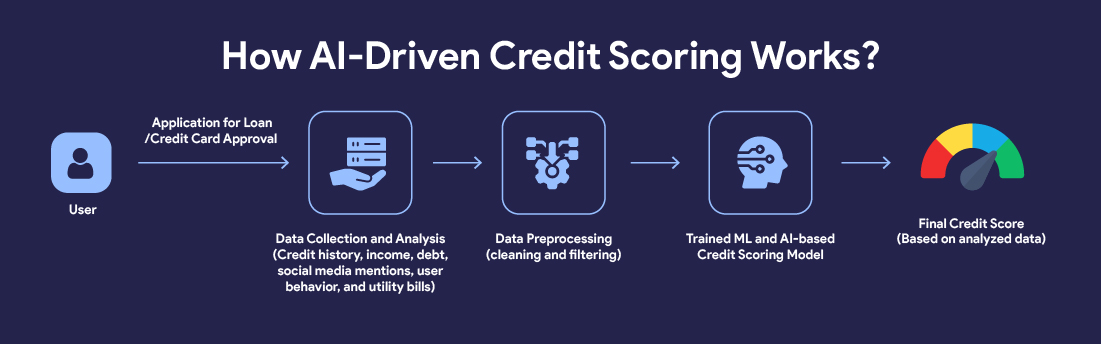
Lending platforms detect fraud by combining identity checks, rules, device and behavioral signals, anomaly detection, machine learning models and human investigation. Common threats include identity theft, synthetic identities, manipulated documents, account takeover, application stacking and suspicious transaction patterns. Rules catch known patterns; anomaly detection flags unusual behavior; supervised models learn from confirmed fraud cases; investigators make the final call. Tune for both error types: false positives turn away good borrowers, while false negatives become losses.
Important: AI-driven lending decisions must be evaluated for fairness, explainability, accuracy and regulatory compliance. AI supports responsible lending governance; it does not replace it.
Lending Platform Development Cost in 2026
Building a lending platform typically costs from tens of thousands of dollars for a narrow MVP to several hundred thousand dollars or more for a production platform, and seven figures for an enterprise-grade, multi-product system. The biggest variables are scope, integrations, compliance requirements and where the team is based.
Published 2026 benchmarks illustrate the spread (these are third-party estimates, not JumpGrowth quotes):
| Scope | US/UK-based team | India-based team | Source and assumptions |
|---|---|---|---|
| LOS MVP | $45,000–$90,000 | $15,000–$35,000 | EngineerBabu, June 2026; India figures assume RBI-specific scope |
| Full production LOS | $150,000–$400,000 | $45,000–$120,000 | Same source; excludes bureau fees, certifications, cloud |
| Enterprise (AI scoring, multi-market) | $500,000–$1.5M+ | $150,000–$500,000+ | Same source |
| Lending app MVP (blended rates) | $30,000–$60,000 | — | Synodus; app-level MVP (login, loan request, KYC, dashboard), blended $50/hr example |
Treat these as rough orientation. A credible estimate comes only from a scoped requirements document.
What Affects the Cost of Lending Software Development?
| Cost Factor | Why It Affects Cost | Complexity Impact |
|---|---|---|
| Loan product complexity | Variable rates, fees, grace periods, restructuring | High |
| LOS + LMS scope | Servicing roughly doubles the calculation and testing surface | High |
| Number of integrations | Each provider adds contracts, sandbox testing and error handling | High |
| Underwriting logic | Rules are cheaper than ML models with governance | Medium to high |
| Regulatory scope | Disclosures, adverse action, state-specific rules | High |
| User roles and workflows | More roles mean more permissions and screens | Medium |
| Web + mobile | Native apps add separate builds | Medium |
| Reporting | Regulatory and investor reports need precise data | Medium |
| Security requirements | Pen tests, audits, SOC 2 readiness | Medium |
| Data migration | Moving an existing loan book requires reconciliation | High if applicable |
| Team location and model | Onshore, nearshore and offshore rates differ significantly | High |
What Is the Cost of a Loan Management System?
A custom loan management system costs more than its feature list suggests, because servicing logic must be correct for every edge case over the life of each loan. Cost drivers include interest accrual methods (actual/365, 30/360), payment waterfalls, partial and early payments, rescheduling, delinquency and charge-off rules, collections workflows, accounting integration, bureau furnishing and reporting. A simple single-product LMS sits at the lower end of the production range above; a multi-product LMS with accounting and furnishing sits at the upper end.
How Much Does a Lending App MVP Cost?
A lending app MVP usually falls in the $30,000–$90,000 range for a US-market product, depending on scope and team location (see the table above for sources and assumptions). A typical MVP includes borrower onboarding, a loan application, rules-based eligibility, an admin dashboard, essential integrations (identity, credit, payments), basic loan status management and security foundations.
Know what you are buying:
- Prototype: clickable or partially working; no real money moves.
- MVP: real loans to real borrowers in a limited product, volume or state footprint.
- Production-ready platform: hardened security, full servicing, monitoring, disaster recovery and audit readiness.
Recurring costs continue after launch: cloud hosting, per-call API fees, credit bureau pulls, identity verification checks, payment processing, monitoring tools, security assessments and ongoing maintenance and enhancements.
Lending Platform Development Timeline
A lending platform usually takes three to four months for a focused MVP and six to twelve months or more for a full production platform, depending on scope, integrations and approvals.
| Development Phase | Typical Activities | Estimated Duration (illustrative) |
|---|---|---|
| Discovery and requirements | Product, workflow and compliance scoping | 2–4 weeks |
| Workflow mapping and architecture | Data model, ledger design, integration plan | 2–3 weeks |
| UX/UI design | Borrower and back-office flows | 3–5 weeks (overlaps) |
| Backend and frontend development | Core modules in sprints | 8–24 weeks |
| Third-party integrations | Sandbox, certification, production keys | 4–12 weeks (overlaps) |
| Testing and security validation | Calculation tests, QA, pen test | 3–6 weeks |
| Pilot deployment | Limited live lending | 2–6 weeks |
| Production rollout and optimization | Scale, monitor, iterate | Ongoing |
These durations are illustrative, not delivery commitments. Common reasons for delays include provider credentialing and approvals, licensing or regulatory reviews, bank partner onboarding, data migration, complex credit workflows, security remediation and legacy system integration.
How Long Does a Lending MVP Take?
A narrow lending MVP (one product, one channel, rules-based decisions, core integrations) commonly takes around 10 to 16 weeks of build time, consistent with the published ranges cited above. A complete lending ecosystem with multiple products, ML underwriting and full servicing takes considerably longer.
What Are the Steps to Build a Lending Platform?
- Validate the lending model, borrower segment and unit economics.
- Get legal and compliance advice on licensing and applicable rules.
- Document products, credit policy and workflows.
- Prioritize MVP features.
- Decide whether to build, buy or combine both approaches.
- Select providers (identity, credit, payments, bank partner).
- Design architecture, data model and security controls.
- Build in iterative sprints with calculation tests from day one.
- Integrate and certify third-party services.
- Run QA, security testing and a compliance review.
- Pilot with limited volume.
- Launch, monitor, and improve based on loan performance data.
Build vs. Buy: Should You Build a Custom Lending Platform or Use SaaS?
Buy when your lending product is standard and speed matters most; build when your product, borrower experience or data strategy is your competitive advantage; combine the two when only part of the stack is differentiating.
| FactorCustom DevelopmentSaaS/Off-the-Shelf | ||
| Initial investment | Project-dependent | Subscription or licensing |
| Customization | Greater architectural flexibility | Depends on vendor |
| Time to launch | Usually longer | Potentially faster |
| Ownership | Contract-dependent | Vendor-dependent |
| Integrations | Designed to requirements | Limited by supported options |
| Maintenance | Client or partner responsibility | Often vendor-managed |
| Scalability | Depends on architecture | Depends on provider |
| Vendor dependency | Can be reduced with good ownership terms | Often higher |
Is custom lending software better than SaaS? Neither is better in general. A common hybrid approach is to license a proven LMS or ledger and build a custom origination experience, decision layer and integrations around it.
What Are the Best Lending Platform Software Options?
The best lending software depends on whether you are a bank, credit union, fintech or commercial lender, and which part of the lifecycle you need. Examples of established US-market products (descriptions from vendor sites, checked November 2026; not endorsements):
| Product | Category | Intended segment | Buyer considerations |
|---|---|---|---|
| nCino | Banking and lending platform with AI capabilities | Banks and credit unions: commercial, small business, consumer, mortgage | Built for institutions; less suited to small fintech startups |
| LoanPro | API-first, composable loan management and credit platform | Fintechs, consumer, auto and business lenders, financial institutions | Strong for servicing; origination UX often built separately |
| MeridianLink | Digital lending platform (consumer, mortgage, account opening) | Credit unions, banks, mortgage and auto lenders | Oriented to depository institutions |
| Finastra Loan IQ | Commercial loan servicing | Corporate, syndicated and private credit lenders | On-premises, container-based cloud, or hosted service |
Request demos against your own loan scenarios, confirm API coverage for your required integrations, and get pricing in writing.
Compliance and Security Requirements for US Lending Platforms
The compliance requirements for a lending platform depend on the lender's business model, products, borrower types, states served and regulatory status, not on the software alone. Software can support compliance by producing correct disclosures, enforcing rules and keeping records, but it cannot make a lender compliant. Confirm obligations with qualified legal and compliance professionals. The information below reflects the landscape as of November 2026 and is not legal advice.
Important US Regulatory Considerations
| Law / regulation | What it covers | Platform implications |
|---|---|---|
| Truth in Lending Act / Regulation Z | Cost-of-credit disclosures (APR, finance charge) | Accurate APR calculation, disclosure timing and records |
| ECOA / Regulation B | Fair lending; adverse action notices | Specific decline reasons, controls on prohibited bases, model fairness testing |
| FCRA | Use and furnishing of consumer reports | Permissible purpose, risk-based pricing and adverse action notices, furnishing accuracy |
| GLBA (Privacy Rule, FTC Safeguards Rule) | Financial privacy and data security | Privacy notices; nonbank lenders need a written information security program under the Safeguards Rule |
| Bank Secrecy Act / AML | Anti-money laundering, customer identification | Program obligations vary by institution type (banks, certain nonbank mortgage lenders); sanctions screening is broadly expected |
| E-SIGN Act | Electronic records and signatures | Consumer consent before electronic disclosures; retention |
| Regulation E | Electronic fund transfers | Autopay authorization rules; no compulsory EFT as a condition of credit |
| FDCPA / Regulation F | Debt collection | Applies mainly to third-party collectors; contact-frequency and disclosure rules shape collections tools |
| RESPA / Regulation X | Mortgage servicing | Servicing notices, escrow, loss mitigation (mortgage only) |
| Military Lending Act | Credit to active-duty servicemembers | Covered-borrower checks and rate caps |
| State licensing and usury laws | Lender licenses, rate and fee caps | Per-state product configuration |
| State privacy laws (e.g., CCPA/CPRA) | Consumer data rights | GLBA-covered data is partly exempt; other data may not be |
| UDAAP | Unfair, deceptive or abusive practices | Clear UX, honest marketing, fair fee practices |
Not every law applies to every lender. A small-business lender, for instance, is generally outside TILA but still subject to ECOA. Recordkeeping matters across the board; Regulation B, for example, requires creditors to retain application records for specified periods. Note too that federal guidance is shifting: the CFPB withdrew dozens of guidance documents in 2025, while the statutes and regulations above remain in force. Have counsel confirm current expectations before launch.
How Do You Secure a Lending Platform?
You secure a lending platform by designing security in from the start: encryption, strong identity controls, least-privilege access, secure APIs, audit logging, testing and an incident response plan. Core controls:
- Encryption in transit (TLS 1.2+) and at rest, with managed keys and rotation
- Multi-factor authentication for borrowers and mandatory MFA for staff
- Role-based access control with least privilege and maker-checker approvals
- An API gateway with authentication, rate limiting and input validation
- Secrets management (no credentials in code or configuration files)
- Data minimization and field-level protection for SSNs and bank details
- Immutable audit logs of data access and decisions
- Secure coding aligned with the OWASP ASVS and OWASP API Security Top 10
- Vulnerability management, dependency scanning and regular penetration testing
- Backups, tested disaster recovery and defined RTO/RPO targets
- Monitoring, alerting and a documented incident response plan
- Third-party and vendor risk management
Frameworks such as the NIST Cybersecurity Framework 2.0 and the FFIEC IT Examination Handbook help structure a program; PCI DSS applies if you store, process or transmit card data. Following a framework is not the same as certification or compliance.
How to Choose a Lending Software Development Company
Choose a lending software development company on proven lending domain knowledge, financial software architecture skills, integration experience, security practices and clear ownership terms, not on hourly rate alone. Evaluate:
- Fintech and lending domain knowledge
- Understanding of both origination and servicing
- Financial software architecture (ledgers, decimal precision, idempotency)
- Third-party integration experience
- Data security expertise
- Regulatory awareness (without posing as your legal counsel)
- Testing and QA, especially calculation testing
- Scalability and performance engineering
- Documentation and maintainability
- Post-launch support
- Source code and IP ownership
- Transparent estimation
Should You Outsource Lending Platform Development?
Outsourcing makes sense when you need lending and engineering skills faster than you can hire them, provided you keep product ownership, access control and knowledge transfer in your hands.
| Model | Benefits | Trade-offs |
|---|---|---|
| In-house | Full control, retained knowledge | Slow and costly to hire fintech talent |
| Outsourced project | Fixed scope, fast start | Change requests, handover risk |
| Dedicated team | Long-term continuity, scalable | Requires active product ownership |
| Hybrid | Internal leads plus external engineers | Needs clear governance |
Whatever the model, keep code in your own repositories, own the cloud accounts and provider contracts, enforce least-privilege access for vendors, and require documentation as part of each delivery.
Questions to Ask a Lending Software Development Partner
- Have you developed financial services or lending software before? (Look for named, verifiable projects.)
- Do you understand both LOS and LMS workflows? (They should explain the booking handoff.)
- How do you approach financial integrations? (Sandbox, certification and failure handling.)
- How do you handle sensitive borrower data? (Encryption, access, logging, data minimization.)
- How do you design underwriting workflows? (Versioned rules, audit trails, manual review.)
- How do you approach payment and disbursement integrations? (Idempotency, reconciliation, returns.)
- What is your preferred architecture and why? (A good answer depends on your scope.)
- How do you approach regulatory requirements? (They implement what your counsel specifies.)
- How do you test financial calculations? (Golden test cases, edge cases, independent checks.)
- Who owns the source code and documentation? (You should.)
- What is included in post-launch maintenance? (SLAs, patching, provider updates.)
- How do you estimate development cost and timeline? (A discovery phase before a firm quote.)
- How do you manage third-party provider dependencies? (Abstraction layers, early credentialing.)
- Can you provide relevant, verifiable project references?
Why Consider JumpGrowth for Lending Platform Development?
JumpGrowth is a Richardson, Texas-based software development company that provides engineering teams for product companies, including in financial services. JumpGrowth is a technology partner, not a lender or financial institution.
Its published lending-related work includes the Loan Mantra case study, in which JumpGrowth engineers took over an existing .NET lending platform from a previous vendor. They stabilized and documented the platform, migrated it to Microsoft Azure, and delivered features including dynamic document templates, a DocuSign integration, an algorithm matching applications to lenders and advisors, and a credit report API integration.
Depending on your stage, JumpGrowth offers:
- Product Discovery to define lending workflows, scope and risks before you build
- MVP Launch Teams that work to a 13-week blueprint, typically targeting launch in about 90 days
- Production Teams for long-term platform ownership
- Staff Augmentation to add Java, .NET, machine learning, QA or DevOps engineers to your team
Not sure which fits? Compare engagement models.
Planning to build a custom lending platform? Discuss your product requirements, technical architecture, integrations and development roadmap with the JumpGrowth team. Book a discovery call →
Final Lending Platform Development Checklist
- Lending model and target borrowers defined
- Loan products and workflows documented
- LOS and LMS requirements identified
- Borrower and admin features prioritized
- Credit and identity integrations identified
- Payment and disbursement workflows mapped
- Architecture selected based on requirements
- Security and privacy requirements documented
- Regulatory review completed by qualified professionals
- AI and underwriting requirements assessed
- Development cost estimated
- Project timeline established
- Build-vs-buy decision evaluated
- Vendor ownership and maintenance terms agreed
- Testing and launch plan prepared
Recommendation: Start with your lending workflows, regulatory obligations, integrations and business goals. Choose technology and estimate cost only after those are clear; teams that pick a stack first usually end up paying to rework it.
Frequently Asked Questions
Definition and Basics
01What is a lending platform?
A lending platform is software that manages some or all of the lending lifecycle, including onboarding, applications, underwriting, disbursement, repayment, servicing, collections and reporting.
02What is lending platform development?
Lending platform development is the process of designing, building, integrating, testing and maintaining software that runs a lender's origination and servicing operations, including its financial integrations and compliance controls.
03How does a digital lending platform work?
A digital lending platform collects a borrower's application, verifies identity and income, pulls credit data, applies underwriting rules, issues a decision, executes the agreement, disburses funds, then schedules, collects and reconciles repayments until the loan closes.
04What are the types of lending platforms?
The main types are consumer and personal loan, mortgage, small-business, commercial, peer-to-peer, BNPL, embedded, auto and microfinance lending platforms. Each differs in workflow, data sources and regulation.
05What is the difference between LOS and LMS?
A loan origination system (LOS) manages a loan from application to approval and booking. A loan management system (LMS) manages it after booking: disbursement, repayments, servicing and collections.
Features
06What features should a lending platform have?
A lending platform should have secure onboarding, application management, credit assessment and underwriting, approval workflows, e-signature, disbursement, repayment processing, servicing, collections, reporting, audit trails and an admin dashboard.
07What are the must-have features of a loan app?
A loan app's must-have features are secure registration with MFA, a loan calculator, application and document upload, status tracking, notifications, repayment schedules, payments, statements and customer support.
08What is a loan origination system?
A loan origination system is software that captures loan applications, verifies data, runs credit checks and underwriting rules, routes approvals, generates documents and records each decision for audit.
09How does automated underwriting work?
Automated underwriting applies verification, eligibility rules and risk models to an application, then returns approve, decline or refer, logging every input and reason so the decision can be explained and audited.
10What integrations does a lending platform need?
Most lending platforms integrate identity verification, credit bureaus, bank data (open banking), payment processors, e-signature, accounting, fraud detection and notification services. The exact list depends on the product and market.
Architecture and Tech Stack
11What is the best tech stack for a lending platform?
There is no single best stack. Common choices are React or Angular on the front end; Java/Spring Boot, .NET, Node.js/TypeScript or Python on the back end; PostgreSQL or SQL Server; and AWS, Azure or Google Cloud.
12What architecture is used for lending software?
Lending software typically uses a layered architecture with a presentation layer, API and integration layer, business logic, decision engine, loan ledger, and security and observability layers. It is built as a modular monolith, microservices or an event-driven system.
13Should a lending platform use microservices?
Not automatically. A modular monolith is usually better for an MVP. Microservices pay off when multiple teams and products need independent scaling and releases.
14How do you integrate credit bureaus into a lending app?
You get approved as a subscriber with a bureau or reseller, establish permissible purpose under FCRA, connect via secure API, normalize the report data, handle errors and log every pull.
15How does open banking help lending platforms?
Open banking gives lenders borrower-authorized access to bank transaction data, which speeds up income verification, cash-flow underwriting and account ownership checks, particularly for thin-file borrowers.
Cost
16How much does it cost to build a lending platform?
Published 2026 benchmarks range from about $30,000–$90,000 for a US-market MVP to $150,000–$400,000 for a full production platform with a US/UK team, and more for enterprise systems. Actual cost depends on scope.
17What is the cost of a loan management system?
A custom LMS generally falls within the production platform range above. Cost rises with interest methods, payment waterfalls, restructuring, collections, accounting integration and bureau reporting.
18What affects the cost of lending software development?
The main cost drivers are product complexity, LOS and LMS scope, number of integrations, underwriting approach, regulatory requirements, platforms (web and mobile), security, data migration and team location.
19How much does a lending app MVP cost?
A lending app MVP typically costs around $30,000–$90,000 for the US market, according to published 2026 benchmarks. Offshore teams can cost less, and estimates depend heavily on scope.
Timeline
20How long does it take to build a lending platform?
A focused MVP usually takes three to four months. A full production platform typically takes six to twelve months or more, depending on integrations and approvals.
21How long does a lending MVP take?
A narrow lending MVP with one product, rules-based decisions and core integrations commonly takes about 10–16 weeks of build time.
22What are the steps to build a lending platform?
Validate the model, get legal advice, document workflows, prioritize features, decide whether to build or buy, select providers, design the architecture, build iteratively, integrate, test, pilot and launch.
Build vs. Buy
23Should I build or buy a lending platform?
Buy if your lending product is standard and speed matters most. Build if your product or borrower experience is your differentiator. Many lenders combine a licensed LMS with custom origination.
24Is custom lending software better than SaaS?
Neither is universally better. Custom software offers flexibility and ownership; SaaS offers faster launch and vendor-managed maintenance but less control.
25What are the best lending platform software options?
Established options include nCino, LoanPro, MeridianLink and Finastra Loan IQ, each aimed at different segments. The best choice depends on your institution type and lending products.
AI and Risk
26How is AI used in lending platforms?
AI is used for credit risk scoring, fraud detection, document extraction, income verification support, default prediction, collections prioritization, customer support and portfolio analytics.
27How does AI credit scoring work?
AI credit scoring trains a model on historical loan outcomes to predict default risk. It must be validated, monitored, tested for fairness, and able to give specific adverse action reasons.
28How do lending platforms detect fraud?
Lending platforms detect fraud by combining identity verification, rules, device and behavioral signals, anomaly detection, machine learning models and human investigators.
Compliance and Security
29What compliance does a lending platform need?
Compliance depends on the lender's model, products and states. Commonly relevant areas include disclosures, fair lending, credit reporting, privacy and data security, AML, e-signature consent and state licensing.
30What regulations apply to digital lending in the US?
Regulations that may apply include TILA/Regulation Z, ECOA/Regulation B, FCRA, GLBA and the FTC Safeguards Rule, the Bank Secrecy Act, E-SIGN, Regulation E, debt collection rules and state licensing laws.
31How do you secure a fintech lending app?
Secure a fintech lending app with encryption, MFA, role-based access, a secure API gateway, secrets management, audit logs, OWASP-aligned secure coding, penetration testing, disaster recovery and incident response.
Vendor Selection
32How do I choose a lending software development company?
Look for verifiable lending projects, LOS and LMS knowledge, financial architecture skills, integration and security experience, calculation testing, clear IP ownership and transparent estimates.
33Who builds custom lending platforms?
Custom lending platforms are built by in-house fintech engineering teams, specialist fintech consultancies and software development companies such as JumpGrowth, often alongside licensed lending software vendors.
34Should I outsource lending platform development?
Outsource if you need lending and engineering expertise faster than you can hire, but keep ownership of code, cloud accounts, provider contracts and product decisions.
Sources
- CFPB — Regulation B, 12 CFR 1002.9 (adverse action notices)
- CFPB — Circular 2023-03: Adverse action notification requirements
- CFPB — Regulation Z, Regulation E, Regulation F, Regulation X
- CFPB — Personal Financial Data Rights (Section 1033)
- Cozen O'Connor — Section 1033 compliance date: rule enjoined and under reconsideration (April 2026)
- FTC — Fair Credit Reporting Act; Gramm-Leach-Bliley Act
- eCFR — FTC Safeguards Rule, 16 CFR Part 314
- Cornell LII — 15 U.S.C. 1681b (permissible purposes); 15 U.S.C. 7001 (E-SIGN)
- FinCEN — Statutes and regulations
- NIST — Cybersecurity Framework; FFIEC — IT Examination Handbook
- OWASP — ASVS; API Security Top 10
- Cost benchmarks — EngineerBabu (June 2026); Synodus
- Vendors — nCino, LoanPro, MeridianLink, Finastra Loan IQ
Keep reading
- Software Development
What Is Reverse Engineering in Software Development? Process, Benefits, Challenges, and Use Cases
2 minutes readRead article - Software Development
Product Engineering Services in 2026: What They Actually Include (And What to Demand from a Partner)
11 minutes readRead article - Software Development
Custom Software Development Company vs. In-House Team: A 2026 Cost and Risk Analysis
11 minutes readRead article
Build your team
Share where the roadmap is blocked and the capabilities you need. We’ll map a practical team and delivery model.
Comments
Be the first to comment.